Climate customer discovery: the 3-sentence email template
If you've ever stared at an empty compose window, typing and deleting the same paragraph to a sustainability director at a mid-sized utility, you already know the particular dread of climate customer discovery.
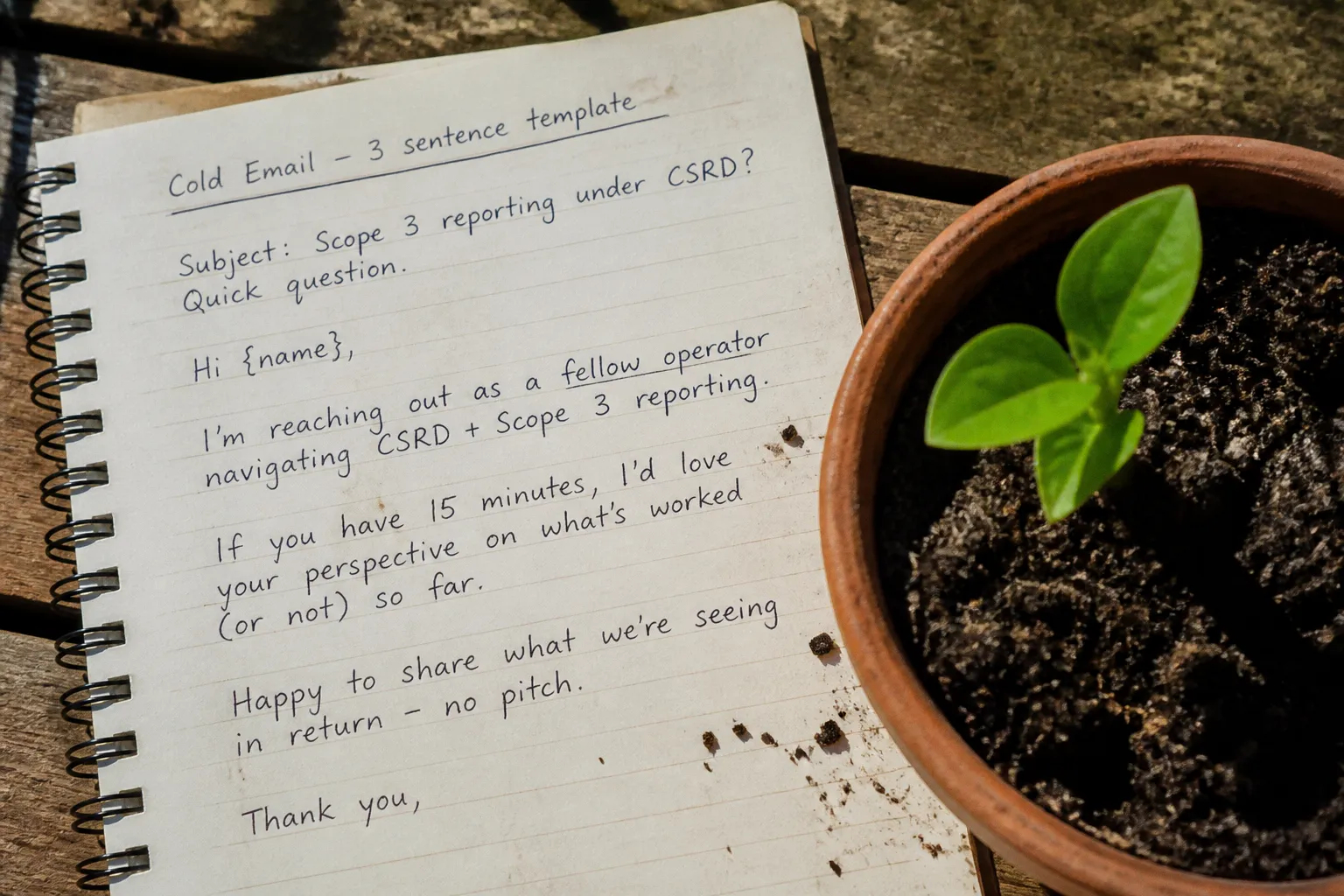
You have a technology that genuinely moves the needle on emissions. You've modeled the unit economics. You've rehearsed the pitch to your co-founder twice over Sunday coffee. And still, the cursor blinks back at you, because you know — really know — that the moment you frame your note like a sales pitch, you lose the person on the other end before they read past your second sentence.
That hesitation is healthy. It's also expensive. The climate transition runs on conversations between people who can act and people who've spent years inside the operations you're trying to change. Your email is the bridge to that conversation, and right now, the data tells us most of those bridges are burning down in inboxes. Generic outreach pulls a response rate of roughly 0.4%. Personalized, tightly-framed outreach to the same kinds of decision-makers? That number climbs to somewhere between 8.9% and 17.4% — a twenty-to-forty-fold difference, driven almost entirely by how the first email feels to read. The trick isn't volume. It's structure. Specifically, it's a three-sentence template designed to feel like advice-seeking, not selling.
The most successful climate discovery emails don't ask for a sale. They ask for a perspective — and they do it in fewer sentences than the reader expects.
The Psychology of Low-Friction Climate Outreach
Before we touch a single sentence, let's name what's actually happening in the inbox you're writing to.
Sustainability leads, asset managers, municipal decarbonization officers, grid operators — these are people whose jobs literally require them to evaluate climate solutions all day. They don't need another pitch. What they don't have enough of is structured time to think out loud about the operational problems behind their next procurement cycle. When you write to them, you're competing with three things: their calendar, their inbox triage reflexes, and a quiet professional pride that says "I shouldn't waste my afternoon on something that doesn't respect my expertise."
This is why the gap between 0.4% and 17.4% isn't about copy tricks. It's about cognitive friction. An email that reads as a sales pitch likely activates the reader's "vendor" filter almost immediately — and once that filter is up, your chances probably slide back toward the generic baseline regardless of how polished the language is. An email that reads as a peer asking for an expert perspective bypasses that filter, because the cost of replying is now framed as generosity rather than risk. That shift in framing is where the whole lift lives, and it's worth testing directly: send ten emails that lead with your product and ten that lead with a question about their operations, and watch what happens to your reply rate.
Three signals lower that friction reliably:
- Specificity of context. Mention the compliance obligation, the Scope 3 reporting cycle, the asset class, or the operational constraint you're researching. Generic terms like "sustainability questions" do the opposite — they signal that you haven't done your homework.
- Constraint on the ask. A named time window — fifteen minutes — tells the reader you respect the cost of their attention. Open-ended "let's chat sometime" reads as undefined labor.
- Frame as advice, not recruitment. You're not asking them to become a customer, an advisor, or a beta tester in the first message. You're asking them to talk about their world.
When those three signals stack, the email stops feeling like outreach and starts feeling like a thoughtful question. That's the entire game, and once you see it, you can't unsee it in the way other founders are still writing.
Anatomy of the 3-Sentence Discovery Framework
The template is small enough to hold in your head on a Monday morning, which is precisely the point. Founders over-engineer outreach. The most effective discovery emails in B2B climate work stay under six to eight sentences total, and the cleanest versions compress the whole intent into three. Each sentence has one job, and only one job.
| Sentence | Purpose | What it must contain | What it must avoid |
|---|---|---|---|
| Sentence 1 — Context hook | Establish that you've done specific homework on the reader's world | A reference to their role, a regulatory code, a reporting cycle, or an operational pain | Generic flattery ("I love what your team is doing") |
| Sentence 2 — The ask, framed as perspective | Position the conversation as advice, not selling | A 15-minute exchange, a named operational question, and explicit non-commercial framing | Pricing, pilot offers, decks, NDA requests |
| Sentence 3 — Frictionless reply mechanism | Make saying yes the path of least resistance | A short sign-off, a calendar link, or a low-pressure alternative like "even a brief reply by email" | Long bios, attachments, links to a homepage |
Let's walk through each, because the craft lives in the small choices.
Sentence 1 does the heaviest lifting. This is where you prove you've actually looked at who you're writing to. If you're reaching a sustainability lead at a regional utility, you might mention their integrated resource plan, a state-level mandate, or a specific emissions disclosure they're known for. If you're reaching a corporate Scope 3 lead, you might reference a category of their value chain that you've noticed is underserved by current tooling. The sentence should be short enough that the reader can verify your credibility at a glance — under twenty-five words usually. The mistake here is padding it with compliments. The reader doesn't need to be told they're impressive; they need to see that you understand which part of their work is hard right now.
Sentence 2 is where most founders panic and start selling. Don't. The job of this sentence is to convert your interest into a fifteen-minute conversation the reader will experience as collegial. Wording like "I'd value fifteen minutes of your perspective on [specific operational question]" lands very differently from "Would you be open to a 30-minute call to discuss a potential pilot?" The first sounds like two professionals trading notes. The second sounds like a vendor with a calendar invite already drafted. The body of sentence two should name the topic narrowly — not "climate strategy" but "how your team is currently tracking scope 3 supplier data for the next disclosure cycle." That specificity is what makes the ask feel research-grade rather than sales-grade.
Sentence 3 makes saying yes effortless. The simplest version is a brief sign-off plus a sentence like "If it's easier, even a short reply by email would help." That kind of low-commitment alternative can meaningfully shift reply rates at the margins, because it offers a partial-credit path for people who are interested but not yet sold on giving you time. A calendar link is fine if it's tucked inside the sentence, not pasted on its own line like an advertisement.
If your reader can tell what you do and what you sell from sentence one, the email has already failed as a discovery message.
Crafting Subject Lines That Bypass Sustainability Fatigue
The inbox triage reflex fires before the body even loads, which means your subject line carries the entire first impression. In B2B sustainability, the worst-performing subject lines share one trait: they're interchangeable. "Quick question about sustainability." "Partnership opportunity." "15 minutes for climate innovation." These read as mass-produced, and the same reader behavior that produces 0.4% reply rates on generic emails starts at the subject line.
The high-performing patterns share different traits. They reference a concrete obligation, a specific timeframe, or a narrowly-scoped question. They also stay short — under nine words whenever possible — because longer subjects truncate on mobile and force the reader to do extra cognitive work before opening.
Here are four subject-line archetypes that consistently clear the noise in climate discovery:
1. Compliance-anchored — "Scope 3 supplier data — question for [Company]"
2. Role-anchored — "Question for your integrated resource planning team"
3. Operational-anchored — "Decarbonization question — 15 min perspective?"
4. Cycle-anchored — "[State mandate] reporting cycle — quick question"
Notice what's absent: there's no exclamation point, no "urgent," no "partnership," and no claim that your company is transforming anything. The reader's eyes skim the inbox for signals of cost. Compliance signals and role signals reduce perceived cost by saying, "I've done the work to know which desk you sit at." When you can name the desk accurately, the reader has permission to open.
A practical note on testing. With a three-sentence email and a tightly targeted list, you'll usually see meaningful read patterns within a small batch per variant — you don't need a thousand sends to learn something. The marginal learning from your next dozen personalized sends is almost always worth more than another week of planning the perfect subject line.
Operationalizing the 15-Minute Perspective Exchange
The template gets you the reply. The conversation gets you the validation. Let's talk about how the fifteen-minute call actually runs, because most founders either over-prepare or under-prepare, and both kill the signal.
Under-preparation looks like showing up with a generic list of "discovery questions" you saved from a startup podcast. The conversation meanders, the interviewee feels like a survey respondent, and you walk away with quotes that don't actually test your riskiest assumptions.
Over-preparation looks like arriving with a thirty-question script and treating the call as a deposition. The interviewee feels interrogated, closes up, and remembers you as the person who took too much of their afternoon.
The sweet spot for climate discovery is what we call a "perspective exchange": three to five questions you've prepared, but only one or two of which you actually need answered. The others are there as warmth and reciprocity. You should be willing to share something useful back — a benchmark, a regulatory clarification, a pattern you've seen across other utilities — because the call is supposed to feel like a conversation between professionals, not an extraction. The moment reciprocity disappears, the dynamic flips back to vendor and prospect, and your data quality collapses.
A clean fifteen-minute structure looks like this:
- Minutes 0–2: Genuine acknowledgment of their time, brief reminder of how you found them and why you're asking.
- Minutes 2–4: One open-context question ("Walk me through how your team currently handles [X]") that lets them talk about their world.
- Minutes 4–9: One or two targeted questions tied to your riskiest assumption — the one that, if wrong, would change your roadmap.
- Minutes 9–12: Brief reciprocal share — a benchmark, a reference, a connection — that gives them something back.
- Minutes 12–15: A graceful close with a named next step, or none at all if the conversation hasn't earned one.
A discovery call that ends without a sale, a pilot, or a follow-up meeting is not a failure. It is, in fact, the desired outcome. You're gathering signal, not closing deals. If every discovery conversation feels like a sales conversation in disguise, your email template is doing the wrong job upstream.
Scaling Personalized Outreach Without Losing Authenticity
Here's the tension every climate founder hits somewhere around send number thirty. Personalized outreach gets results, and personalized outreach doesn't scale the way you'd like. You can't research every prospect individually forever, and the moment you start treating your list as a list, your reply rates slide back toward 0.4%.
The way through is segmentation. Not the B2B-SaaS version with twenty persona columns in a spreadsheet, but a working version with three tiers, each one trading depth for volume in a deliberate way.
| Tier | Personalization depth | Example | Use it for |
|---|---|---|---|
| Tier 1 — Highest priority | Sentence 1 hand-written per prospect, references a specific document, mandate, or operational detail | A specific utility you have inside context on | Your most strategic accounts — the ones whose replies will reshape your roadmap |
| Tier 2 — Pattern-anchored | Sentence 1 follows a tight template with two or three swap-in variables (region, mandate, asset class) | Utilities in a specific state, corporates in a specific sector | Your weekly workhorse — the volume that actually populates your discovery calendar |
| Tier 3 — Trigger-anchored | Sentence 1 references a public event (a new sustainability hire, a fresh disclosure filing, a capex announcement) | Any company matching a fresh trigger | Broad coverage, paired with trigger-event monitoring so the personalization isn't decorative |
Tier 1 is where you'll see reply rates living near the high end of the 8.9%–17.4% range, because the context hook reads as genuinely specific. Tier 2 is where most of your cumulative learning will come from, because the volume is high enough to surface patterns. Tier 3 trades depth for breadth, and it only stays authentic if you're actually tracking triggers — news, filings, hires — rather than swapping in variables that look personal but aren't.
The other piece of the scaling puzzle is your tracker. If you're sending three-sentence emails and recording replies in your head, you'll lose signal within a month. Even a minimal log — prospect name, tier, send date, reply date, reply type, and a one-line summary — will let you see, by send number one hundred, which subject-line patterns are working, which sentence-2 framings are landing, and which sectors are quietly outperforming. Without that loop, you're flying blind, and the only way you'd learn anything is by accident.
A final note on follow-ups. Climate professionals are busy, and the first reply often comes on the second or third touch, not the first. A polite, brief follow-up a few days later — restating the time ask in one sentence and adding no new context — meaningfully lifts cumulative reply rates without crossing into pest territory. The follow-up should never be longer than the original email, and it should never introduce new asks, new links, or new context. Brevity is the entire brand you're building, and a long follow-up quietly undoes all the alignment you earned in the first message.
Closing
Here's the part where I want to be honest with you. The three-sentence template is not a silver bullet. It's a forcing function. It forces you to do the work you were probably going to skip anyway — to name who you're writing to, to specify what you actually need to learn, and to respect the cost of someone else's attention. Most of the lift in climate customer discovery comes from that preparation, not from any particular phrase.
So your next step is small and concrete. Pick the ten prospects you're most uncertain about. Draft a three-sentence email for each one, hand-written, with sentence one anchored to something real in their world. Send five of them this week. Track the replies. Watch what shifts in how you think about your own roadmap by Friday. That's the loop we want you in, and that's the loop where the climate transition actually gets built — one careful, short email at a time.