Plimoth Patuxet Museums: Ticket options and visitor planning
The main planning error at Plimoth Patuxet Museums is treating the attraction as one site. It is not. The main campus sits at 137 Warren Avenue. Mayflower II and Plimoth Grist Mill are in downtown Plymouth, about 2.5 miles north.
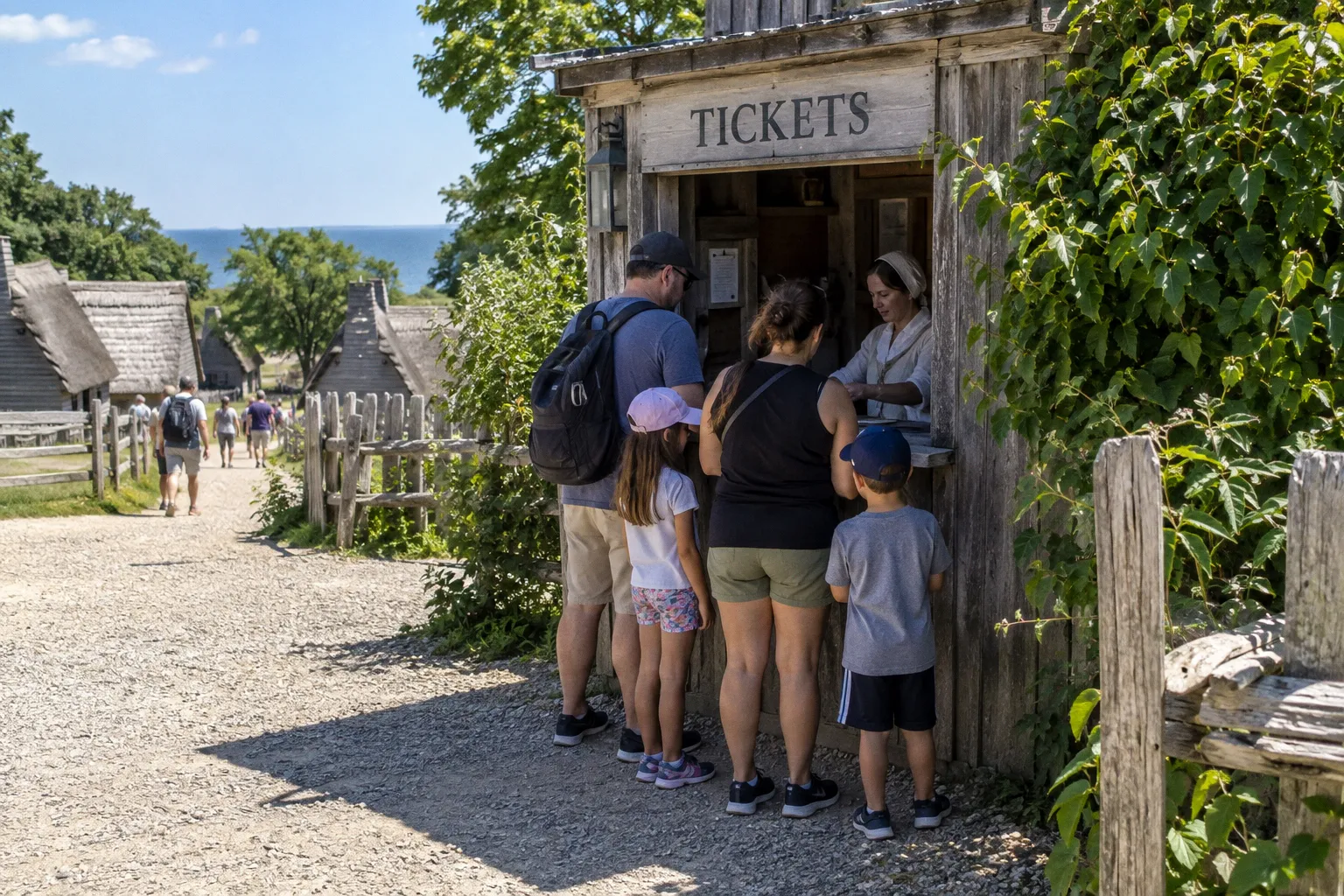
A ticket decision without a site plan creates a transport problem.
Tickets and prices
Plimoth Patuxet Museums
Plymouth
01 · GetYourGuide
Entry ticket · Available today and tomorrow
USD34.81
02 · Official
Official ticket
USD35
Box office and online booking
Plimoth Patuxet Museums — At the box office
The second error is buying access for more locations than the schedule can support. The full Heritage Pass covers every historic site and remains valid for two days. That makes it the highest-throughput option for a complete visit. It is not automatically the best option for a short stop.
The correct way to buy tickets for Plimoth Patuxet Museums is to work backward from time, site priority, and transport capacity.
The site layout determines the ticket you need
Plimoth Patuxet combines several living-history environments. The Historic Patuxet Homesite presents Indigenous life in the region before English settlement. The 17th-Century English Village represents Plymouth Colony in 1627. The Craft Center adds demonstrations and practical production. These sites are grouped on the main campus.
Mayflower II and Plimoth Grist Mill operate from separate downtown locations.
That split matters because the sites do not function as adjacent rooms in one museum. They require separate movement and separate time blocks. If your itinerary includes all locations, model the visit as two operating zones:
| Visit zone | Sites | Planning role | Suggested time |
|---|---|---|---|
| Main campus | Historic Patuxet Homesite, 17th-Century English Village, Craft Center | Primary visit block | 2–3 hours |
| Downtown Plymouth | Mayflower II | Short focused stop | About 30 minutes |
| Downtown Plymouth | Plimoth Grist Mill | Demonstration and mill visit | About 40 minutes |
The main campus carries the largest time requirement. The English Village is not a static display. It is a living-history environment built around interpretation, questions, demonstrations, and movement between structures. The Historic Patuxet Homesite uses a different historical frame and should not be compressed into a quick walk-through if it is one of your priorities.
Mayflower II is easier to slot into a dense day. Plimoth Grist Mill also has a defined visit window. The bottleneck is not usually the duration of either downtown site. It is the transfer between downtown Plymouth and Warren Avenue, plus the time lost when visitors attempt to cover the main campus at the end of the day.
The ticket is a capacity decision. Buy access for the sites your schedule can absorb, not the sites listed on the map.
Which Plimoth Patuxet admission option fits the itinerary
The available ticket structure is built around three levels of access: single-site entry, a Combination Pass, and the two-day Heritage Pass.
Single-site tickets reduce cost exposure when the plan is narrow. They also reduce scope. If the objective is only the Mayflower II, or only the Grist Mill, a single-site option avoids purchasing access to the main campus that will not be used.
The Combination Pass sits between a single location and the complete museum network. It is useful when the itinerary includes more than one attraction but does not require every historic site. The exact value depends on which locations you intend to visit and how the pass is configured at the time of booking. Confirm the included sites before payment.
The Heritage Pass is the broad-access option. It covers:
- The Historic Patuxet Homesite.
- The 17th-Century English Village.
- The Craft Center.
- Mayflower II.
- Plimoth Grist Mill.
- Two days of validity.
That final parameter changes the operating model. A two-day pass removes the need to force the main campus and downtown locations into one day. It allows a visitor to allocate the main campus to one block and return to downtown Plymouth separately.
Use this decision logic:
1. If you have less than three hours, choose the site that matches the main purpose of the visit. A single-site ticket may be the cleanest option.
2. If you have one day and want two or more locations, compare the Combination Pass with separate entry. The correct choice depends on the included sites and the sequence.
3. If you want the complete Plimoth Patuxet experience, choose the Heritage Pass. It removes the access bottleneck across the network.
4. If you have two days in Plymouth, the Heritage Pass has a structural advantage because its validity matches the available time.
5. If your group has mixed interests, use the itinerary rather than the group size as the primary control variable. Not every visitor needs every site.
The common failure is buying the broadest pass and then allocating only a few hours to use it. That is not a ticket problem. It is a throughput problem.
Single-site access
Single-site entry is appropriate when one location carries the visit.
Choose Plimoth Patuxet alone if the priority is the main campus, especially the 17th-Century English Village and Historic Patuxet Homesite. Choose Mayflower II alone if the ship is the primary target. Choose Plimoth Grist Mill alone if the mill demonstration is the specific objective.
This approach works well for:
- A short Plymouth stop.
- Visitors who have already seen one of the other locations.
- Groups with limited mobility or limited attention span.
- A schedule built around another attraction.
- Repeat visitors returning for one site.
Do not select a single-site ticket by assuming the other locations are within walking distance. Mayflower II and Plimoth Grist Mill are downtown. The main campus is outside that cluster.
The Combination Pass
The Combination Pass is a middle layer. It can reduce the friction of buying separate access when your plan includes multiple locations, but it requires more attention at checkout than a single-site ticket.
Treat the pass as a bundle of defined permissions. Check:
- Which locations are included.
- Whether the validity period matches your schedule.
- Whether the pass can support a split visit across days.
- Whether every member of the group needs the same access level.
- Whether a site is operating on the date of your visit.
The Combination Pass is most efficient when the itinerary contains a known pair or subset of sites. It is less useful when the group is undecided. Indecision creates idle capacity. A broad pass may solve that, but only if there is enough time to use it.
The Heritage Pass
The Heritage Pass is the system-wide option. It covers the main campus, Mayflower II, and Plimoth Grist Mill for two days.
This is the pass to use when the visit objective is coverage. It supports a two-phase itinerary:
- Day one: Main campus, including the English Village, Historic Patuxet Homesite, and Craft Center.
- Day two: Downtown Plymouth, with Mayflower II and Plimoth Grist Mill placed around the rest of the day.
You can also reverse the sequence. The correct order depends on operating hours, weather, lodging, and other Plymouth plans. The key is not the order. It is avoiding an overloaded day.
The Heritage Pass also reduces decision friction inside the visit. Once access is secured, the group can move between covered locations without recalculating whether a separate ticket is justified. That has value for families and larger groups, where every additional payment decision creates delay.
Ticket prices, discounts, and access programs
Exact Plimoth Patuxet ticket prices change. The live booking interface should control the current amount. This article focuses on the structure of the options rather than publishing figures that may become stale.
The standard categories include adult, senior, and child admission. The Heritage Pass, Combination Pass, and single-site tickets each use their own category structure. Do not compare the headline adult price alone. Compare the total access required by the itinerary.
For example, a single-site ticket can be the correct choice for one adult visiting Mayflower II. It is a poor control decision for a family planning the main campus plus both downtown locations. Conversely, a Heritage Pass can be inefficient for a visitor stopping only for the mill.
Several access programs change the calculation.
Active US military members and immediate family
Active US military members and their immediate family can receive a discounted Heritage Pass rate when the eligible service member presents a Geneva Conventions Common Access Card.
The operational condition is documentation. Bring the required identification. Do not assume that a general military affiliation, a photograph of a card, or an expired credential will produce the same result. The rate applies to the Heritage Pass structure and has separate adult and child categories.
Veterans Day admission
Veterans receive complimentary admission on Veterans Day, November 11. If the visit is scheduled for that date, confirm the current operating details before arrival. Holiday operations can affect staffing, demonstrations, and site availability.
Wonderfund Access Card
Wonderfund Access Card holders, including DCF foster families, can purchase admission in person at the museum admission desk for a low per-person rate for up to four people per visit.
This is an in-person access route. Plan for the admission desk rather than assuming the online ticket flow will apply. Bring the required card. The maximum group size under this program is four people per visit.
The practical rule is simple:
- If you qualify for a discount, verify the document requirement before travel.
- If the program requires in-person purchase, do not build the itinerary around a digital-only transaction.
- If the group contains visitors with different eligibility, confirm how the admissions desk handles the party before entering the queue.
How to build a visit that does not collapse at the bottleneck
The museum’s standard hours are daily from 9:00 AM to 5:00 PM. Those hours define the outer boundary. They do not guarantee that every site, demonstration, or outdoor component will operate at the same capacity on every date.
Start with the main campus. It requires two to three hours for a meaningful visit. Allocate that block before adding downtown stops. If you start with Mayflower II and the Grist Mill, you risk reaching Warren Avenue with insufficient time for the English Village and Historic Patuxet Homesite.
A basic one-day sequence is:
1. Arrive at the main campus near opening.
2. Reserve two to three hours for the Historic Patuxet Homesite, English Village, and Craft Center.
3. Leave time for the transfer to downtown Plymouth.
4. Visit Mayflower II for roughly 30 minutes.
5. Visit Plimoth Grist Mill for roughly 40 minutes.
6. Keep the final part of the day flexible rather than assigning the last available minutes to a site.
This sequence has the highest control over the largest block. It also protects against the main campus becoming the end-of-day bottleneck.
A split two-day sequence is more stable:
1. Use the first day for the main campus.
2. Use the second day for Mayflower II and Plimoth Grist Mill.
3. Place downtown locations around the rest of the Plymouth itinerary.
4. Recheck operating details before the second visit.
A split visit is especially effective for groups. Children, older visitors, and people who need more time between stops may not sustain a full campus visit plus two downtown locations in one continuous day. The Heritage Pass provides the access window. The itinerary must still provide the recovery time.
The best time to visit Plimoth Patuxet
The best time to visit Plimoth Patuxet is the earliest period that gives your group enough operating capacity. Earlier arrival reduces queue exposure and protects the main campus block. It also leaves more options if the visit runs longer than planned.
Avoid designing the day around the last available admission window. That creates a binary failure state: if the first site runs late, the remaining sites become unusable.
For outdoor areas, weather is a direct input. The Historic Patuxet Homesite and English Village are not equivalent to an indoor gallery. Rain, heat, and cold change walking speed, dwell time, and group performance. Seasonal closures or changes to outdoor exhibits can occur, and specific winter blackout dates should be confirmed before travel.
Use this operating logic:
- If weather is stable, start with the main campus and keep downtown sites later.
- If weather is uncertain, check current conditions and operating notices before committing to a full-campus schedule.
- If the group includes young children, reduce the number of fixed transitions.
- If the group includes history specialists, reserve more time for interpretation rather than treating the suggested durations as hard limits.
- If the visit is part of a larger Plymouth day, choose the pass that protects the sites you can realistically reach.
Visiting Plimoth Patuxet with a group
Group planning has one extra variable: decision latency. Every person has a different priority. One visitor wants the ship. Another wants the English Village. A child wants movement. Someone else wants lunch before the next transfer.
Resolve the site hierarchy before arrival.
Set one primary site and one secondary site. Then define the point at which the group stops adding locations. This prevents the itinerary from expanding until no site receives enough time.
A workable group structure is:
- Primary block: Main campus for two to three hours.
- Transfer block: Movement to downtown Plymouth.
- Secondary block: Mayflower II or Plimoth Grist Mill.
- Optional block: The remaining downtown site only if the schedule still has capacity.
If the group has two days, remove the optional block from day one. Use the second day for downtown locations. This lowers transfer pressure and makes the visit easier to manage.
For ticket selection, group members do not need identical priorities, but they do need compatible access. A Heritage Pass is efficient when most of the group intends to use all sites. Separate or combination access can be more rational when interests split sharply.
Avoid the assumption that the cheapest individual entry is always the lowest-cost group decision. A low price with poor site coverage can create a second purchase later. Unit economics applies to admission as it does to any other system: compare total access consumed, not the first transaction.
What to confirm before arrival
Plimoth Patuxet museum hours are generally listed as 9:00 AM to 5:00 PM daily, but the practical schedule still depends on site operations. Confirm the following before travel:
- Which locations are open on your date.
- Whether the selected pass covers the sites you intend to visit.
- Whether the pass is valid for one day or two.
- Whether a discount requires in-person purchase.
- Which identification is accepted for military or access-program rates.
- Whether outdoor exhibits have seasonal limitations.
- How you will move between the Warren Avenue campus and downtown Plymouth.
- Whether the group can complete the main campus before the planned downtown transfer.
The museum’s former and related search terms can create confusion. Visitors may still search for Plimoth Plantation or Plymouth Plantation, but the current institution is Plimoth Patuxet Museums. The relevant planning terms are the 17th-Century English Village, Historic Patuxet Homesite, Mayflower II, and Plimoth Grist Mill.
Do not collapse these names into one location. They represent different components of the visit.
The failure mode is predictable: too many sites, too little time, and a downtown transfer placed after the main campus has already consumed the day.
Final decision
Use single-site access if one location is the objective. Use the Combination Pass if you have a defined multi-site plan but do not need the entire network. Use the Heritage Pass if you want all historic sites or need two days to distribute the visit.
The operating sequence is equally clear:
- Main campus first when visiting in one day.
- Downtown locations separately when using the two-day Heritage Pass.
- Arrival near opening when the itinerary includes multiple sites.
- Current ticket and seasonal details confirmed before departure.
- Documentation prepared when using a discount or access program.
The binary checklist is simple.
Buy the Heritage Pass if:
- You intend to visit the main campus, Mayflower II, and Plimoth Grist Mill.
- You have enough time for a two-day plan or a full one-day itinerary.
- You want to remove access decisions during the visit.
Do not buy the Heritage Pass if:
- You only need one site.
- Your schedule cannot support the main campus.
- Your group has no interest in the full set of locations.
The correct Plimoth Patuxet admission option is the one that matches the throughput of the day. Anything else is unused capacity.