Bootstrapping vs venture capital: shifts in climate startup growth
You've built something real. Maybe it's a novel direct-air-capture module, a smarter grid-balancing algorithm, or a bio-based alternative to a petrochemical input that industry has used for decades. The science works. Early pilots look promising.
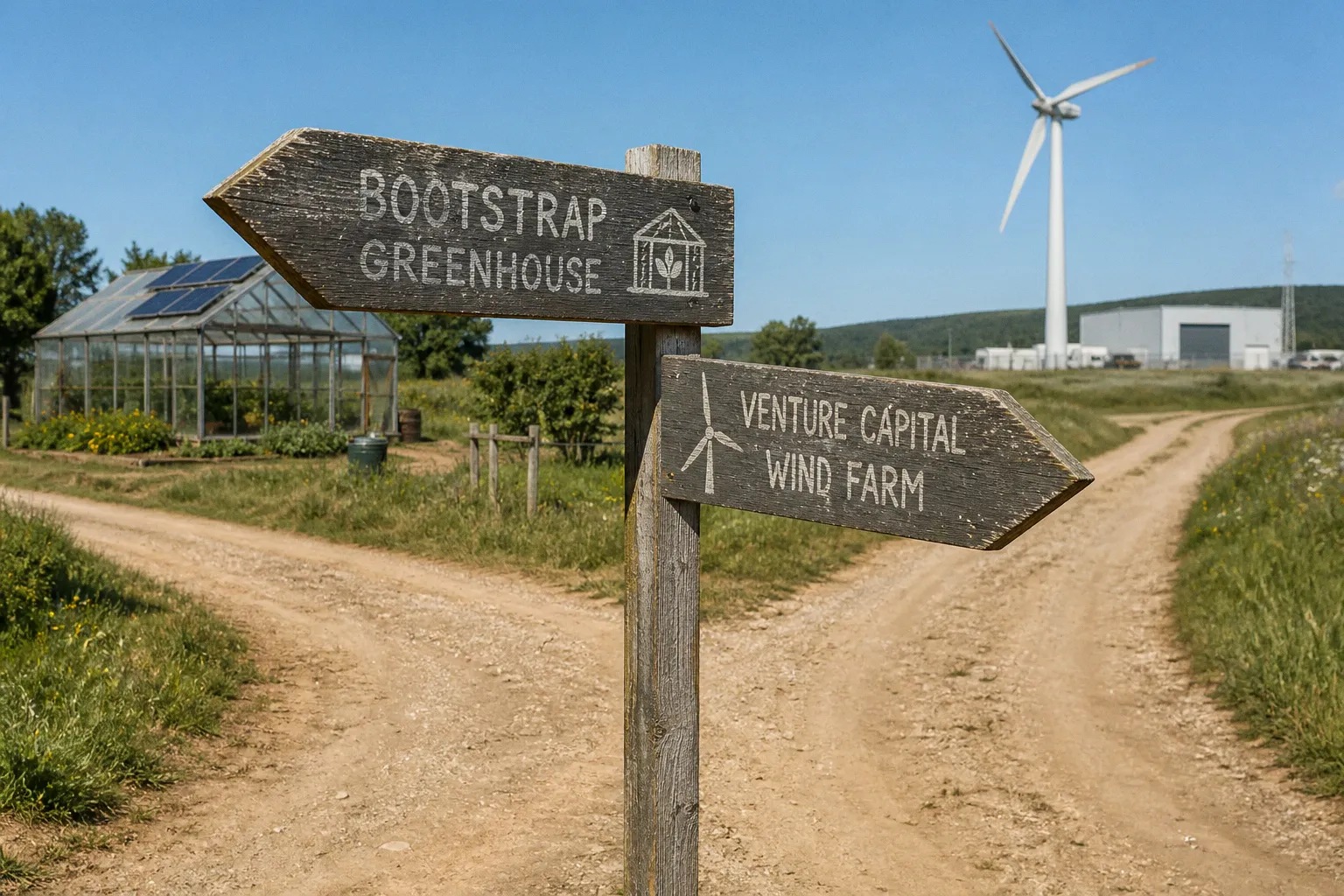
Bootstrapping vs. Venture Capital: The Shifts Reshaping How Climate Startups Actually Grow
And now you're standing at the fork every climate founder eventually reaches: Do you raise venture capital to scale fast, or do you self-fund your way forward and keep full control of the wheel?
It's a paralyzing question — and it's gotten harder, not easier, over the past few years. The climate tech funding landscape has undergone a sharp recalibration since its 2021 peak, and the rules of the game have shifted in ways that affect both paths. If you're trying to figure out which direction makes sense for your company right now, you're not alone. Let's walk through what's actually changed, what each path demands of you, and how to think about alignment between your funding strategy and the kind of company you're trying to build.
The Recalibration of Climate Capital: From High-Burn to Unit Economics
Let's start with the macro picture, because it shapes everything downstream.
Global venture capital investment in climate tech hit $51 billion in 2021 — a high-water mark that felt, at the time, like the beginning of a permanent upward curve. It wasn't. By 2023, that number had dropped 14.5% to $41.1 billion. Early-stage deals fell 24.8% year-over-year. Venture-growth deals — the bigger checks meant to fuel scaling — dropped 34.5%. Europe's climate tech VC funding took an even steeper hit, sliding from a $23.9 billion peak in 2021 to $9.6 billion by 2025.
What happened? Two things, roughly simultaneously. First, rising interest rates made institutional investors (the limited partners, or LPs, who fund venture capital firms) more cautious about speculative, long-horizon bets. Second, a wave of high-profile climate tech companies that had raised enormous rounds burned through cash without reaching the commercial milestones investors expected. The market corrected — hard.
But here's the nuance that matters for you as a founder: venture capital didn't disappear. It restructured. Growth-stage capital actually rebounded to $40.5 billion globally in 2025, up 8% from the previous year. The catch? Deal count fell 18% over the same period. Investors were writing fewer, larger checks — concentrating their bets on companies that had already proven they could execute.
The climate capital market didn't shrink — it got pickier. The question isn't whether money exists. It's whether your company is at the stage where that money comes with manageable strings.
A 2026 Silicon Valley Bank report captured the downstream effect of this shift with a striking data point: a record 52% of venture-backed climate tech companies are now actively improving gross margins. They're shedding weaker product lines, redesigning for manufacturing efficiency, and doubling down on core unit economics. The "grow at all costs" era is over, at least for now. Even companies that already took venture money are being forced to think like bootstrappers — focused on whether each dollar spent actually generates sustainable value.
This recalibration changes the calculus for founders at every stage. If you're pre-seed or seed, the bar for what constitutes a compelling pitch has risen. If you're growth-stage, the path to your next round runs directly through your P&L.
The VC Clock: Understanding Institutional Constraints and Exit Mandates
Before you can honestly evaluate whether venture capital is right for your climate startup, you need to understand what you're actually agreeing to when you take that check. And I don't mean the term sheet — I mean the structural reality of how venture funds work.
Venture capital funds operate on finite lifetimes. The standard is 10 to 12 years, mandated by the institutional limited partners — pension funds, endowments, family offices — who provide the capital that VCs invest. That clock creates an inherent pressure: the fund needs to generate returns within that window, which means the companies in its portfolio need to produce a liquidity event (an acquisition or an IPO) within roughly 5 to 10 years of receiving investment.
For software companies with low capital requirements and fast iteration cycles, that timeline can work. For climate tech companies developing hardware, navigating regulatory approvals, building physical infrastructure, or selling into slow-moving industrial markets — the mismatch can be severe.
Here's the math that should give every climate founder pause: fewer than 1% of all startups reach a $1 billion valuation. Approximately three-quarters of venture-backed startups fail to return capital to their investors. Those aren't numbers designed to scare you away from VC — they're numbers designed to help you understand what you're optimizing for when you choose that path.
When you take venture capital, you're not just accepting money. You're accepting a timeline. You're accepting the expectation that you will pursue aggressive growth, that you will prioritize speed-to-scale, and that you will eventually provide your investors with a return that justifies the risk they took on you. If your technology requires 8 years of iterative development before it reaches commercial readiness, that timeline may not align with your investor's fund lifecycle.
This doesn't make venture capital bad. It makes it a specific tool designed for a specific kind of company at a specific kind of stage. The problem arises when founders take VC money without fully internalizing what it demands — and then find themselves navigating conflicts between what's right for the technology and what's right for the fund.
The Case for Bootstrapping: Maintaining Autonomy in Capital-Intensive Markets
So what does the other path look like?
Bootstrapping a climate tech company means funding your operations through revenue, grants, non-dilutive capital, and whatever personal resources you can marshal. It means growing at the pace your cash flow allows rather than the pace your investor expects. And in the current climate capital environment, it's a path that more founders are seriously considering — not because they lack ambition, but because they want to preserve the alignment between their mission and their decision-making authority.
The advantages are real and tangible:
1. Full strategic control. You decide what to build, when to pivot, which customers to serve, and how fast to grow. No board seats, no investor updates that reshape your roadmap, no pressure to hit growth targets that don't serve your technology's actual development timeline.
2. Forced discipline on unit economics. When every dollar comes from your own revenue or carefully deployed grants, you learn — fast — whether your product actually makes economic sense. You can't hide behind a runway of investor cash. This discipline is exactly what the market now rewards: remember that 52% figure from the SVB report? Bootstrapped companies arrive at that focus naturally.
3. Preserved equity. Every percentage point of ownership you retain is a percentage point of future value — and of control. For founders building companies they intend to run for a decade or more, that compounding ownership matters enormously.
4. Freedom to take the long view. If your direct-air-capture technology needs five more years of iteration before it's commercially competitive at scale, bootstrapping lets you invest that time without the existential pressure of a fund clock ticking in the background.
But let's be honest about the tradeoffs, because bootstrapping a climate tech company is not the same as bootstrapping a SaaS product. Climate solutions are often capital-intensive by nature. You may need specialized equipment, lab access, manufacturing partnerships, or regulatory certifications that cost real money. Growing slowly in a market where first-mover advantage and deployment scale can determine who wins is a genuine strategic risk.
Bootstrapping isn't the absence of ambition — it's the choice to let your technology's readiness, not your investor's timeline, set the pace.
The founders I work with who bootstrap successfully in climate tech tend to share a few characteristics. They find creative ways to generate early revenue — consulting, licensing interim versions of their technology, partnering with established companies who need their expertise. They aggressively pursue non-dilutive funding: government grants, prize competitions, corporate innovation partnerships. And they're ruthlessly honest about which milestones they need to hit before they're ready to scale, so they don't waste scarce resources on premature growth.
Strategic Scaling: Why Growth-Stage Investors Are Concentrating on Proven Winners
Here's where the two paths start to converge in an interesting way.
The data from 2025 tells a clear story: growth-stage capital is flowing again, but it's flowing selectively. That $40.5 billion in global climate tech venture and growth capital went to fewer companies, in larger amounts, with sharper expectations around commercial traction. Investors aren't looking for promising science anymore — they're looking for proven execution.
What does this mean for you, practically?
If you're bootstrapping, it means the option to raise capital later hasn't disappeared — it's just moved. The bar is higher, but the checks are bigger. If you can use your bootstrapping phase to demonstrate product-market fit, build a real customer base, and prove that your unit economics work, you'll be in a dramatically stronger position when you do decide to raise. You'll negotiate from strength rather than desperation, and you'll attract investors who want to back winners rather than gamble on possibilities.
If you're considering VC from the start, it means the pitch has changed. Investors want to see that you understand your cost structure, that you've thought carefully about manufacturing efficiency, and that you have a credible path to gross margin improvement. The days of raising a large seed round on the strength of a compelling deck and a climate thesis alone have largely passed.
Here's a framework I find helpful for thinking about where your company sits:
| Factor | Favors Bootstrapping | Favors Venture Capital |
|---|---|---|
| Capital intensity of technology | Low to moderate — can build and test with limited hardware | High — requires significant upfront investment in equipment or infrastructure |
| Time to commercial readiness | Long (5+ years of development) | Shorter (2-3 years to meaningful revenue) |
| Market dynamics | Niche or specialized, with room to grow steadily | Winner-take-most, where speed and scale determine market position |
| Founder priorities | Mission alignment, long-term control, sustainable growth | Rapid scaling, market capture, maximizing total impact through deployment speed |
| Revenue model | Can generate early revenue through services, licensing, or interim products | Revenue requires full product deployment at scale |
Neither column is inherently better. The question is which one matches the reality of your technology, your market, and your personal definition of success.
Designing for Efficiency: Lessons from the 2026 Climate Tech Landscape
Whether you choose to bootstrap or raise venture capital, one lesson from the current landscape applies universally: design for efficiency from day one.
The 52% of VC-backed climate tech companies now focused on improving gross margins aren't doing it because they want to — they're doing it because the market demands it. But the founders who built efficiency into their operations from the beginning, before investors forced the issue, are the ones navigating this environment with the least friction.
What does "designing for efficiency" actually look like in practice for a climate tech startup?
Manufacturing-first thinking. If you're building hardware, your product isn't just the technology — it's the process by which that technology gets made. The founders who are thriving right now started thinking about manufacturing scalability, component sourcing, and assembly complexity during the R&D phase, not after. They asked questions like: Can this be built with standard tooling? Are the materials available at volume? How many assembly steps does this require, and can we reduce that number?
Revenue before scale. This sounds obvious, but a surprising number of climate founders assume they need to reach a certain scale before they can generate any revenue. In practice, there are almost always interim revenue opportunities: consulting on the problem you're solving, licensing early-stage IP, selling pilot units to research institutions, or offering your analytical capabilities as a service. These revenue streams don't just fund your operations — they validate your market and build relationships with future customers.
Grant strategy as a discipline. Government grants, particularly in climate tech, can provide significant non-dilutive capital. But pursuing grants strategically — rather than applying to everything that looks relevant — requires discipline. The most effective founders I work with treat grant applications like product development: they identify the grants that align with their specific milestones, they build relationships with program officers, and they use the application process itself to sharpen their commercial narrative.
Lean team design. In the current environment, every hire needs to justify itself. The climate tech founders who are navigating this period most successfully tend to run lean, with small teams of high-impact generalists supplemented by specialized contractors or advisors for specific needs. This isn't about working people harder — it's about building a team structure that can adapt quickly without burning through cash.
Choosing Your Path: Alignment Over Ideology
Here's what I want you to take away from all of this: the bootstrapping-versus-venture-capital decision is not a moral one. It's not about being "pure" or "ambitious." It's about alignment — between your funding strategy and your technology's development timeline, between your growth model and your market's dynamics, and between your investors' expectations and your company's reality.
The climate tech funding landscape has recalibrated. The froth of 2021 is gone, and what remains is a market that rewards discipline, efficiency, and proven execution. That's actually good news for founders who are building real things, because it means the companies that survive this period will be stronger, more sustainable businesses — regardless of how they funded their early stages.
So here's your immediate next step: take thirty minutes this week and write down, honestly, where your technology sits on that table above. Not where you wish it sat, or where your pitch deck says it sits — where it actually sits today. Then ask yourself which funding path creates the most alignment between where you are now and where you need to be in three years.
That clarity won't make the decision easy. But it will make it honest. And in a market that's increasingly rewarding honesty over hype, that's the strongest foundation you can build on.