Delaware C-Corp vs PBC: legal shifts for climate startups
A climate founder usually does not choose a legal structure because the distinction feels intellectually interesting.
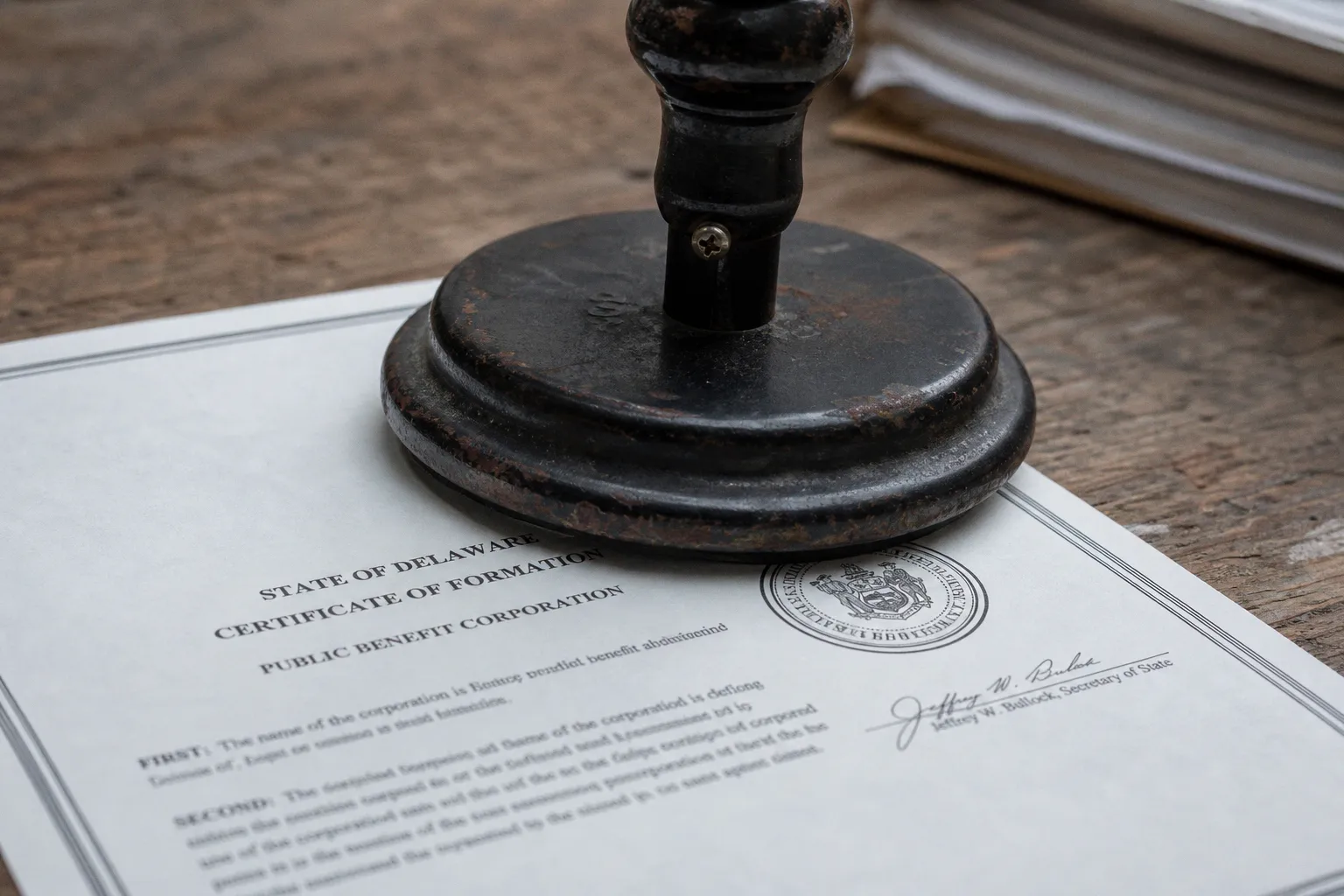
They choose it when the company is raising its first serious round, negotiating with a technical cofounder, or trying to explain to an investor why the business will sometimes reject the fastest path to revenue.
Compare car rental deals in United Kingdom
See available offersPartner link — DiscoverCars comparisonThat is when the Delaware C-Corp vs PBC question stops being a branding exercise. A traditional Delaware C-Corporation gives investors a familiar vehicle and a relatively direct fiduciary framework. A Delaware Public Benefit Corporation adds a legal obligation to balance financial returns with defined public benefits and the interests of people materially affected by the company’s conduct.
For a climate startup, that difference can be meaningful. It can also be less dramatic than founders expect. A PBC is still a for-profit corporation, taxed as a C-Corporation by default. It is not a nonprofit, a special federal tax category, or a substitute for a credible climate strategy. The real decision is whether the company wants its environmental mission to sit in the charter, where directors must take it into account, rather than only in the pitch deck, website, or founder’s intentions.
The fiduciary shift: from one priority to three
The traditional C-Corp is built around a familiar venture-backed bargain. Shareholders provide capital. Directors and officers make decisions for the corporation. The company pursues growth and shareholder value within the boundaries of corporate law.
That description is simplified, but it reflects the expectation most investors bring to the table. If a climate software company can increase enterprise value by serving a lucrative but less climate-aligned market, the board’s job is generally evaluated through the lens of the corporation and its stockholders. The company may still choose a mission-led path, but the mission is not necessarily a separate statutory interest directors must balance.
A Delaware PBC changes that legal architecture. Its board must balance three interests:
- The pecuniary interests of the stockholders.
- The best interests of people materially affected by the corporation’s conduct.
- The specific public benefit or benefits identified in the company’s charter.
That third point is where the practical work begins. “Fight climate change” is emotionally clear but operationally weak. A charter benefit should give the board something concrete enough to use when the trade-offs become uncomfortable. A company might define its public benefit around reducing greenhouse-gas emissions, improving access to climate resilience tools for underserved communities, accelerating energy efficiency, or supporting a particular environmental outcome.
The wording matters because the charter is not a marketing page. It becomes part of the company’s legal and governance vocabulary. It can shape board discussions, acquisition decisions, product priorities, and the way the company explains a controversial trade-off to investors.
Consider a carbon accounting platform that is offered an acquisition by a large enterprise software company. The deal would create a strong financial return for shareholders, but the buyer intends to discontinue the product’s free tools for smaller manufacturers. If the PBC’s stated benefit includes broadening access to emissions measurement for smaller businesses, the board has an additional obligation to consider that consequence. It does not mean the board must reject the acquisition. It means the decision cannot be reduced to price alone.
That is the distinction founders often miss. PBC status does not guarantee that the mission wins every argument. It requires the board to put the mission into the argument.
A PBC does not remove the trade-off between impact and returns. It makes the trade-off visible, documentable, and part of the board’s legal work.
For climate companies, this can be useful precisely because the business model is often exposed to long timelines and competing definitions of success. A hardware startup may need to decide whether to sell a lower-cost product with a shorter service life or a more durable system with a slower sales cycle. A climate adaptation company may have to choose between enterprise contracts and work with municipalities that have greater public need but slower procurement. A PBC structure gives directors a formal way to account for those tensions.
It does not solve them.
What a PBC does not do
The most common mistake is treating PBC status as a protective shell around the mission. It is not. The company still needs revenue, competent governance, responsible capitalization, and a product customers will pay for.
A PBC does not:
- Turn a for-profit company into a charitable organization.
- Create a separate federal tax status.
- Automatically make the company more attractive to impact investors.
- Guarantee that directors can ignore financial performance.
- Replace impact measurement or credible operating evidence.
- Make every climate claim legally defensible.
- Prevent investors from asking hard questions about margins, market size, or exit potential.
This is why the legal structure should follow a real governance intention. If the founders mainly want the words “public benefit” on the website, a PBC may add administrative and drafting complexity without changing how the company is run. If they expect mission-related conflicts to arise and want the board to address them deliberately, the structure may be worth the commitment.
The 2020 Delaware amendments lowered the cost of changing course
Early incorporation decisions are made with incomplete information. Founders may know they want to build a climate company but not yet know whether their first customers will be utilities, industrial manufacturers, local governments, or consumers. They may not know which investors will lead the round or whether the company will eventually need a strategic acquisition rather than a conventional venture exit.
That uncertainty used to make PBC conversion feel more permanent and more expensive. Delaware’s amendments to the General Corporation Law changed the calculation.
In July 2020, Delaware enacted amendments that became effective in August of that year. One important change reduced the stockholder voting threshold for converting a traditional Delaware C-Corp into a PBC, or converting a PBC back into a conventional corporation, from a two-thirds supermajority to a simple majority of outstanding voting stock.
The shift is substantial. A company that once needed a large block of aligned shareholders can now make the change with more than 50% of the outstanding voting stock, assuming the required corporate process is followed.
The amendments also eliminated statutory appraisal rights for dissenting stockholders when a conventional corporation converts to a PBC. Appraisal rights can give dissenting shareholders a mechanism to seek a judicial determination of the fair value of their shares. Removing that feature takes away a potentially significant financial barrier to conversion.
The practical result is not that founders can casually switch structures. The process still involves board approval, stockholder approval, amended charter documents, capitalization analysis, investor communication, and careful legal drafting. But the decision is less locked in than it once was.
| Decision point | Traditional Delaware C-Corp | Delaware PBC |
|---|---|---|
| Federal tax treatment | C-Corporation by default | C-Corporation by default |
| Core governance emphasis | Financial interests of the corporation and stockholders | Stockholder economics, affected stakeholders, and stated public benefit |
| Climate mission in charter | Optional and usually not a statutory balancing requirement | Required public benefit language and board balancing obligation |
| Conversion threshold | Not applicable when already a C-Corp | Conversion between structures generally requires a simple majority of outstanding voting stock under the 2020 amendments |
| Appraisal rights on conversion from conventional corporation | Historically relevant to conversion analysis | Delaware eliminated statutory appraisal rights for dissenting stockholders in this conversion |
| Benefit reporting | No PBC-specific biennial benefit report | Report to stockholders at least once every two years |
| Public disclosure of benefit report | No PBC requirement | Delaware does not require the report to be public |
| B Corp relationship | A conventional C-Corp cannot achieve full B Corp certification under B Lab’s structure requirement | Delaware PBC status is generally required for full B Corp certification, but does not itself provide certification |
This flexibility matters most for founders who are not yet sure how much governance weight the mission needs. Incorporating as a traditional C-Corp and converting later is legally more workable than it was before 2020. But “we can always convert later” should not become an excuse to avoid the conversation now.
Conversion requires shareholder alignment. It also creates a narrative problem if the company has spent years promising one governance model and then changes it during a financing, acquisition, or leadership transition. Investors may ask whether the mission is becoming more meaningful or simply more convenient. Employees may wonder whether the company is strengthening its commitments or trying to manage public perception.
The legal barrier has fallen. The trust barrier has not.
Tax, QSBS, and B Corp status: three things founders keep blending together
Climate founders often encounter three acronyms in the same conversation: C-Corp, PBC, and B Corp. They describe different things.
A Delaware PBC is a legal entity structure under state corporate law. By default, it is taxed as a C-Corporation. A B Corp is a certification administered by B Lab, a nonprofit organization, based on an assessment of a company’s social and environmental performance, accountability, and transparency.
The labels overlap in practice, but they are not interchangeable.
PBC status does not create a special federal tax break
Choosing a Delaware PBC does not create a separate federal tax classification. The company is still operating within the C-Corporation tax framework by default. Founders should not assume that the PBC structure comes with climate-specific federal exemptions, reduced corporate taxes, or a special treatment reserved for mission-led businesses.
The tax analysis remains the tax analysis: incorporation, equity compensation, deductions, credits, research and development treatment, payroll, state obligations, and the company’s specific activities all need to be reviewed on their own terms.
For a hardware company, that might include the treatment of tooling, prototypes, inventory, and research expenses. For a software company, it may involve development costs, contractor arrangements, and equity grants. PBC status does not make those questions disappear.
QSBS is not automatically lost
The same clarification applies to Qualified Small Business Stock. A Delaware PBC is taxed as a C-Corporation by default and does not, merely because it is a PBC, lose QSBS eligibility.
That does not mean every share in every climate startup qualifies. QSBS depends on a range of statutory requirements, including the corporation’s organization, gross asset limits, active business requirements, holding period, and the way the stock was issued and acquired. The company’s lawyers and tax advisers need to examine the actual facts.
The useful point for founders is narrower: PBC status itself is not a reason to assume QSBS treatment has been destroyed.
This is one of those places where a confident statement in a founder group chat can cause unnecessary panic. The right response is not “PBC means no QSBS” or “PBC guarantees QSBS.” The right response is to keep the legal structure and the tax qualification in separate boxes, then have counsel analyze both.
B Corp certification is a separate project
B Corp certification is not granted automatically when a company incorporates as a PBC. Certification requires an assessment and other obligations administered by B Lab. A Delaware corporation generally must be a PBC to achieve full B Corp certification, but the legal entity is only one part of the process.
There is also a timing issue. B Lab allows a Delaware PBC to hold “Pending B Corp” status for one year before full certification is required. That status may help a young company signal direction while it works through the assessment, but it should not be presented as equivalent to full certification.
For an early-stage founder, the distinction affects planning:
1. Choose the legal form. Decide whether the board should have a statutory duty to balance the stated public benefit with financial and stakeholder interests.
2. Draft the charter benefit precisely. Avoid broad language that sounds impressive but gives the board no usable decision framework.
3. Build operating evidence. Track the environmental and social outcomes the company claims to create.
4. Assess certification separately. B Corp certification requires its own timeline, documentation, and ongoing discipline.
5. Keep investor language accurate. “Delaware PBC” and “B Corp certified” should never be used as synonyms.
The strongest climate legal structure cannot compensate for weak impact evidence. A charter can force a board to consider the mission; it cannot manufacture results.
Litigation risk: the 2% threshold is meaningful, but not a free pass
A board considering PBC status may worry that every difficult commercial decision will invite litigation from a disappointed shareholder or an activist group. That concern is understandable, especially for founders who have never dealt with derivative claims.
Delaware law limits who can bring a derivative suit to enforce the PBC balancing requirement. A stockholder must individually or collectively own at least 2% of the outstanding shares. For a listed company, the threshold is the lesser of 2% of outstanding shares or shares with a value of $2 million.
That threshold is designed to prevent frivolous lawsuits from parties with no meaningful economic stake. It narrows standing; it does not eliminate accountability.
A 2% holder can still have influence in a venture-backed company. A lead investor, founder group, or aligned shareholder bloc may reach the threshold. And the absence of a lawsuit does not make the governance obligation optional. The board still needs to show that it considered the relevant interests in good faith and made a reasoned decision.
This changes how a climate startup should prepare for board decisions. The company does not need a theatrical impact ceremony for every product meeting. It does need an evidence trail when the decision clearly touches the public benefit in its charter.
A useful board memo might include:
- The financial opportunity and expected effect on revenue, margin, and runway.
- The relevant environmental or social benefit stated in the charter.
- The people or communities materially affected by the decision.
- The downside risks, including unintended environmental consequences.
- Alternatives considered and why they were rejected.
- Mitigations, milestones, or review dates.
- The final rationale for balancing the competing interests.
This is not bureaucracy for its own sake. It is operational hygiene. Climate businesses routinely make decisions that carry external effects: sourcing materials, choosing manufacturing partners, setting data boundaries, pricing access to resilience tools, measuring avoided emissions, or deciding which customers are excluded from a product’s initial market.
A PBC board should be able to explain not only what it decided, but what it saw.
The mission must be specific enough to govern
Suppose a company’s charter says its public benefit is to “advance a sustainable future.” That language may be sincere, but it is difficult to apply. Does selling to a major oil producer advance sustainability if the product reduces methane leakage? Does it undermine the mission if the same customer uses the product to prolong fossil-fuel infrastructure? Should the board evaluate direct emissions only, or also the customer’s broader business model?
The more general the benefit, the more room there is for argument. That can be useful in a changing market, but it can also make the PBC obligation feel symbolic.
A better charter benefit does not need to predict every future decision. It should identify the company’s intended contribution with enough precision to guide choices. The operating team can then translate it into metrics: tons of emissions reduced, buildings retrofitted, households reached, water saved, heat-risk exposure lowered, or verified improvements in supply-chain performance.
Metrics will never capture the whole mission. They can make board reasoning less slippery.
Operational reality: the biennial report is not a sustainability department
A Delaware PBC must report to its stockholders at least once every two years on its sustainability performance and progress toward its public benefit. Delaware law does not require that report to be publicly available, and it does not require the company to measure performance against a third-party standard in the way some other benefit corporation frameworks do.
That gives founders flexibility. It also creates room for weak reporting.
A report prepared every two years is the legal minimum, not a sensible operating rhythm for a company whose business model depends on climate outcomes. By the time a PBC discovers that its impact metric is impossible to calculate, the product roadmap may already be built around it. By the time investors see a problem, the company may have spent a year making claims it cannot substantiate.
The better approach is to treat the statutory report as the outer boundary of a much more regular management process.
For an early-stage company, that process might look like this:
- Monthly: Track a small number of operating indicators tied to the product’s claimed climate benefit.
- Quarterly: Review those indicators alongside financial and customer metrics at the board level.
- Before major commercial decisions: Document foreseeable effects on the public benefit and materially affected groups.
- Annually: Revisit whether the metrics still reflect the company’s actual product and customer mix.
- At least biennially: Prepare the formal stockholder report required for the PBC.
The metrics should be modest enough to maintain. A startup cannot afford a forty-page impact reporting system while it is still searching for product-market fit. It may be able to track three or four meaningful indicators with clear definitions and consistent data collection.
For example, a building-efficiency software company might track verified energy savings in customer sites, the percentage of savings attributable to its product, deployment time, and the share of projects serving smaller building operators. A climate-risk platform might track the number of assets assessed, the quality of underlying hazard data, and whether customers took documented adaptation actions—not simply how many dashboards were opened.
The difference is between measuring activity and measuring effect. Activity is easier and often more flattering. Effect is harder, messier, and usually more useful.
Investor expectations are changing, but not uniformly
Climate founders sometimes assume that impact-oriented investors will automatically prefer a PBC. That may be true for some funds and individual investors, but there is no reliable basis for treating it as a universal requirement. The available facts do not establish that climate venture funds generally mandate a traditional C-Corp or a PBC in their standard term sheets.
What can be said with more confidence is that investor familiarity matters. Traditional Delaware C-Corps remain the default structure for venture financing, and many investors understand their governance documents, preferred-stock mechanics, option plans, and exit pathways. A PBC is increasingly recognizable—major venture-backed and public companies, including Lemonade, Warby Parker, Coursera, Vital Farms, Anthropic, and Veeva Systems, have adopted or converted to the structure—but recognition is not the same as identical expectations.
The conversation with investors should therefore focus on mechanics, not moral positioning.
A founder should be ready to answer:
- What exact public benefit is in the charter?
- How will the board evaluate conflicts between return and mission?
- What reporting will investors receive?
- Will the PBC structure affect future financing documents or a sale process?
- How will preferred stockholders participate in decisions involving the public benefit?
- What happens if a future board or investor group wants to convert back to a conventional C-Corp?
- Which impact claims are supported by current data rather than future aspirations?
The purpose is not to persuade every investor that the PBC is noble. It is to show that the structure has been selected deliberately and will not create surprises during the next financing.
Should a climate startup incorporate as a C-Corp or a PBC?
There is no universal answer, but the decision becomes clearer when founders separate mission intensity from mission aesthetics.
A traditional Delaware C-Corp may be the cleaner starting point when:
- The company has not yet defined a specific public benefit.
- The founders expect rapid changes in product direction and customer segment.
- The initial investor group strongly prefers conventional governance and the mission can still be protected through contracts, board composition, or company policy.
- The team lacks the capacity to track impact claims responsibly.
- The founders want to postpone the legal commitment until the business model is clearer.
A Delaware PBC may make more sense when:
- Climate or public benefit is central to the company’s reason for existing, not merely a market category.
- The founders expect recurring decisions where financial returns and climate outcomes may diverge.
- Employees, customers, or mission-aligned investors need a durable governance signal.
- The board is willing to document how it balances competing interests.
- The company can state its public benefit with enough specificity to guide action.
- The founders want the mission to remain relevant through fundraising, leadership changes, or an eventual sale.
There is also a middle path: incorporate as a conventional Delaware C-Corp, build serious impact governance from the beginning, and preserve the option to convert once the company has enough clarity and shareholder alignment. The 2020 amendments make that path more practical than it used to be.
But delaying conversion should not mean delaying discipline. A traditional C-Corp can still set climate targets, report performance, protect data integrity, and reject misleading claims. A PBC can still fail at all of those things. The entity type changes the board’s legal balancing obligation; it does not substitute for operational courage.
A practical decision process for founders
Before filing formation documents, or before proposing a conversion, work through five questions:
1. What decision could the legal structure change?
Name an actual scenario: accepting a fossil-fuel customer, pricing a resilience product, choosing a supplier, selling the company, or discontinuing an unprofitable impact program. If the answer is “none,” the PBC may be serving mainly as a signal.
2. Can the public benefit be written in operational language?
If the benefit cannot be connected to customers, products, or measurable outcomes, it may be too vague for a charter.
3. Who needs the commitment to be durable?
Founders, employees, communities, customers, and investors may value durability differently. Identify whose trust the structure is intended to support.
4. Can the board handle the reporting burden?
The statutory report is biennial, but credible governance requires more frequent internal review. Assign ownership before incorporation.
5. What will happen in the next financing or exit?
Discuss the structure with likely investors and counsel before the term sheet, not after. Conversion is easier than it once was, but it is still a shareholder and governance event.
Legal formation is one of the least glamorous parts of building a climate company. It happens before the first pilot works, before the supply chain is stable, and often before anyone knows whether the original business model will survive contact with customers. That is exactly why the choice needs realism rather than ideology.
A PBC is not a badge that turns a difficult climate startup into a trustworthy one. A conventional C-Corp is not automatically hostile to impact. The meaningful question is whether the company’s legal obligations match the trade-offs it expects to face.
Delaware’s 2020 changes made that choice less irreversible by lowering the conversion vote to a simple majority and removing statutory appraisal rights for dissenting stockholders in a conventional-corporation-to-PBC conversion. The shift gives founders room to evolve. It does not give them permission to postpone every hard governance decision.
The hard-earned lesson is simple: incorporate for the company you are actually building, not the climate narrative you hope to tell later. If the mission will shape board decisions when money, growth, and environmental outcomes pull in different directions, put that commitment where governance can reach it. If the mission is still a hypothesis, build the evidence first—and keep the path to a PBC open.