Climate MVP development: no-code vs custom code criteria
The popular assumption is that a climate startup should avoid custom software until it has “validated the market.” It sounds disciplined. It is also incomplete.
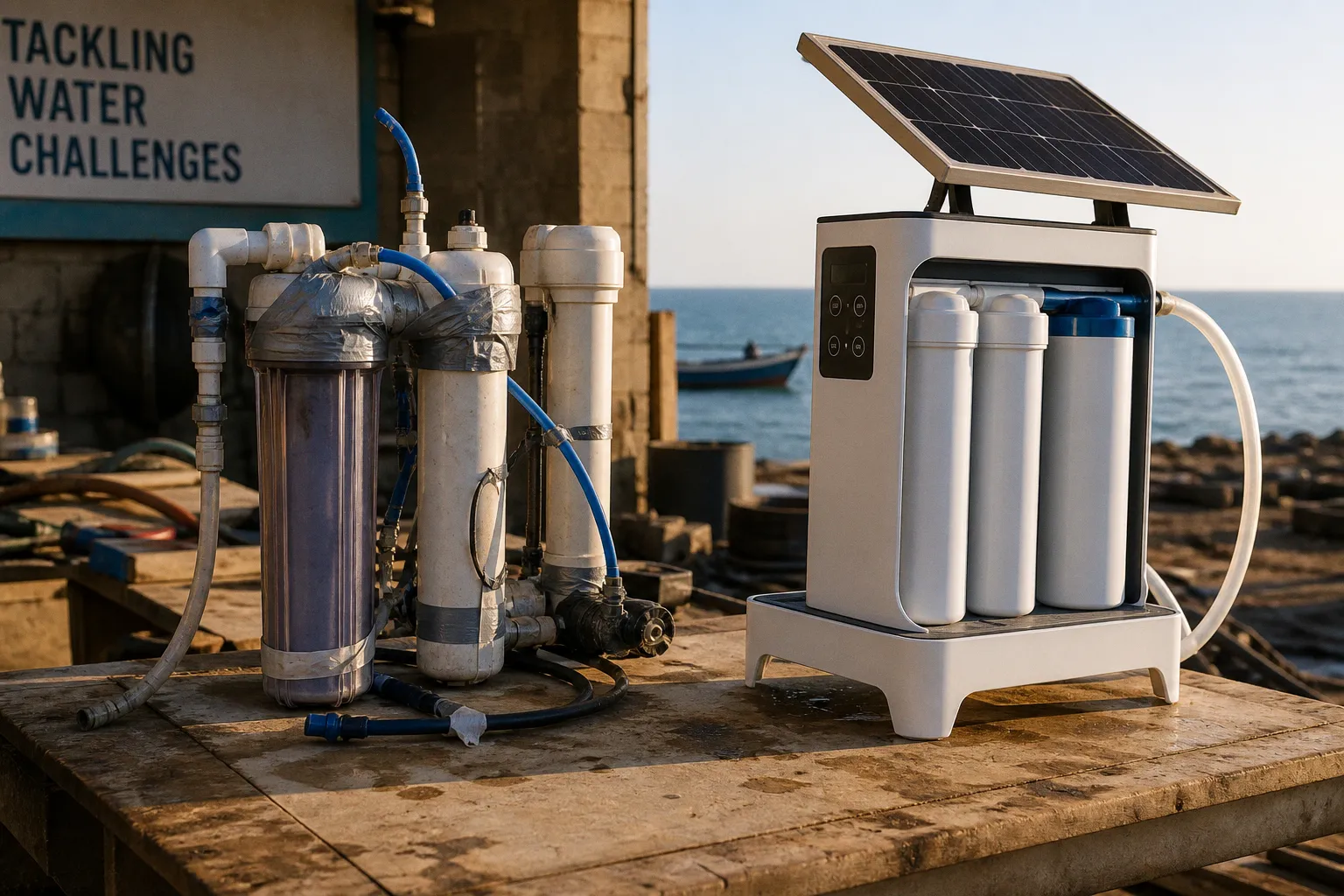
A no-code MVP can help a non-technical climate founder test demand, coordinate a pilot, and expose operational friction before a large engineering commitment. But climate products rarely live inside a neat form-and-dashboard universe. They ingest messy field data, connect to industrial systems, handle calculations that customers may scrutinize, and often need to work where connectivity is unreliable. At some point, the product stops being a workflow and becomes infrastructure.
That is the real choice in no-code vs custom code for a climate startup—not speed versus sophistication, or cheap versus expensive. It is a question of where complexity enters the business, how much of it can be hidden safely, and whether your MVP needs to demonstrate a commercial promise or a technical one.
No-code is not a shortcut around complexity. It is a decision about where the complexity will sit—and who will pay for it later.
The Data Complexity Threshold: When No-Code Hits a Wall
The best no-code MVP tools for climate startups are useful when the core problem is coordination. A customer submits information, a team reviews it, a report is generated, a task is assigned, or a pilot’s progress is tracked. These are valuable functions, especially when the business is still learning what users actually need.
The problem begins when founders treat every climate product as a coordination problem.
A carbon accounting platform, for example, may appear simple from the outside: collect activity data, apply emissions factors, produce a report. But the difficulty is rarely the interface. It sits in data provenance, unit conversion, versioned factors, boundary definitions, missing records, and customer-specific calculation logic. A polished dashboard built with a no-code stack does not make those questions disappear. It simply places them behind a more attractive surface.
Before choosing a platform, map the product’s data behavior rather than its feature list. Ask:
- Does the product use structured data, or will users upload spreadsheets, PDFs, images, and inconsistent exports from existing systems?
- Are calculations straightforward, or do they depend on changing assumptions and multiple data sources?
- Does every customer follow roughly the same workflow, or will the product require extensive conditional logic?
- Must the system preserve a full audit trail of edits, approvals, and data sources?
- Does the product need to connect to sensors, meters, equipment controllers, fleet systems, or enterprise APIs?
- Will it still work when the user has poor connectivity or no reliable browser access?
- Is the output merely operational, or could it influence regulatory reporting, financing, insurance, procurement, or safety decisions?
The more “yes” answers you have, the less likely a purely no-code architecture will remain comfortable.
Where no-code works well
No-code is particularly effective when the MVP needs to test a business process rather than prove a novel technical capability. Common examples include:
1. Pilot intake and qualification
A form can collect site details, equipment information, baseline energy use, operating constraints, and contact data. A workflow tool can route submissions to the right person and flag missing fields.
2. Manual data operations behind a customer-facing interface
A startup can create a customer portal while a small internal team cleans and verifies data manually. That may sound inelegant. It is often the fastest way to discover which parts of the process deserve automation.
3. Project and installation coordination
Climate hardware businesses can use no-code tools to track site surveys, permits, procurement, commissioning, maintenance requests, and customer approvals.
4. Early reporting and evidence collection
A simple portal can help customers upload invoices, utility bills, photographs, maintenance records, or supplier documents before the team knows which data fields will become standard.
5. Concierge services with software support
If the actual early product is an expert service—such as a retrofit assessment or supply-chain emissions review—no-code can organize delivery without pretending the software is more mature than the operation.
These are not second-rate applications. They are often where market learning happens. The friction is visible, the workflow can change quickly, and the founder does not have to finance a full engineering team before a buyer has demonstrated urgency.
Where no-code becomes a liability
No-code is a poor fit when the product’s value depends on a technical behavior that the platform cannot reliably control. That includes:
- continuous processing of high-volume telemetry;
- edge or offline functionality;
- complex optimization and forecasting;
- real-time control of physical equipment;
- strict latency requirements;
- proprietary algorithms that are central to differentiation;
- large-scale geospatial analysis;
- advanced permissions across multiple enterprise tenants;
- data models that change frequently or contain deep relationships;
- integrations that require custom protocols or unusual authentication;
- calculations where reproducibility and version control are commercial requirements.
A no-code platform may technically support parts of these functions. That is not the same as being a sound foundation for them. “Possible” is a dangerous standard in MVP development. The better question is whether the feature can be operated, tested, secured, and explained when the first serious customer asks what happened to a number.
Speed-to-Market Versus Long-Term Scalability
No-code wins the first race because it reduces the amount of code required to create a usable workflow. It does not necessarily reduce the amount of product work.
You still need to define the data model, design the user journey, establish permissions, handle errors, document assumptions, test edge cases, and decide what happens when a customer sends a file in the wrong format. The work moves. It does not evaporate.
Custom development has the opposite profile. It is slower to start because the team must make technical decisions before the market has provided much evidence. But those decisions can produce a system that is easier to extend, automate, and integrate once the product direction is clearer.
This creates a practical comparison:
| Decision factor | No-code MVP | Custom-code MVP |
|---|---|---|
| Initial build speed | Usually faster for forms, portals, workflows, and internal tools | Slower because architecture and engineering foundations must be created |
| Upfront cost | Lower when the scope is narrow and the founder can manage configuration | Higher due to engineering, testing, infrastructure, and technical leadership |
| Product iteration | Fast for changes within the platform’s logic | Fast after the foundation is stable, but slower for early structural changes |
| Data complexity | Suitable for structured, moderate-complexity data and human-in-the-loop processes | Better for complex models, high-volume data, custom calculations, and specialized integrations |
| User experience | Can be strong for standard workflows, but may hit limits in unusual interactions | More control over performance, interface behavior, and accessibility |
| Integrations | Good for common services and APIs supported by connectors | Better for proprietary systems, industrial protocols, and unusual data flows |
| Technical debt | Often hidden in workarounds, platform constraints, duplicated logic, and manual operations | More visible, but can accumulate through rushed architecture and weak engineering practices |
| Migration risk | Can become significant when data structures and business rules are trapped in a platform | Lower platform dependency, but poor early code can still create expensive rewrites |
| Best validation target | Demand, workflow, willingness to pay, and operational fit | Technical feasibility, system performance, proprietary capability, and scale-sensitive economics |
The founder’s job is to identify which kind of uncertainty matters first.
If the uncertainty is commercial—will facility managers share data, will installers use the workflow, will a procurement team pay for a report—no-code often provides enough leverage. If the uncertainty is technical—can the system classify satellite imagery accurately, optimize charging schedules, or process equipment data with acceptable reliability—custom development may be required before the market test means anything.
This is where climate founders often carry a bias from conventional software. A basic web application can be mocked convincingly. A climate product may depend on physical conditions, site-specific data, and operational constraints that a mock cannot reproduce. A clickable interface might prove that someone likes the concept. It does not prove that the product survives contact with a building, a factory, a farm, or a grid connection.
The Climate Tech MVP Platform Selection Problem
Choosing a platform by popularity is a weak substitute for architecture. A tool may be widely used and still be wrong for your product.
For a no-code MVP, the platform should be assessed as part of a stack—not as a magical single solution. One tool may manage the database, another the interface, another automation, another authentication, and another reporting. This modularity creates speed, but it also creates failure points.
A typical early climate software stack might include:
- a structured database for organizations, sites, assets, measurements, documents, and users;
- a front end for customer submissions and review;
- an automation layer for notifications, approvals, and data movement;
- file storage with predictable access controls;
- a reporting or visualization layer;
- an integration method for importing data from spreadsheets, APIs, or customer systems;
- a clear export path if the company later migrates to custom software.
The last item is routinely ignored. It should be part of the first platform decision.
Five questions to ask before committing to no-code
1. Can you export the data in a useful form?
An export is not automatically a migration strategy. Check whether the platform lets you retrieve raw records, attachments, timestamps, relationships, user identities, and change history. If the only practical export is a flattened spreadsheet, you may be building a future reconstruction project.
2. Where do business rules live?
If critical calculations are spread across formulas, automation steps, interface conditions, and manual instructions, the product has no single source of truth. That may be tolerable for a small pilot. It becomes dangerous when several people operate the system or when customers challenge an outcome.
Document the rules separately from the platform. A simple decision log can record:
- the input required;
- the transformation applied;
- the source or assumption behind it;
- the responsible owner;
- the date it changed;
- the expected output;
- the test case used to confirm it.
That document is not bureaucracy. It is an escape route.
3. Can the system represent uncertainty?
Climate data is often incomplete, estimated, seasonal, or dependent on measurement quality. A product that presents every output as equally precise creates credibility risk.
The MVP should distinguish between measured data, customer-provided estimates, default values, and modelled results. If the platform cannot represent these distinctions cleanly, the limitation is not cosmetic. It affects the product’s claims.
4. What happens when an integration fails?
An automation that works in a demo is not the same as an integration that can be operated. Design for expired credentials, duplicate records, partial imports, changed column names, missing readings, and delayed data.
A good early workflow does not merely move data from A to B. It shows what failed, who owns the failure, and how the record can be repaired without starting over.
5. What is the exit cost?
Estimate the effort required to move the core data and logic to another system. You do not need a perfect forecast. You need to notice whether the answer is “a weekend of cleanup” or “someone will have to reverse-engineer the company.”
The fastest MVP is not the one that launches first. It is the one that produces trustworthy evidence without trapping the company inside its first tool.
Managing Technical Debt in Early-Stage Climate Software
Technical debt is often described as a future engineering problem. In climate startups, it can become a customer and credibility problem much earlier.
Suppose a team manually reconciles utility data during a pilot. That is not automatically technical debt. It may be an intentional learning mechanism. The debt appears when the manual step is invisible, undocumented, and treated as if it were already automated.
The same applies to no-code workflows. A workaround is not a failure if the team knows why it exists and what evidence would justify replacing it. It becomes a liability when the workaround quietly becomes the product.
Separate learning infrastructure from production infrastructure
A useful early distinction is between systems designed to learn and systems designed to operate reliably at scale.
Learning infrastructure can tolerate:
- manual review;
- limited customer volume;
- temporary data structures;
- internal-only interfaces;
- controlled pilot environments;
- imperfect automation;
- frequent changes to the workflow.
Production infrastructure needs stronger guarantees around:
- permissions and tenant separation;
- monitoring and alerting;
- backup and recovery;
- repeatable calculations;
- auditability;
- performance;
- integration resilience;
- support ownership;
- predictable costs.
The mistake is not starting with learning infrastructure. The mistake is allowing customers to depend on it without deciding what must change before broader deployment.
Set migration triggers before the platform becomes painful
Founders often wait for a dramatic failure before moving from no-code to custom development. That creates a rushed rewrite, usually at the least convenient moment—after a major customer has already been promised a deadline.
Define migration triggers in operational terms. For example:
- a manual process is repeated often enough that it delays pilot delivery;
- the same calculation requires multiple people to verify it;
- a customer needs an integration the platform cannot support reliably;
- permission requirements become difficult to reason about;
- platform fees rise with usage faster than the revenue model can support;
- response times make the workflow unusable;
- the team cannot test changes without risking live customer data;
- a core differentiator is being constrained by the platform’s interface or data model.
These triggers are not universal thresholds. They are decision points. The exact moment depends on the product and customer commitments.
A founder building a reporting service may remain on no-code longer than a founder building software that controls battery dispatch. That is not inconsistency. It is an acknowledgment that the cost of failure is different.
Budget Allocation: Where Custom Development Actually Pays Off
“Custom code is expensive” is true in the least useful way. The relevant question is whether custom development removes a bottleneck that affects revenue, trust, or defensibility.
There are several areas where it can pay off early.
1. The part of the product that creates proprietary value
If your product is differentiated by a specialized model, optimization engine, data pipeline, or control logic, that component probably should not be buried inside a general-purpose no-code workflow. The user interface can remain lightweight while the technical core is developed properly.
This hybrid structure is often more rational than choosing one side for the entire product:
- no-code for intake and internal operations;
- custom services for calculations or optimization;
- standard cloud storage for files;
- a simple front end for the pilot;
- manual review where the data is still uncertain.
The architecture should follow the value—not the founder’s desire to label the business “software” as early as possible.
2. Reliability at the point of customer exposure
A climate startup can survive an awkward internal admin tool. It has less room for a customer-facing system that loses submissions, produces inconsistent outputs, or fails during a site visit.
Spend custom engineering effort where failure is visible and consequential. That may mean authentication, data ingestion, calculation reproducibility, or the interface used by a customer’s operations team. Not every screen deserves bespoke development. Some screens are simply expensive decoration.
3. Integrations that determine adoption
In enterprise climate markets, a product that requires customers to retype data may be rejected regardless of how elegant the dashboard looks. If adoption depends on connecting to an existing ERP, building management system, fleet platform, meter provider, or asset database, integration work can be more valuable than additional interface polish.
The integration should be tested against real sample data—not a clean demo payload. Look for missing fields, inconsistent naming, different time zones, duplicate assets, and records that arrive out of order. Reality has a habit of breaking the presentation layer’s confidence.
4. Security and access control
A pilot may begin with three users and one organization. That does not mean access control can remain an afterthought, especially when the system contains energy bills, facility data, supplier information, or operational records.
A no-code platform may provide useful permissions, but the team must understand exactly how they work. “The tool has roles” is not a security model. You need to know what each user can see, edit, export, and trigger—and whether a configuration change could expose another customer’s records.
5. A data model that will survive the pilot
Custom development pays off when the underlying entities are stable but relationally complex. A climate product may need to represent organizations, legal entities, sites, meters, assets, suppliers, reporting periods, emissions factors, documents, estimates, approvals, and calculation versions.
If the product’s central data model is already becoming difficult to explain, take that as evidence. The issue may not be that the no-code tool is weak. The issue may be that the business needs a more deliberate technical foundation.
Building a Climate MVP Without Coding: A Practical Operating Model
A non-technical founder can build a meaningful climate MVP without coding, but not without technical judgment. The work involves deciding what will be simulated, what will be manual, and what must be real.
Start by writing the customer promise in operational terms. Avoid language such as “we make decarbonization actionable” unless you can describe the action. Instead:
- the facility manager uploads twelve months of utility records;
- the system identifies missing periods;
- the team produces a prioritized retrofit brief;
- the customer approves one measure;
- the platform tracks the evidence required for the pilot;
- the result is reviewed against an agreed baseline.
Now mark each step as one of three types:
- real now — the system must perform this reliably;
- manual behind the scenes — the customer can receive the outcome while the team performs part of the work;
- simulated for learning — the feature exists only to test whether the workflow or demand is real.
This prevents a common form of startup theatre: building a convincing interface around an unproven operational promise.
A sensible no-code pilot sequence
1. Create the smallest usable intake flow
Collect only information needed to deliver the first outcome. Every extra field increases abandonment and creates data-cleaning work.
2. Use a controlled data structure
Define naming conventions for sites, assets, units, reporting periods, and document types. A spreadsheet may be sufficient at first, but it should not be a different spreadsheet every week.
3. Keep a human review step
Early climate data often needs interpretation. Make the review explicit rather than hiding it behind a falsely automated score.
4. Record assumptions alongside outputs
If a result depends on an estimate or default factor, show that internally and, where appropriate, to the customer. Trust is easier to build when uncertainty is visible.
5. Test with operationally difficult inputs
Use files with missing rows, inconsistent units, duplicate records, and unfamiliar naming. A clean sample proves very little.
6. Measure the workflow, not vanity engagement
Track how long it takes to onboard a site, resolve a data issue, produce an output, and complete a customer action. These measures reveal friction that a page-view count will politely ignore.
7. Decide what deserves engineering next
Prioritize the bottleneck that limits customer value or repeatability. Do not automatically convert the most visible feature into custom code.
Strategic Integration of No-Code and Custom Code
The no-code versus custom-code debate becomes less useful when treated as a permanent identity choice. Most serious climate products will use both.
No-code is well suited to the edges of a system—the changing parts where the team is still learning. Custom code is better suited to the core—the stable, high-consequence logic that must perform consistently.
That core-and-edge distinction can guide investment:
| Product area | Likely early choice | Why |
|---|---|---|
| Lead qualification and pilot intake | No-code | Requirements change frequently and failure is recoverable |
| Internal task management | No-code or existing software | The workflow is operational rather than proprietary |
| Customer document collection | No-code with controlled storage | Useful for testing adoption and data requirements |
| Complex emissions or energy calculations | Custom service or carefully isolated logic | Reproducibility, testing, and versioning matter |
| Sensor and equipment ingestion | Custom integration when central to value | Data reliability and protocol handling become differentiators |
| Customer dashboards | No-code initially, custom later if needed | Interface requirements become clearer after live use |
| Alerts and approvals | Hybrid | Standard notifications can be automated; critical decisions need explicit controls |
| Optimization and forecasting | Custom development | The technical method is often the product itself |
| Pilot reporting | No-code plus human review | Fast iteration is valuable while the reporting format is still evolving |
| Identity, permissions, and audit trails | Platform capabilities plus technical review | Access mistakes can damage trust before the product is mature |
The hybrid approach does require discipline. Data must move between systems in a controlled way. Interfaces need ownership. Critical calculations should not be duplicated in three different places because each tool offers a convenient formula field.
A small technical architecture document can prevent avoidable confusion. It should identify:
- the system of record for each major data type;
- which workflows are automated and which are manual;
- where calculations are performed;
- how records are uniquely identified;
- how errors are surfaced;
- how data is exported;
- who approves changes to business logic;
- what would trigger a migration.
This is not an enterprise architecture exercise. It is a defense against accidental complexity.
The Criteria That Should Decide the MVP Path
The right choice depends less on the founder’s technical background than on the product’s risk profile. A non-technical founder can use custom development intelligently by commissioning a narrow technical core. A technical founder can still make a poor decision by building an elaborate system before understanding the customer workflow.
Use these criteria to make the decision concrete:
Choose no-code first when:
- the main uncertainty is whether customers want the workflow or outcome;
- the product can tolerate a human-in-the-loop process;
- the data is mostly structured and the volume is manageable;
- integrations are common or can initially be handled through uploads;
- the calculation logic is simple, transparent, or not yet the main differentiator;
- the pilot has a small number of controlled users;
- the platform provides usable exports and access controls;
- the team has a clear plan for tracking assumptions and manual work.
Choose custom development early when:
- technical performance is the main thing the customer is buying;
- the product controls physical systems or affects operational safety;
- data arrives continuously, at scale, or through specialized protocols;
- proprietary algorithms create the competitive advantage;
- the product requires advanced offline capability;
- output accuracy, auditability, or reproducibility is central to trust;
- platform limitations would force the team into fragile workarounds;
- the cost of a wrong result is high;
- migration would be difficult because the first version will create a large, valuable data history.
There is a third option, and it is frequently the most honest: build a service-assisted MVP. Let the customer experience the intended outcome while experts perform some of the complex work manually. This tests willingness to pay and operational value without claiming that automation has already been solved.
The founder should be explicit about the boundary. A service-assisted MVP is not a deception when the manual layer is part of the learning plan. It becomes one when sales materials imply a level of automation, coverage, or precision the operation cannot provide.
The Reality Check Before You Build
Before selecting no-code MVP tools for climate startups, run a short evidence exercise. Take one real customer scenario—not the idealized journey from the pitch deck—and trace every input, decision, exception, and output.
Then ask four uncomfortable questions:
1. What must be true for the customer to receive value?
Identify the dependency that cannot be faked, whether it is a reliable meter feed, a site survey, an accurate baseline, or a verified emissions factor.
2. What can be manual without damaging the promise?
Manual review is acceptable when it improves quality and remains economically plausible. It is not acceptable when the product’s business model assumes instant scale.
3. What failure will the customer notice first?
Fix that before polishing secondary features. Customers rarely care that the dashboard has another filter if the uploaded data disappears.
4. What evidence would justify moving to custom code?
Set the trigger before sunk-cost bias takes over. Otherwise, the team will defend the first platform because it contains months of configuration, not because it remains the right tool.
The market does not reward technical purity. It rewards a product that solves a costly problem with enough reliability for someone to change behavior, approve a budget, or renew a contract.
No-code can be the right path for building a climate MVP without coding—especially when the first goal is to expose demand, workflow friction, and data requirements. Custom code earns its place when complexity is not accidental but central to the value proposition. The sensible route is often to combine them: keep discovery fast at the edges, and engineer the core before it becomes a credibility risk.
Do not ask whether your startup is “ready” for custom development. Ask which assumption the next version must test, what kind of failure that test can tolerate, and where the market will stop being patient.
Then build that version—not the one that makes the architecture look impressive in a demo.