Contract Manufacturing: What Changes for Climate Hardware
The hardest decision in climate hardware is rarely whether to outsource production. It is deciding when outsourcing becomes less risky than keeping the build in-house.
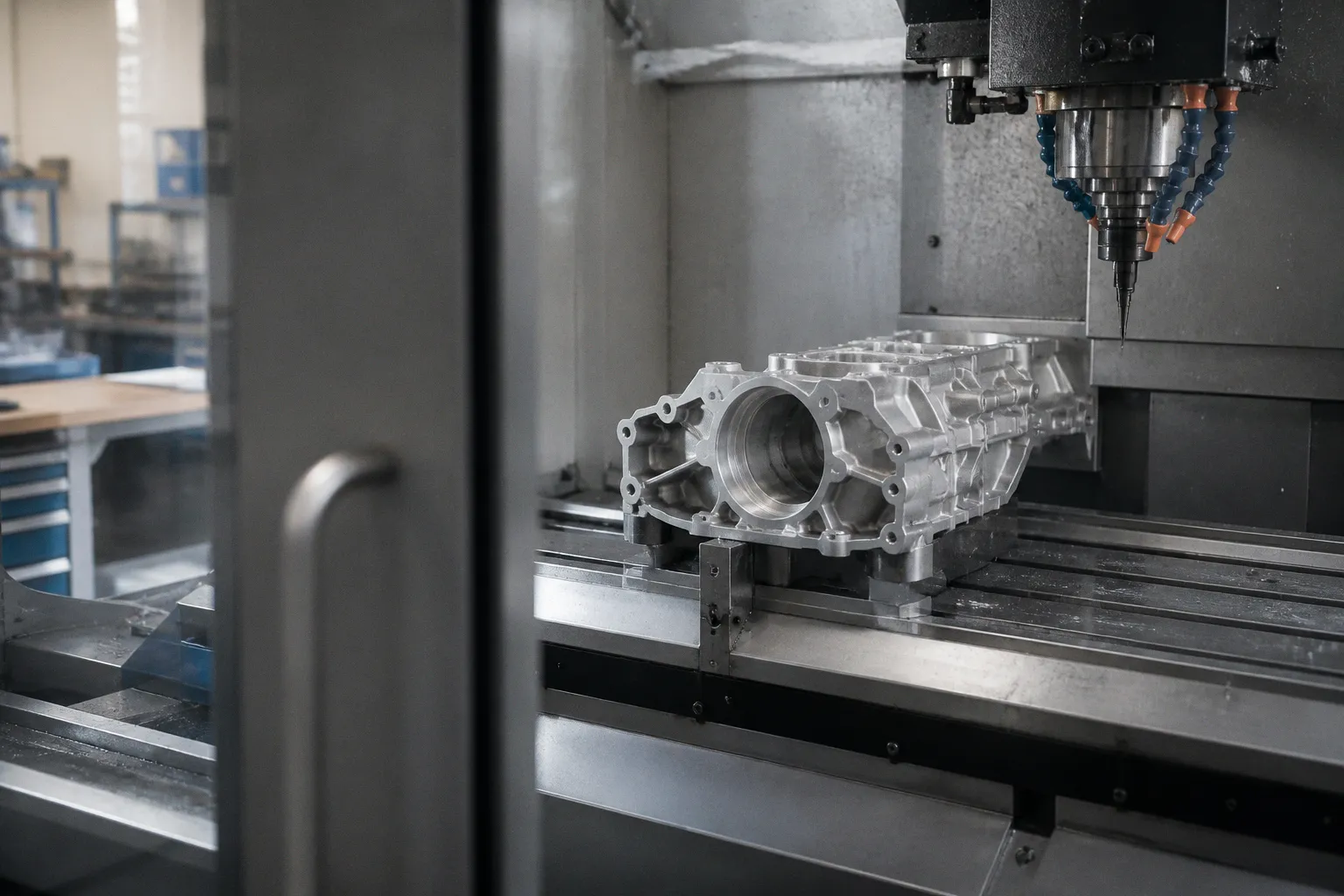
A prototype can work beautifully on a founder’s bench and still fail as a product. The enclosure may require hand fitting. A supplier may quietly substitute a material. An assembly step may take twelve minutes instead of three. A certification requirement may force a late redesign. None of these problems necessarily appear in the first working unit.
That is the uncomfortable reality of the climate hardware contract manufacturing transition: proving that a product works is only the first part of the job. The larger challenge is proving that it can be built repeatedly, inspected consistently, certified properly, and delivered without destroying the economics or the environmental case.
For industrial hardware startups, roughly 20% of the effort can sit in proving prototype feasibility. The remaining 80% arrives when the team tries to scale into repeatable production. This is the hardware valley of death—not a single failure point, but a long stretch where technical, financial, operational, and supply-chain risks become visible at the same time.
The 80/20 problem: a prototype is evidence, not a manufacturing plan
Founders often move toward contract manufacturing because the prototype phase has become exhausting. The team is ordering parts, chasing vendors, improvising fixtures, inspecting every unit by hand, and solving problems through personal knowledge of the build.
That is useful early on. It is also dangerous if mistaken for a production system.
A prototype assembly process can depend on:
- One engineer knowing exactly how much pressure to apply during assembly.
- A component arriving from a single supplier with no qualified alternative.
- Manual calibration that is too slow or inconsistent for volume.
- Parts being modified after delivery with drills, files, adhesives, or improvised brackets.
- A founder catching defects through visual inspection that has never been translated into a documented quality standard.
The prototype demonstrates that the product can exist. Contract manufacturing requires a different level of evidence: that an external team can build it using defined inputs and achieve an acceptable yield.
This distinction matters particularly in climate tech. A product may include electronics, sensors, power systems, thermal components, pumps, valves, chemical handling, specialized materials, or mechanical assemblies exposed to harsh operating conditions. The manufacturing partner is not simply putting a box together. It may be managing interfaces between disciplines that were previously held together by the founding team’s judgment.
The trade-off is straightforward:
| Approach | What it preserves | What it exposes |
|---|---|---|
| Continue building in-house | Fast informal iteration and direct control over every unit | Founder dependency, inconsistent processes, limited capacity, weak production data |
| Move directly to a contract manufacturer | Access to equipment, operators, process expertise, and a clearer path to volume | Higher coordination burden, less day-to-day control, risk of premature tooling or redesign |
| Use a staged outsourcing model | Learning from a manufacturing partner while keeping some engineering control | More management complexity and a longer period of overlapping responsibilities |
| Build a dedicated production operation | Maximum ownership of process, quality, and strategic capacity | Capital requirements, hiring needs, facility overhead, and operational distraction |
There is no universally correct answer. A novel material or chemical process may need close control over environmental conditions and handling procedures that a general electronics manufacturer cannot provide. A sensor-heavy device may benefit from a partner with strong electronics assembly and test infrastructure. A mechanical product with demanding tolerances may require a supplier experienced in precision machining and fixture design.
The right question is not whether contract manufacturing is cheaper. At the prototype-to-pilot stage, it may not be. The better question is whether the partner can remove specific operational risks that the founding team is not equipped to manage alone.
A contract manufacturer does not turn an unfinished product into a finished one. It makes every unresolved assumption more expensive and more visible.
EVT, DVT, and PVT: the gates are different for a reason
The standard hardware validation path has three major stages: Engineering Validation Testing, Design Validation Testing, and Production Validation Testing. They are often abbreviated as EVT, DVT, and PVT.
These stages are not interchangeable milestones, and passing one does not guarantee that the next will go smoothly. Each asks a different question.
EVT: does the engineering work?
Engineering Validation Testing is where the team proves the core technical architecture. The product may still look rough. The enclosure may not be final. Some parts may be expensive, temporary, or sourced through channels that are unsuitable for production.
That is acceptable if the purpose of the build is clear.
EVT should help answer questions such as:
- Does the system achieve its essential technical function?
- Do the major subsystems work together under expected operating conditions?
- Are power, thermal, mechanical, fluid, or control assumptions holding up?
- Which components are limiting performance or reliability?
- What must change before the design is handed to a production-oriented partner?
Typical EVT prototype builds take around 6 to 10 weeks, although the schedule depends heavily on component availability, design maturity, and the number of iterations required.
For a climate hardware startup, EVT is often where the product’s technical ambition meets physical constraints. A thermal management system may perform well in a controlled test but struggle with heat dissipation in a compact enclosure. A monitoring device may produce clean data until exposed to vibration, condensation, dust, or unstable connectivity. A process unit may achieve the desired reaction or separation performance while creating maintenance requirements that customers will not accept.
The temptation is to treat a successful EVT as permission to order production tooling. That is usually premature. EVT proves technical feasibility; it does not prove that the design is manufacturable, certifiable, serviceable, or economically repeatable.
DVT: does the finished design survive reality?
Design Validation Testing uses near-final builds to test the integrated product. This is where the design needs to behave less like an engineering experiment and more like the thing a customer will actually receive.
DVT typically addresses:
- Mechanical durability and environmental stress.
- Component interactions under real operating conditions.
- Tolerance stack-ups and fit across parts.
- Safety requirements and relevant certifications.
- Final materials, finishes, labels, connectors, and interfaces.
- Assembly sequence and service access.
- Reliability over expected use cycles.
- Test procedures that can identify failures before shipment.
DVT builds often take around 8 to 14 weeks. The schedule can expand when certification testing reveals a design issue, when a component changes, or when the team discovers that a near-final part behaves differently from the prototype substitute.
This is also where the relationship with a climate hardware manufacturing partner becomes more consequential. A good partner should not wait for the startup to hand over a perfect design package. It should identify manufacturability problems early: inaccessible fasteners, unnecessary part count, difficult inspection points, fragile connectors, poor tolerance assumptions, or materials that are difficult to source consistently.
That does not mean the manufacturer owns the product design. It means the design must be exposed to production knowledge before production commitments become irreversible.
PVT: can the factory build it repeatedly?
Production Validation Testing is the bridge between a validated design and commercial manufacturing. The objective is to confirm that the factory’s tooling, work instructions, fixtures, test stations, inspection points, and supplier inputs can produce consistent units.
PVT is not a ceremonial first batch. It is a controlled test of the production system.
Typical PVT pilot line validation runs take around 4 to 8 weeks. Pilot production runs commonly range from 50 to 500 units, depending on the product, factory setup, market need, and risk profile.
The critical questions are operational:
- Can operators follow the work instructions without relying on the founding engineer?
- Are cycle times stable enough to plan capacity?
- Do incoming parts meet the required specifications?
- Which defects recur, and where in the process are they introduced?
- Does the final test catch the failures that matter?
- Can the factory maintain acceptable yield as the process repeats?
- Are packaging, labeling, and shipping procedures ready for real distribution?
PVT is where the startup learns whether it has a product or merely a collection of successful demonstrations.
What changes when production leaves the building
Outsourcing climate hardware production changes the company’s operating model. The founder is no longer managing only product development. They are managing an information system that has to transfer intent across organizational boundaries.
That system includes the bill of materials, drawings, tolerances, approved suppliers, firmware versions, test limits, assembly instructions, quality records, change-control procedures, and non-conformance processes. If any of these remain informal, the manufacturer will fill the gap with its own assumptions.
Sometimes those assumptions are reasonable. Sometimes they are invisible until the first production problem.
The documentation burden arrives earlier than expected
A contract manufacturer needs more than a 3D model and a parts list. It needs to understand how the product is supposed to be built and how a good unit is distinguished from a bad one.
The production package may need to cover:
- Controlled mechanical drawings with revision history.
- A complete bill of materials, including approved alternates.
- Electrical schematics, PCB files, and firmware version control where relevant.
- Torque specifications, adhesives, sealing methods, and critical assembly notes.
- Calibration procedures and test fixtures.
- Incoming inspection requirements for high-risk components.
- Acceptance criteria for cosmetic and functional defects.
- Packaging requirements for transport, storage, and installation.
- Field-service procedures and replaceable subassemblies.
- A formal process for approving engineering changes.
This work is not administrative decoration. It is how the company preserves product knowledge when the people who built the prototype are not standing beside every unit.
Design for manufacturing is a negotiation, not a one-time review
Design for Manufacturability, or DFM, is often treated as a gate before production. In practice, it is an ongoing negotiation between product ambition, process capability, schedule, cost, and customer value.
A manufacturer may recommend a material substitution, a different fastening method, a larger radius, fewer assembly steps, or a change in component placement. Some suggestions will make the product stronger and easier to build. Others may reduce performance, serviceability, or the credibility of the product’s environmental claims.
This is where founders need a clear hierarchy. Not every change deserves a fight, but not every suggestion should be accepted in the name of efficiency.
Separate the requirements into three groups:
1. Non-negotiable performance and safety requirements. These define what the product must do and what risks it must not create.
2. Customer-visible or mission-critical attributes. These may include operating life, noise, repairability, energy performance, data accuracy, or compatibility with existing infrastructure.
3. Flexible implementation choices. These are opportunities for simplification, lower process variation, better availability, or easier service.
The messy part is that a change can improve one group while harming another. A cheaper component may increase energy consumption. A sealed enclosure may improve protection but make repair impossible. A lighter material may reduce shipping emissions while shortening service life. Climate hardware decisions need a wider lens than unit price.
Pilot production is where the supply chain starts telling the truth
A pilot run validates more than the factory floor. It tests the supply chain’s ability to deliver the right parts, in the right condition, at the right time, with enough consistency to support production.
A prototype may survive because the team manually selects components. A pilot exposes the difference between a carefully chosen sample and an ordinary shipment.
The supply chain questions become concrete:
- Which components have long lead times?
- Which parts have a single source?
- Are supplier specifications stable across batches?
- What happens when a component is discontinued?
- Can the manufacturer trace lot numbers and material changes?
- Which parts require special storage or transport?
- Are imported materials affected by customs, hazardous-goods rules, or seasonal availability?
- Does the production schedule depend on one fragile upstream assumption?
For climate products using novel materials, electrochemical components, specialty coatings, or industrial equipment, the answer may require more than a standard supplier audit. The manufacturing partner needs to understand the material’s handling requirements, degradation modes, shelf life, safety profile, and acceptable variability.
Yield is a business metric, not just a factory metric
A high defect rate is not simply a manufacturing inconvenience. It affects cash runway, customer commitments, warranty exposure, and the amount of material that must be scrapped or reworked.
During PVT, track the process rather than looking only at the final number of good units. Useful measures include:
- First-pass yield.
- Rework hours per unit.
- Scrap by component and failure mode.
- Test failures by production step.
- Time spent waiting for missing parts or engineering decisions.
- Assembly cycle time.
- Defects found internally versus defects found after shipment.
- Frequency and impact of engineering changes.
The point is not to demand perfect performance from the first pilot run. The point is to understand what is creating variation and whether the factory has a credible path to reduce it.
A manufacturer that reports problems early may be safer than one that presents an attractive but unexplained yield number. Resilience is not the absence of failure. It is the ability to detect, contain, learn from, and prevent recurring failure.
The climate accounting problem: outsourcing does not outsource responsibility
Climate founders sometimes focus intensely on operational emissions while treating manufacturing as a procurement issue. That is a mistake.
Supply chain emissions are, on average, more than 11 times higher than operational emissions. The exact profile varies by product and sector, but the general implication is hard to ignore: a product’s environmental case can be weakened upstream even when its use-phase performance is strong.
When selecting a contract manufacturer for climate tech, ask how the partner can support product carbon footprint work and value-chain decarbonization. This should not be reduced to a marketing claim about renewable electricity at the factory.
The relevant questions include:
- What materials and process inputs are used?
- Can the manufacturer provide reliable data on energy, waste, and material consumption?
- How much transport is embedded in the supply chain?
- Are parts shipped between multiple facilities for machining, coating, assembly, and testing?
- What proportion of scrap is generated during production?
- Can products be repaired, refurbished, or disassembled?
- Are recycled or lower-impact materials technically suitable and traceable?
- Does the partner have a plan for reducing process emissions over time?
The answer may affect factory selection even when another supplier offers a lower initial quote. A partner with better traceability can help the startup make defensible environmental claims, identify high-impact interventions, and avoid discovering later that the product’s footprint is dominated by a material or process nobody measured.
If your product is supposed to reduce emissions, the manufacturing chain cannot remain a black box.
There is also a product-design implication. Manufacturing decisions influence the lifetime impact of the hardware. A component that is slightly more expensive but replaceable may keep the whole product in service longer. A modular architecture may reduce field waste and simplify upgrades. A packaging change may reduce transport volume without changing the customer experience.
These are not abstract sustainability ideals. They are operational design choices that should be made before the production process hardens around them.
Choosing a climate hardware manufacturing partner
The best manufacturing partner is not necessarily the largest facility, the cheapest bidder, or the company with the most impressive customer list. Those signals can be useful, but they do not answer the practical question: can this partner handle the specific kind of uncertainty in your product?
Start with process fit.
A manufacturer experienced in consumer electronics may be excellent at PCB assembly and automated testing but unsuitable for a product involving fluid systems, high-temperature materials, chemical handling, or field installation in difficult environments. A machining specialist may produce excellent metal parts but lack the electronics, firmware, calibration, or final-test capabilities the product requires.
Assess the partner across several dimensions:
- Relevant manufacturing processes: machining, injection molding, sheet metal, electronics assembly, coating, sealing, welding, thermal management, fluid handling, or other processes specific to the product.
- Validation maturity: whether the team understands EVT, DVT, and PVT as distinct gates rather than using them as interchangeable labels.
- Quality systems: how defects are recorded, analyzed, contained, and prevented.
- Engineering support: whether the partner can conduct useful DFM reviews and challenge weak assumptions.
- Supply-chain depth: ability to qualify alternate suppliers and manage constrained or specialized components.
- Certification experience: familiarity with the safety and regulatory requirements relevant to the product’s market.
- Pilot capacity: whether the factory can support a 50-to-500-unit validation run without forcing premature volume commitments.
- Communication discipline: clear ownership of actions, revision control, escalation paths, and response times.
- Sustainability data: willingness and ability to share information needed for product carbon footprint analysis.
- Scale fit: whether the startup will be commercially meaningful to the partner rather than permanently pushed behind larger accounts.
During diligence, ask for evidence rather than broad assurances. Review an example of a production traveler, a non-conformance report, a change-control record, and a pilot quality report if the partner can share them without revealing confidential customer information.
Ask how they would handle a late component change. Ask who owns the test fixture. Ask what happens when the startup misses a design freeze. Ask how tooling changes are approved. Ask which part of the proposed process they believe carries the most risk.
The answers reveal operating culture. A partner who identifies constraints early is often more valuable than one who promises that everything is easy.
A practical comparison: what to keep close and what to delegate
Many founders frame the decision as all internal versus all outsourced. That is rarely how the transition works in practice.
| Function | Keep close to the startup | Delegate when the partner has proven capability |
|---|---|---|
| Product requirements | Customer outcomes, performance thresholds, safety priorities, climate claims | Documentation formatting and production feedback |
| Core technical architecture | System-level trade-offs, proprietary methods, critical algorithms or process know-how | Routine component-level optimization within agreed limits |
| Manufacturing process | Critical parameters that affect performance, safety, or environmental impact | Standardized assembly, inspection, and line balancing |
| Quality | Definition of acceptable product and escalation thresholds | In-process inspection, test execution, and quality reporting |
| Supply chain | Strategic materials, single-source risks, approved alternates | Purchasing execution, supplier coordination, and inventory planning |
| Engineering changes | Approval of changes affecting customers, compliance, performance, or footprint | Implementation of approved changes and documentation updates |
| Field learning | Customer feedback, failure interpretation, product roadmap | Repair logistics and standardized service operations |
This division will evolve. Early in the transition, the startup may need to remain deeply involved in line setup and test development. Later, it may delegate more execution as the process becomes stable. The goal is not to disappear from manufacturing. It is to build enough process knowledge that the company can govern production without personally touching every unit.
The timing question: when should a founder make the move?
The decision to engage a contract manufacturer should happen before the product is fully finished, but not before the core technical direction is credible.
Bring manufacturing expertise into the process early enough to influence enclosure design, part count, tooling choices, supplier strategy, test architecture, and serviceability. Waiting until the design is frozen can turn useful feedback into expensive redesign.
At the same time, avoid outsourcing uncertainty that the startup itself has not resolved. A partner cannot decide what performance truly matters, which failure modes are acceptable, or what environmental claims the company is prepared to defend.
A useful transition sequence looks like this:
1. Stabilize the technical concept. Establish the essential performance and safety requirements before optimizing production details.
2. Identify manufacturing-critical risks. Mark components, materials, processes, and certifications that could control the schedule.
3. Invite partner input during DFM. Use the manufacturer to challenge assembly logic, tolerances, sourcing assumptions, and testability.
4. Build EVT with production questions in mind. Record what is still manual, temporary, single-sourced, or dependent on founder knowledge.
5. Use DVT to close the design gap. Test near-final materials, interfaces, environmental conditions, service procedures, and certification requirements.
6. Treat PVT as a production-system experiment. Measure yield, cycle time, defects, rework, supply performance, and operator independence.
7. Commit to volume only after the evidence is useful. A successful pilot should reduce uncertainty, not merely create inventory.
The emotional trade-off is real. Founders often feel that handing over production means surrendering control. In a sense, it does. But keeping every activity internal can create a different kind of loss: the company becomes dependent on a few people, unable to produce enough units, and too distracted by operations to improve the product.
Control should mean visibility, decision rights, and traceability—not physically performing every task.
The hard-earned lesson
The transition to contract manufacturing is not a procurement event. It is a change in what the company must be able to prove.
At EVT, prove that the technical concept works.
At DVT, prove that the integrated design can survive its real operating environment and meet its obligations.
At PVT, prove that another team can build the product repeatedly using a controlled process.
For climate hardware founders, there is a fourth obligation running through all three stages: prove that scaling the product does not quietly undermine its environmental value. That means understanding materials, transport, energy, waste, repairability, and supplier practices before the production chain becomes too complex to examine.
The strongest climate hardware companies do not avoid the messy parts of manufacturing. They make those parts visible early enough to act on them. They accept that the first factory process will need refinement, that the initial partner may not be the permanent one, and that resilience comes from systems rather than optimism.
A prototype earns attention. A repeatable, serviceable, traceable, and lower-impact production system earns the right to scale.