K-water and Gachon University Launch AI Incubator for Climate Tech Founders
According to the Herald Economy, Korea Water Resources Corporation (K-water) and Gachon University have launched "AI for Climate Tech," a semester-long incubator course built around 24 students working on real water-and-climate problems.
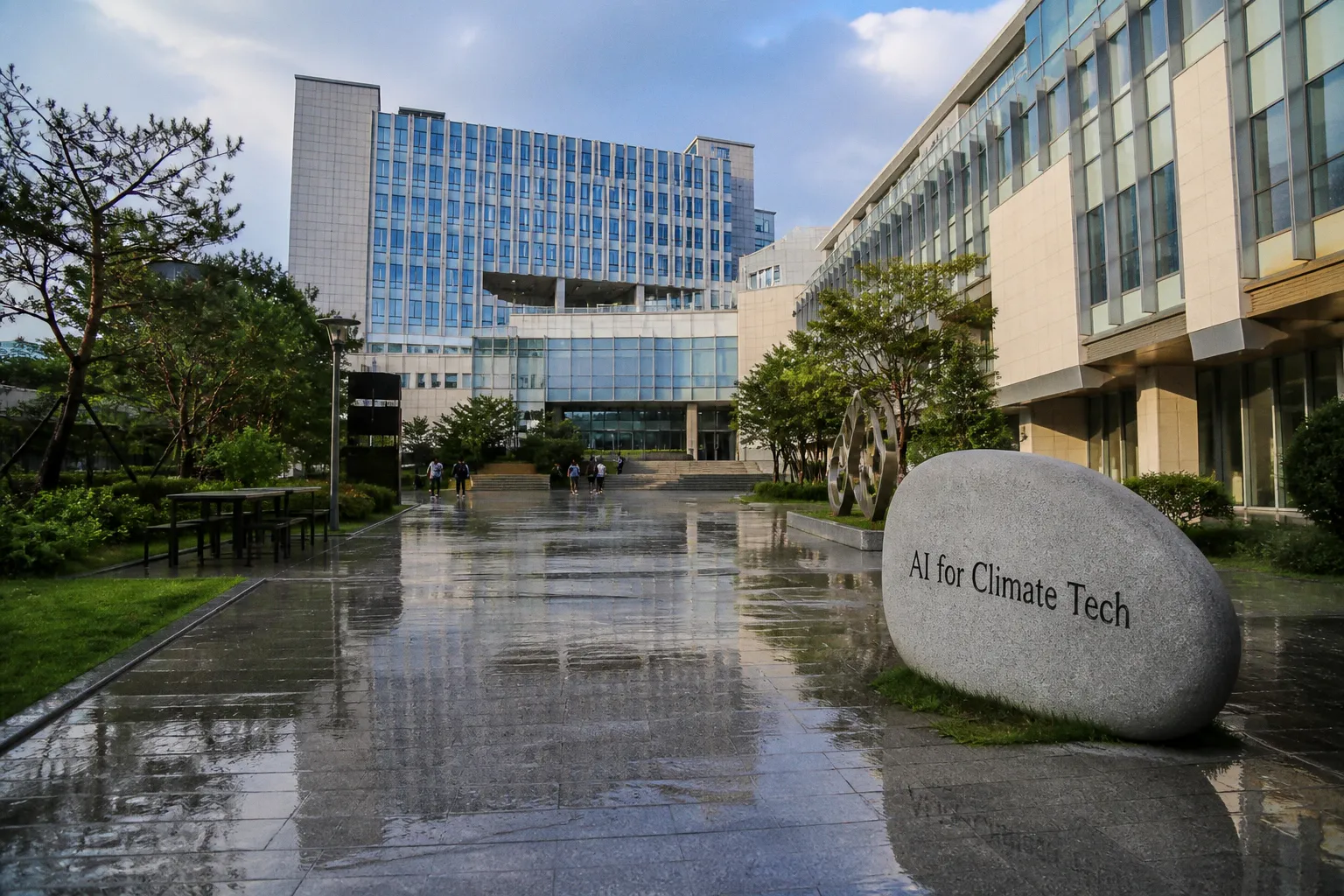
Why this matters to you, as a builder eyeing the climate space: a state utility just opened its data, its drones, and its in-house experts to student founders — and the structure tells us a lot about where pilot pipelines and partnerships are quietly being rebuilt.
The Lab Setup: What Students Actually Get
The program runs as a regular second-semester course at Gachon for 2026, with students split into six teams and dropped into a three-month hands-on environment called "Search Space," hosted at K-water's Daejeon headquarters. Two assignments are pre-defined: one task asks teams to build an algae-detection algorithm from unmanned drone footage, and the other pushes them to design an AI model that spots urban flooding and river overflow through CCTV video. A third, open-ended challenge asks them to prototype a solar power forecasting system that fuses meteorological data with deep learning — and here, teams receive only minimal baseline data, meaning they have to hunt down and integrate the rest themselves.
K-water is staffing the program with two mentor tracks. "Domain mentors" are the corporation's own subject-matter experts who help teams navigate water, climate, and infrastructure context, while "AI mentors" are hands-on practitioners supporting data use and model work. Students are also encouraged to lean on generative AI tools to sharpen how they define problems and shape solutions — a small but telling detail that the organizers want ideation itself treated as a skill, not an afterthought.
Why a Utility Is Funding This (and What That Tells You)
This didn't appear out of nowhere. The program sits inside an MOU K-water and Gachon signed last November to build an AI-driven innovation and startup ecosystem in the water sector, and the explicit goal is to surface solutions that can survive outside the classroom. Outstanding results from the end-of-semester review will be funneled into K-water's internal startup programs, external competitions, and follow-on venture support. As Han Seong-yong, head of K-water's Green Infrastructure Division, put it, the corporation will "actively provide an evidence-based Search Space so that students can define problems from the user's perspective and verify their solutions," and will "spare no effort in offering field-centered education and support so that students' creative ideas can grow into the seeds of climate tech startups."
For the rest of us watching from outside Korea, three signals are worth holding onto. First, regulated utilities with hard physical assets — water networks, drones, CCTV corridors, weather stations — are positioning themselves as data providers for early-stage AI and climate work, not just buyers at the end of the pipeline. Second, the problem statements themselves are narrow enough to be buildable in a semester (algae detection, flood detection, solar forecasting) but broad enough to seed real venture theses. Third, the dual-mentor model — domain expert plus AI practitioner — is quietly becoming a template for how serious corporates want to be approached: bring both the climate credibility and the machine-learning chops into the same room.
Your Next Move This Week
You don't need to be in Daejeon to act on this. Pick one regulated infrastructure operator in your own region — a water utility, a grid operator, a port authority, a municipal transit body — and draft a one-page note outlining a narrow AI problem they'd plausibly care about, using the K-water assignment list as a calibration tool. Reach out to their innovation or partnerships team with that note this week. The companies opening their data to student founders today are exactly the ones writing pilot checks to grown-up founders tomorrow, and the door is most receptive when you arrive with a problem statement that already mirrors their own.