Software to hardware MVP: what changes for climate tech
What happens when your climate software MVP works—but the next version needs a sensor, enclosure, power system, machine, or installation in the real world?
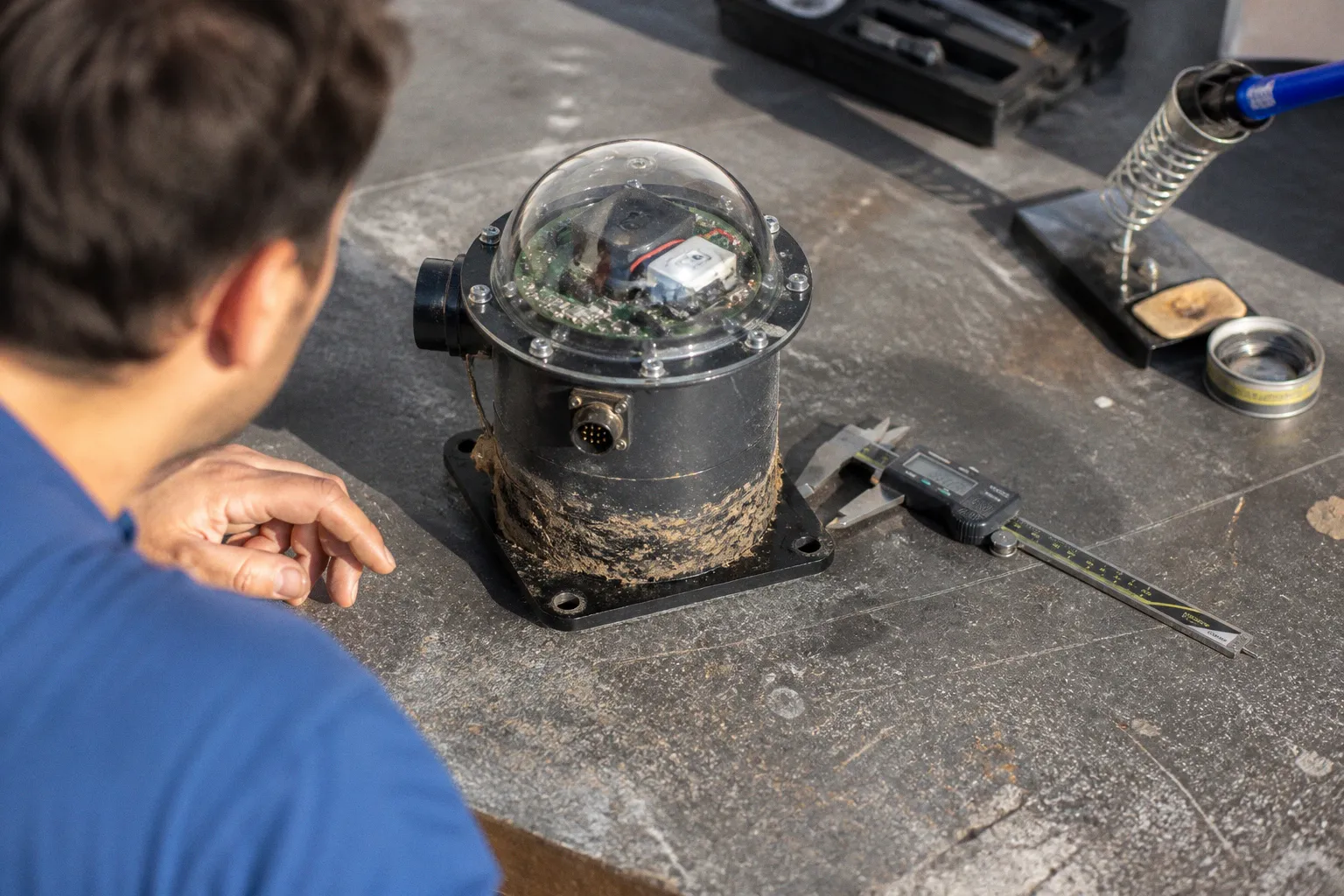
That question can stop a founding team in its tracks. Software lets us test a workflow quickly, change a feature after launch, and distribute a new version without touching every deployed unit. A hardware MVP carries a different kind of commitment. Once we choose components, create tooling, place an order, or build physical inventory, some decisions become expensive to reverse.
This is the heart of the climate software to hardware MVP transition: we are not simply adding a physical interface to an existing product. We are moving into a longer, more capital-intensive operating system—one shaped by materials, manufacturing, field conditions, logistics, safety, and financing.
For climate founders, the shift is especially meaningful. A product may need to operate outdoors, survive heat or moisture, integrate with infrastructure, meet sector-specific requirements, or prove performance over time before a customer can rely on it. The business still needs software, data, and a clear user workflow. But those layers now sit on top of a physical development lifecycle.
A hardware MVP is not the software MVP with a box around it. It is a new learning system, with different risks and different clocks.
The fundamental shift: from digital iteration to physical constraints
A software MVP is usually built to test whether a user can complete a meaningful task. Can a facilities manager identify an energy waste pattern? Can a farmer interpret a water-use recommendation? Can a fleet operator act on a carbon or fuel-efficiency insight?
The first version may be simple. It might use manual data entry, a spreadsheet behind the interface, a no-code workflow, or a limited integration. That is often a strength: the team can validate the problem and the behavior before investing in a fully automated system.
A physical product changes what counts as a useful experiment.
Suppose the next step is a field device that measures temperature, soil moisture, air quality, energy consumption, or equipment performance. The team now has to learn not only whether customers want the information, but whether the device can collect it reliably in the intended environment. The question becomes broader:
- Does the sensor remain accurate outside the lab?
- Can it be installed without specialist labor?
- How often does it need power, maintenance, or calibration?
- Does the connectivity work at the deployment site?
- Can the enclosure withstand the conditions it will face?
- Can the product be assembled consistently rather than only by the founding team?
- Does the total system create enough value to justify its physical and operational cost?
These are not late-stage details. They shape the MVP itself.
A climate software product can sometimes test demand before building the complete technical stack. A climate hardware product still needs to test demand, but it must also expose the physical assumptions that could make the product unworkable or uneconomic.
What stays the same—and what does not
The underlying customer problem should remain the anchor. We are still trying to understand who experiences the problem, what they do today, what a better outcome is worth, and what evidence would make them adopt a new solution.
The difference is that evidence now comes from several connected layers:
| Layer | Software MVP | Hardware MVP |
|---|---|---|
| Customer workflow | Can the user complete the task? | Can the user complete the task with the physical product in place? |
| Technical performance | Does the application process and display data correctly? | Does the device capture dependable data under real conditions? |
| Deployment | Account setup, integrations, training | Installation, transport, site access, maintenance, connectivity |
| Iteration | Code can often be changed after release | Components, tooling, inventory, and manufacturing choices may be locked in |
| Capital need | Product development and cloud operations | Product development plus prototyping, equipment, tooling, inventory, testing, and deployment |
| Commercial proof | Usage, retention, workflow improvement | Field performance, repeatability, service model, unit economics, and customer adoption |
This table is not a reason to abandon a digital-first approach. In many cases, the software MVP is the smartest place to begin. It helps us learn what the customer actually needs before we commit to a device or production process.
The mistake is assuming that the evidence from the software version automatically validates the hardware business. It does not. It validates part of the problem and perhaps part of the workflow. The physical system needs its own proof.
Start with the riskiest physical assumption
Founders often begin hardware development by asking what the product should look like. That is understandable. A visible prototype can make the idea tangible for customers, investors, and potential technical partners.
But appearance is rarely the first question.
For an early climate hardware MVP, we want to identify the assumption that could invalidate the entire concept. It may be measurement accuracy, energy consumption, environmental durability, installation time, data transmission, thermal performance, material availability, or the ability to manufacture the product at a repeatable quality level.
A non-technical founder does not need to answer every engineering question alone. They do need to make the assumptions visible and organize the work around learning them.
A useful starting sequence looks like this:
1. Define the customer outcome in operational terms.
Avoid stopping at a broad promise such as reducing emissions or improving resilience. Identify the decision the customer needs to make, the physical process involved, and the result that would justify adoption.
2. Separate the product into evidence layers.
List what must be proven about the user workflow, the data, the physical performance, the installation, and the commercial model. This prevents a polished dashboard from hiding a weak measurement system.
3. Rank assumptions by consequence.
An assumption that affects the core value proposition belongs ahead of a cosmetic improvement. If the device cannot work in the target environment, a better mobile interface will not rescue the MVP.
4. Choose the cheapest credible test.
The first test may use off-the-shelf components, a bench setup, manual assembly, or human interpretation of data. The goal is not to pretend the prototype is production-ready. The goal is to learn whether the central physical principle works.
5. Write down what would change your decision.
A test is useful only when the team knows what result means continue, redesign, narrow the use case, or stop.
This approach gives the team a bridge from software thinking to hardware discipline. We keep the experimental mindset, but we become more explicit about what cannot be changed cheaply later.
The four-stage hardware validation roadmap
The climatetech hardware development lifecycle is often described through four validation stages: Pre-alpha, Alpha or Engineering Validation Testing (EVT), Beta or Design Validation Testing (DVT), and Pilot Production Validation (PVT).
These stages are not merely labels for increasingly attractive prototypes. Each one should answer a different class of question.
1. Pre-alpha: test the core assumption
Pre-alpha work is about whether the fundamental idea can function at all.
At this point, the system may be rough, manually assembled, or dependent on substitute components. That is acceptable if the test is designed to answer a narrow question. A pre-alpha prototype might explore whether a sensor can detect a meaningful change, whether a mechanism can produce the intended physical effect, or whether a power source can support the operating concept.
The key is to resist premature completeness. We do not need a beautiful enclosure if the central measurement principle is still uncertain. We do not need a fully automated cloud platform if the team has not established that the device can produce data worth acting on.
For a climate founder, the output of pre-alpha should be a clearer technical and customer hypothesis—not a miniature version of the final product.
2. Alpha or EVT: test engineering choices
Engineering Validation Testing is where the team begins turning a working concept into a coherent system.
The questions become more connected:
- Do the selected components work together?
- Does the electronics architecture support the required operation?
- Can the device collect and transmit data consistently?
- Does the early design fit the intended use environment?
- Are the main failure modes becoming visible?
- Can the team assemble the unit using a repeatable process?
The EVT prototype may still be unsuitable for customers. It is an engineering learning tool. It helps the team discover where the design is fragile before committing to larger quantities or more expensive production arrangements.
This stage is also where software and hardware teams need a shared language. The software layer may need to handle missing data, delayed connectivity, sensor drift, device status, and firmware changes. Those are not edge cases in a field-deployed product. They are part of the product experience.
3. Beta or DVT: test the design in realistic conditions
Design Validation Testing asks whether the product design can meet its intended requirements.
The prototype should now resemble the planned product more closely. The enclosure, interfaces, power system, materials, and user interaction all matter. Testing should move toward the conditions in which the product will actually operate.
For climate products, this can be where hidden assumptions surface. A device that performs well indoors may behave differently outdoors. A component that works during a short demonstration may require different protection for long-term deployment. A system that produces clean data in a controlled setup may need stronger error handling in a remote or intermittently connected environment.
DVT is not only about technical performance. It is also an opportunity to examine the human side of deployment:
- Can a customer or installer understand the setup process?
- Are the mounting points, connectors, and access panels practical?
- What happens when a unit needs service?
- Can the customer tell whether the device is functioning?
- Does the operating procedure fit the existing workflow?
A technically sound product can still fail at this stage if it creates too much friction for the people who have to install and use it.
4. Pilot Production or PVT: test repeatable manufacturing
Pilot Production Validation focuses on whether the product can be produced through the intended manufacturing process.
This is a different challenge from making one excellent prototype. A founder may be able to build a small number of units with personal attention, custom adjustments, and expert intuition. Customers and investors, however, need confidence that the product can be assembled repeatedly, inspected consistently, and supported after deployment.
PVT brings manufacturing reality into the validation process:
- Are the assembly steps documented clearly?
- Can suppliers provide the required components with predictable quality?
- Are inspection and testing procedures practical?
- Does the unit behave consistently across a small production run?
- Can defects be found before shipment?
- Is the bill of materials stable enough to support production planning?
The transition from DVT to PVT is where many teams discover that a design is technically possible but operationally painful. That discovery is valuable, especially before the company has committed to significant inventory or customer promises.
The purpose of validation is not to make the prototype look finished. It is to make the next expensive decision safer.
Capital architecture: why hardware needs more than software venture funding
A software MVP can often be developed with a relatively concentrated budget: product work, cloud infrastructure, design, customer discovery, and a small operating team. Hardware carries those needs forward while adding physical costs and longer development cycles.
Climate tech hardware startups typically raise 20% to 50% more equity funding than software startups. When non-equity project and equipment financing is included, the funding requirement can approach twice the level associated with software businesses.
That difference is not simply a matter of buying components. Hardware capital is spread across several forms of risk:
- engineering and prototyping;
- laboratory or specialized testing;
- tooling and manufacturing preparation;
- minimum order quantities;
- inventory held before revenue;
- shipping and supply chain management;
- installation and field support;
- equipment or project assets;
- redesigns caused by failed tests or unavailable components.
This is why a software investor deck and a hardware financing plan cannot be identical. The company needs to show not only product-market evidence, but also how capital moves through the validation and commercialization stages.
Match the funding instrument to the work
Different development activities create different financing needs. Equity can support the company and its team, but it may not be the only suitable source of capital.
A practical funding architecture can include:
- Equity for core company building: team formation, product strategy, software development, engineering leadership, and early operations.
- Grants for technical and climate validation: research, testing, demonstration, and work aligned with public climate priorities.
- Equipment or asset financing: machinery, test equipment, and physical assets that may have a useful life beyond a single prototype.
- Project finance for deployment: capital tied to a specific installation, pilot site, or commercial asset.
- Customer-funded pilots: paid deployments that test value while contributing to development costs.
- Concessional public capital: funding designed to reduce risk at the point where a technology is not yet attractive to conventional capital.
At the First-of-a-Kind, or FOAK, scale-up stage, blended finance becomes especially relevant. FOAK assets often rely on a mix in which concessional public capital accounts for 30% to 40% of the capital structure. The exact structure will vary by sector and project, but the principle is important: early commercial climate infrastructure often needs capital that recognizes both the public value and the technical risk.
For founders, this means financing should be part of product planning—not an activity saved for the week before the runway ends.
Build a simple capital map alongside the product roadmap. For each stage, identify what must be funded, when the cash leaves the business, what evidence unlocks the next source, and which costs may be recovered by customer revenue or project financing.
That map will also make conversations with investors more grounded. Instead of saying the company needs funding to scale, we can explain which validation step the capital enables and what uncertainty should be reduced afterward.
Supply chain realities and the cost of locked-in design
Software teaches us that change is normal. A feature can be released, measured, revised, and released again. Hardware accepts change differently.
Once a design is connected to manufacturing tooling, a bill of materials, supplier commitments, and physical inventory, a seemingly small modification can create a chain of consequences. A new component may require a different board layout. A different enclosure may alter heat management or installation. A supplier change may affect certification, performance, or lead time. Inventory already in the warehouse may become difficult to use.
This is one of the central climate tech hardware scaling challenges: the company is not only developing a product. It is building a network of dependencies.
Bring operations into the design room
Operations should not arrive after engineering has finished. The team needs early visibility into:
- component availability and substitution options;
- supplier concentration;
- lead times and minimum order quantities;
- manufacturing capabilities;
- quality-control responsibilities;
- shipping and storage conditions;
- field replacement and repair;
- data connectivity and ongoing device management.
A non-technical founder can contribute meaningfully here by asking clear questions and making trade-offs explicit. Does the component lower the unit cost but create a single-source dependency? Does a smaller enclosure make installation easier but complicate heat dissipation? Does a more precise sensor improve the measurement enough to justify its price and supply risk?
These are alignment questions between product, engineering, finance, and customer operations.
The team should also distinguish between a prototype bill of materials and a production bill of materials. A prototype may use convenient, expensive, or unavailable components because the purpose is learning. That does not mean those parts belong in the commercial design.
Avoid turning the first production run into a referendum on everything
A common failure mode is asking the first production batch to prove too much at once. The team wants the product to demonstrate technical performance, customer value, manufacturing readiness, serviceability, and commercial economics in a single step.
A better approach is to keep the learning objectives visible. If a pilot is intended to validate field performance, do not quietly treat it as proof of mass-manufacturing economics. If it is intended to test installation, do not assume the result validates long-term maintenance. Each deployment can produce several kinds of evidence, but the team should know which conclusion is justified.
This protects the company from overinterpreting an encouraging demo. A successful demonstration is a milestone. It is not automatically production readiness.
Navigating the commercialization lifecycle: from lab to NOAK
Hardware commercialization in climate tech generally moves through four operating phases:
1. Lab research and development validation
2. Pilot deployment
3. FOAK commercial scale-up
4. Nth-of-a-Kind, or NOAK, commercial deployment
The operating challenge changes in each phase.
Lab validation: prove the principle
The lab phase is about technical possibility and controlled learning. The team is refining the design, measuring performance, and identifying failure modes. Customer involvement still matters, but the main question is whether the physical system can achieve the required function.
Pilot deployment: prove the system in context
A pilot introduces real sites, users, weather, infrastructure, schedules, maintenance, and imperfect data. This is where the product meets the operating environment that the lab cannot fully reproduce.
The pilot should have a clear learning contract. What will be measured? What conditions must the product tolerate? What does a successful deployment look like for the customer? Who responds when something fails? How will the team separate a product problem from a site-specific problem?
Without that clarity, pilots become expensive demonstrations that generate positive anecdotes but weak evidence.
FOAK scale-up: prove the commercial asset
A First-of-a-Kind project is the bridge between a validated technology and a repeatable commercial model. It may involve a larger deployment, more complex financing, more stakeholders, and higher consequences for delays or underperformance.
At this point, the company must coordinate technical delivery with contracts, insurance, permitting where relevant, procurement, construction or installation, customer operations, and financing. The product is no longer only an engineering project. It is becoming an operating asset.
This is where blended finance can help, but it does not remove the need for disciplined execution. Public or concessional capital may reduce risk; it does not replace evidence, accountability, or a workable service model.
NOAK deployment: prove repeatability
Nth-of-a-Kind deployment means the company is no longer asking whether one project can work. The question is whether the business can deliver similar projects with improving speed, quality, cost, and predictability.
That requires more than a successful product. It requires an operating system:
- documented installation and commissioning;
- dependable suppliers and alternatives;
- repeatable quality assurance;
- clear customer support;
- service and replacement procedures;
- reliable data infrastructure;
- trained partners or internal teams;
- a financing model that can support multiple deployments.
For a software founder entering hardware, this is the point where the instinct to optimize the product must expand into an instinct to design the whole delivery system.
What this means for a non-technical climate founder
You do not need to become the lead electrical engineer, mechanical designer, or manufacturing specialist. You do need enough technical fluency to connect the customer promise with the physical evidence required to support it.
That usually means building a small group of trusted capabilities early:
- an engineering lead or technical advisor who can translate the concept into testable assumptions;
- manufacturing support that understands design for assembly and production constraints;
- field expertise from the people who will install, operate, or maintain the product;
- a finance partner who understands grants, equipment funding, and project structures;
- legal support appropriate to the product, deployment, and company structure;
- customers willing to define what performance would actually change their decision.
Technical cofounder search should not be reduced to finding someone who can build a prototype. The right partner also needs to be comfortable with uncertainty, customer contact, documentation, supplier conversations, and the slower feedback loops of physical development.
During hiring and partner conversations, ask candidates to explain how they would test the riskiest assumption, what evidence they would need before changing the design, and how they would handle a component becoming unavailable. Their answers will tell you more than a list of tools or technologies.
Build the next decision, not the final product
The climate software to hardware MVP transition becomes manageable when we stop treating it as one giant leap.
First, use the software layer to understand the customer workflow and the decision the product must improve. Then isolate the physical assumptions that software cannot validate. Test those assumptions in the cheapest credible way. Move through Pre-alpha, EVT, DVT, and PVT with a clear learning purpose for each stage. At the same time, build a capital plan that includes grants, equipment financing, project finance, and blended structures where appropriate—not only equity.
The goal is not to make a hardware company behave like a software company. The goal is to preserve the best software habit—fast, honest learning—inside a physical development process that has real constraints.
Your next action can be small: write down the three assumptions that would most seriously damage the product if they proved false. For each one, name the evidence you need, the simplest test that could produce it, and the funding required to run that test.
That is the first step from an exciting concept toward a climate hardware business that can actually scale.