Technical cofounder search: criteria for climate startups
The usual advice for finding a technical cofounder is deceptively simple: find someone who can build the product. For a climate startup, that standard is too weak.
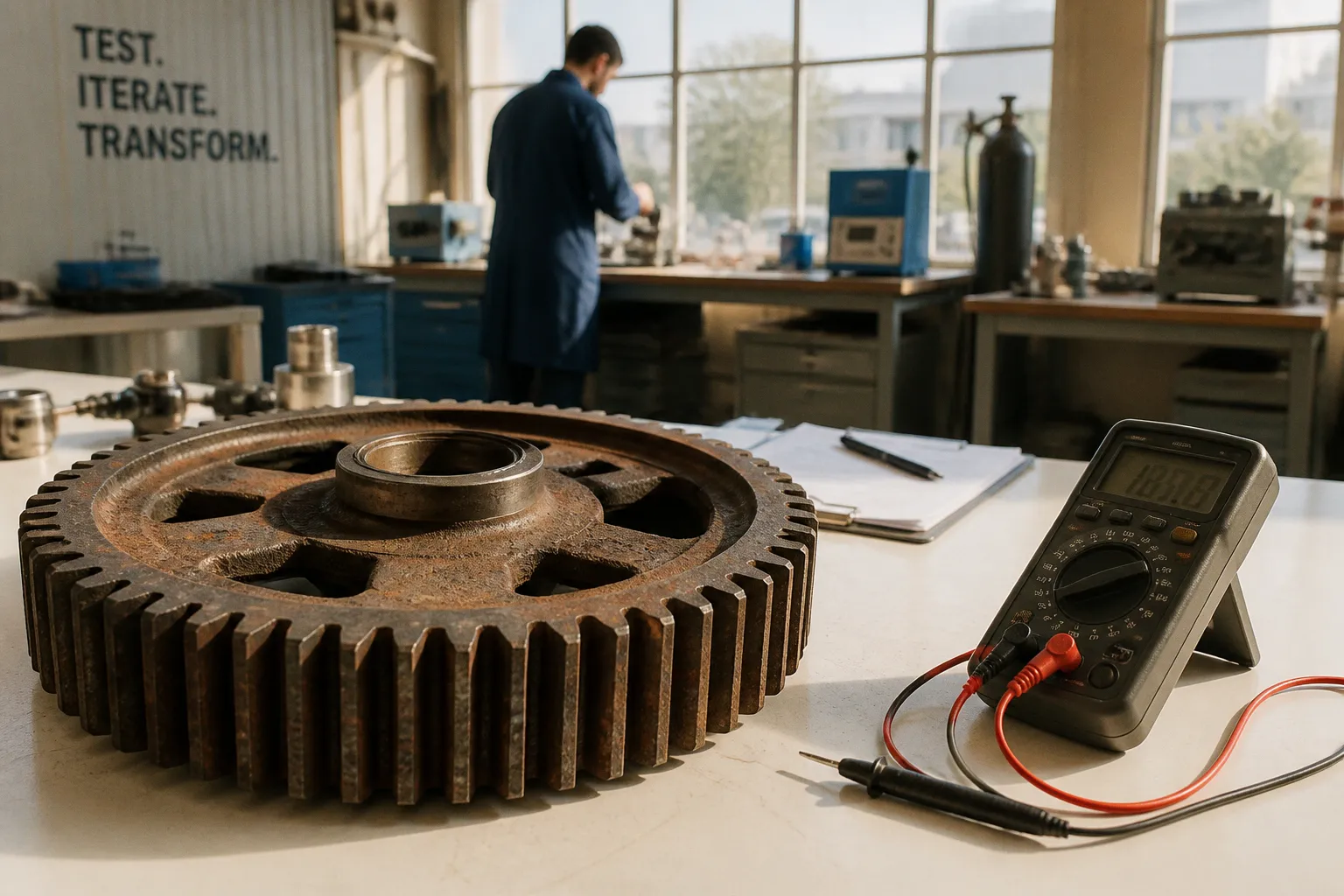
A person who can ship a prototype may still be unable to work through certification, hardware supply chains, lifecycle assessment, deployment constraints, or the uncomfortable economics of decarbonisation.
This is where many founders make an expensive assumption. They treat technical ability as a single category, then evaluate candidates through credentials, impressive job titles, or the vague comfort of having “someone technical” in the room. The market is less sentimental. According to CB Insights data cited in 2025, 23% of failed startups identified not having the right team as a primary reason for failure. Climate companies add more friction to that problem because the product is often tied to physical infrastructure, regulation, scientific uncertainty, or slow-moving industrial buyers.
The question is not simply how to find a technical cofounder. It is how to check criteria for climate startups without confusing general engineering competence with the exact execution profile your company needs.
The high cost of getting the team wrong
A technical cofounder is not just an early employee with a larger equity grant. The role usually carries responsibility for translating the company thesis into something that can be tested, measured, deployed, and eventually maintained.
That distinction matters because climate startups rarely operate in a clean software environment. Even a product that looks like software may depend on sensors, energy data, utility interfaces, industrial workflows, emissions accounting, or regulatory reporting. A hardware company has another layer of exposure: materials, manufacturing tolerances, field maintenance, safety standards, procurement cycles, and capital requirements. The technical roadmap is inseparable from the business model.
The common founder bias is to hire for the most visible problem. If there is no prototype, the founder looks for a builder. If the demo is slow, they look for an engineer who can improve performance. If investors ask about defensibility, they look for someone with a research background. These reactions are understandable—and often wrong.
The first technical hire or cofounder should be selected against the company’s next irreversible bottleneck, not its most embarrassing current gap.
A prototype that cannot be validated with real users is not rescued by better architecture. A sophisticated machine-learning model does not solve the problem of poor data access. A brilliant materials scientist may not be the right person to lead a product through manufacturing. A platform engineer may be excellent at reliability and still be the wrong fit for a company that has not yet established what customers will pay for.
The right technical cofounder is not the person with the most impressive capabilities. It is the person whose capabilities remove your next expensive uncertainty.
There is evidence that the solo-founder route is possible, but it is not the default path in venture-backed startups. Y Combinator’s cofounder matching platform has facilitated more than 100,000 introductions, while approximately 10% of each YC batch consists of solo founders. That does not prove that every climate company needs two founders. It does show that founder matching exists for a reason: execution, fundraising, product decisions, and operational pressure are difficult to carry alone.
The reality check is more useful than the statistic. If you are considering a technical cofounder because investors expect one, stop. If you are considering one because your product genuinely contains a technical bottleneck you cannot own, define that bottleneck first. Otherwise, you may create team complexity before you have created product clarity.
Define the technical need before you search
“Technical cofounder” is a job title, not a specification. Before contacting candidates, write down what the person must accomplish in the next six to eighteen months. Avoid broad descriptions such as “own the technology” or “build the platform.” Those phrases conceal the actual work.
A stronger brief identifies:
- the product assumption that must be tested;
- the first technical milestone that changes the company’s risk profile;
- the parts of the system that need to be built internally;
- the parts that can be purchased, licensed, outsourced, or delayed;
- the relevant scientific, regulatory, or industrial constraints;
- the evidence customers, investors, or partners will expect.
For a climate software startup, the initial technical challenge may be data ingestion and reliability rather than advanced modelling. The company may need to connect fragmented utility, building, fleet, or industrial datasets and turn them into an output a customer can act on. The key skill could be product engineering with strong data systems judgment.
For a climatetech hardware startup, the early problem may be different. The technical lead may need to establish whether a device can be assembled consistently, survive its operating environment, and produce measurements that customers or regulators will trust. That calls for more than a polished prototype. It calls for engineering discipline around testing, documentation, sourcing, and iteration.
For a deep-tech company, the first technical cofounder may be a researcher or specialist whose central contribution is intellectual property, experimental design, or the ability to convert laboratory results into a credible development path. But research depth alone does not guarantee product judgment. The company still needs a route from technical possibility to customer use.
Three broad profiles cover many early-stage technical cofounder searches:
| Technical profile | Best suited to | Main early contribution | Common mismatch |
|---|---|---|---|
| Product Engineer | Software, data products, connected-product MVPs | Ships a usable MVP, works closely with users, turns assumptions into tests | May lack experience with scale, certification, or advanced scientific research |
| Platform Engineer | Infrastructure-heavy software, data platforms, systems with demanding reliability needs | Builds dependable architecture, integrations, security, and operational foundations | May over-engineer before the product has found repeatable demand |
| Researcher or Specialist | Materials, energy systems, climate modelling, biotech, advanced hardware, proprietary algorithms | Brings domain depth, experimental capability, and potential IP | May need support with productisation, customer discovery, and commercial pace |
These profiles are not personality types. They are execution patterns. One person can combine them, but founders should not assume that a candidate who has worked in one mode will naturally perform well in another.
A practical search begins with a forced choice: what must exist by the end of the next two quarters for the company to learn something decisive? If the answer is a testable customer workflow, a product engineer may be the priority. If the answer is a validated scientific result, a researcher may be essential. If the answer is a secure integration layer that allows pilots to operate, a platform engineer may be the better match.
The phrase “technical cofounder” should become more specific before it appears in a job post, founder profile, or investor conversation.
Use climate intensity to shape the role
Climate startups are not equally technical, capital-intensive, or dependent on proprietary intellectual property. Treating them as one category produces weak hiring criteria.
The Climate Brick operational framework groups climate businesses into seven sector-specific categories based on capital intensity and IP intensity. The useful point is not to memorise the seven categories as a branding exercise. The useful point is to ask what kind of company you are actually building—and therefore what kind of technical leadership the company can absorb.
A low-IP climate software product may be able to reach a meaningful MVP with existing APIs, no-code tools, cloud services, and a focused product engineer. A hardware company that depends on custom chemistry, specialised manufacturing, or field infrastructure faces a different development lifecycle. It may need staged technical milestones, laboratory or manufacturing partners, and a cofounder who understands that validation is not the same thing as demonstration.
Consider the technical implications of different operating profiles:
- Software-led and low-capital: The immediate risks often involve workflow adoption, data quality, integration friction, and retention. The technical cofounder should be close to users and comfortable making trade-offs without building a large system prematurely.
- Software with complex infrastructure: The company may depend on real-time data, multiple enterprise systems, security controls, or high reliability. The technical leader must balance speed with architecture that will not collapse during the first serious deployment.
- Connected hardware: The product may require firmware, hardware design, cloud infrastructure, testing, and field support. The cofounder needs cross-functional judgment or a clear plan for assembling that capability.
- Industrial or energy hardware: Manufacturing, certification, procurement, and installation may dominate the roadmap. A candidate with only consumer-electronics experience may underestimate the commercial and operational cycle.
- Deep-tech and research-led: The central question is whether the technical hypothesis can become a repeatable product. The cofounder must manage experiments, evidence, IP, and the transition from research environment to customer environment.
This classification also helps prevent a familiar form of founder theatre: recruiting a candidate who looks strategically impressive but cannot perform the company’s next practical task. A specialist with a strong publication record may be valuable. A former engineering executive may bring useful systems thinking. Neither profile automatically proves that they can build your first product under your current constraints.
Match the candidate to the development lifecycle
The product development lifecycle should appear in the cofounder brief. A climate startup normally moves through several different technical modes:
1. Problem validation: determine whether the customer problem is real, costly, and connected to a measurable climate outcome.
2. Technical feasibility: test whether the proposed solution works under realistic operating conditions.
3. MVP construction: build the smallest version that can generate evidence from users, partners, or field conditions.
4. Pilot deployment: move beyond a controlled demo and confront installation, reliability, maintenance, data gaps, and user behaviour.
5. Compliance and documentation: establish the evidence required for safety, certification, reporting, procurement, or claims.
6. Repeatability: make the product deployable without heroic intervention from the founding team.
7. Scale preparation: address manufacturing capacity, infrastructure, security, support, and unit economics.
Different candidates are valuable at different stages. The engineer who excels at rapid MVP delivery may not want to own certification or manufacturing scale-up. The researcher who can validate the core mechanism may not enjoy customer-facing product decisions. The platform engineer may be most useful once multiple pilots create operational load.
This is not an argument for hiring several cofounders. It is an argument for making the transition points visible. If the role will change significantly after the first year, ask whether the candidate wants that role—or whether the company will need to recruit around them later.
Interview for evidence, not confidence
Founders often assess technical candidates through fluency. Someone speaks confidently about distributed systems, batteries, carbon accounting, or machine learning, and the conversation feels productive. Fluency is not evidence. It may only reveal that the candidate knows the vocabulary.
A better process asks for concrete examples of decisions made under constraint. The goal is not to conduct a theoretical examination. It is to understand how the candidate behaves when data is incomplete, requirements conflict, and the technically elegant solution is not commercially viable.
Questions should expose the candidate’s working method:
- Tell me about a product or system you shipped when the requirements were still changing. What did you deliberately leave out?
- Which assumption did your first prototype disprove?
- How did you decide what to measure, and what evidence was good enough to move forward?
- Describe a technical compromise you made for time, cost, reliability, or manufacturability.
- When did you decide not to build something internally?
- How did you handle a failure in production or in the field?
- What would make you reject our current product thesis?
- Which part of this climate problem is genuinely technical, and which part is a workflow, policy, procurement, or incentives problem?
The last question matters. Climate founders often over-technicalise problems that are actually caused by adoption friction. A technically ambitious solution may be less valuable than a modest product that fits existing operational behaviour and produces defensible evidence.
For hardware and science-led candidates, ask for the chain of proof rather than a general description of expertise. What has been demonstrated in a laboratory? What has been demonstrated in a relevant environment? What remains untested? What failure mode is most likely to appear during a pilot? Which measurements would distinguish a real result from an artefact?
For software candidates, inspect how they treat data provenance, integration reliability, permissions, security, model limitations, and maintenance. A dashboard that produces a climate metric without explaining the data lineage may create commercial and reputational risk. In many climate products, the quality of the evidence is part of the product itself.
A useful interview process includes a short, role-specific working session. Do not ask for free production work or a full business plan. Give the candidate a bounded problem and observe the reasoning:
- For a software product, map the first user workflow and identify the minimum data required to test it.
- For a hardware product, produce a rough verification plan for the first prototype.
- For a research-led product, define the experiment that would most efficiently reduce technical uncertainty.
- For an industrial product, identify the dependencies between engineering, compliance, manufacturing, installation, and service.
The output is less important than the conversation around it. Does the candidate ask for missing information? Do they separate facts from assumptions? Do they identify operational friction? Do they choose a test that can produce a decision rather than merely an impressive result?
In climate tech, technical judgment includes knowing which uncertainty deserves an experiment—and which deserves a customer conversation.
Domain alignment is more than climate enthusiasm
A technical cofounder does not need a PhD in climate science. Nor does every candidate need postdoctoral research experience. Those requirements can become a form of credential bias, especially when the product’s actual difficulty lies in implementation, integration, or distribution.
What the candidate does need is enough domain fluency to recognise where climate claims become technically and commercially fragile.
That may include:
- understanding the difference between reducing emissions, avoiding emissions, removing carbon, and improving resource efficiency;
- knowing what the product can measure directly and what it can only estimate;
- recognising the assumptions behind a lifecycle assessment;
- understanding the boundary conditions of an energy or materials model;
- identifying where regulatory approval or certification affects the roadmap;
- distinguishing a customer’s sustainability language from the operational metric used to make a purchasing decision;
- anticipating how a product behaves after installation, not only during a controlled demonstration.
Lifecycle assessment is a good example. A candidate does not necessarily need to become the company’s LCA specialist. But if the product’s value proposition depends on environmental impact, the technical founder should be able to ask sensible questions about system boundaries, baseline comparisons, functional units, data quality, and uncertainty. Otherwise, the company may build a product whose climate benefit is difficult to demonstrate—or whose benefit depends on assumptions customers and investors will challenge.
Regulatory fluency is similarly practical. The technical cofounder should know which requirements are already binding, which are likely to affect procurement, and which are simply future possibilities being used to decorate a pitch deck. In hardware, safety and certification can determine design choices early. In software, data governance and reporting standards may shape integrations. In energy and industrial markets, a product may be technically ready long before the customer is authorised or equipped to deploy it.
Domain alignment also includes tolerance for the pace of climate markets. Industrial buyers may move slowly. Pilots may require site access, procurement approvals, insurance, training, and integration work. A cofounder who expects consumer-software iteration speed may interpret ordinary deployment friction as a market failure. A cofounder who understands the operating environment will turn that friction into a roadmap.
Assess working compatibility before discussing the split
Equity conversations are not separate from technical evaluation. They reveal how candidates think about risk, control, commitment, and the company’s future.
For a pre-capital climate startup, early technical cofounder compensation is typically equity-heavy and salary-light. That does not make equity a substitute for clarity. Founders should discuss the expected time commitment, salary assumptions, vesting, decision rights, intellectual property ownership, expenses, and what happens if one person leaves.
The exact equity split depends on contribution, timing, risk, and responsibilities. There is no universal benchmark for technical cofounders across climate sectors, and pretending otherwise creates false precision. A software founder joining after customer validation is not in the same position as a researcher joining before the core technical hypothesis has been tested. A person contributing full-time may not be comparable to someone advising for a few hours a week.
The conversation should cover at least these points:
- Commitment: When does the candidate become full-time? What obligations remain outside the company?
- Role ownership: Who owns product, technology, hiring, fundraising support, partnerships, and operations?
- Decision-making: Which decisions require agreement, and who has final authority in technical disputes?
- Vesting and departure: What happens to unvested equity if the relationship ends?
- IP and previous work: Which inventions, code, research, or equipment belong to the company, and what restrictions apply?
- Cash constraints: What salary can the company realistically pay, and for how long?
- Future hiring: Which capabilities will the cofounder build personally, and which will they recruit?
These are not legal decorations. They are operating infrastructure. A founder who avoids the conversation because it feels uncomfortable is storing conflict for later, usually at a more expensive stage.
Working compatibility deserves the same level of scrutiny as technical ability. Look for differences in how candidates handle bad news, uncertain evidence, and changing priorities. A climate startup will produce all three regularly. If one founder treats every challenge as a reason to defend the original idea while the other treats it as a reason to change course, the technical disagreement will eventually become a governance problem.
Run a small project together before making a permanent commitment. It might be a customer discovery sprint, a prototype specification, an experiment plan, or a technical due-diligence review. The project should be real enough to reveal working habits but limited enough that both sides can exit without major damage.
Observe the practical details:
- Does the candidate turn ambiguity into a short list of testable questions?
- Do they communicate risks before being asked?
- Can they explain technical trade-offs without using complexity as status?
- Do they respect non-technical expertise?
- Do they revise their position when new evidence appears?
- Can they distinguish a critical technical issue from a preference?
- Do they finish the agreed work on time?
The point is not to find a perfectly compatible personality. That person may not exist. The point is to identify whether the partnership can absorb disagreement without creating continuous friction.
Build a search process that filters for the real job
Once the role is defined, search through channels that expose working evidence rather than credentials alone. Founder-matching platforms can create volume, but volume is not fit. Y Combinator’s platform has facilitated more than 100,000 introductions; that is useful for reach, not a guarantee of a functioning partnership.
Climate-specific networks, technical communities, university labs, incubators, industrial partnerships, and previous collaborators may produce fewer candidates but better context. A candidate’s past work can be evaluated through shipped products, field deployments, experiments, open-source contributions, patents, technical documentation, or references from people who worked with them under pressure.
A disciplined funnel might look like this:
1. Write the technical thesis. Describe the product, the next decisive milestone, and the constraints that make the role climate-specific.
2. Separate must-have from learnable. Deep expertise may be essential in one area, while other capabilities can be developed or hired later.
3. Review evidence of execution. Look for shipped systems, tested hypotheses, and decisions under constraint—not only employers and degrees.
4. Run a technical conversation. Explore how the candidate thinks about feasibility, evidence, lifecycle, regulation, and customer reality.
5. Run a working session. Give both sides a bounded problem connected to the actual company.
6. Discuss the operating model. Cover time, authority, compensation, equity, IP, and hiring responsibilities before emotions outrun clarity.
7. Use references to test patterns. Ask former colleagues how the candidate handled missed targets, disagreement, production failures, and changing requirements.
8. Start with explicit milestones. Even after joining, define what the first quarter must demonstrate and what decisions follow from each result.
This process may feel slower than accepting the first technically credible person who shows enthusiasm. That is precisely why it has value. Founder recruitment has unusually high switching costs. A weak hire can be replaced; a weak cofounder relationship can disrupt ownership, fundraising, product direction, and team trust at the same time.
The founder’s own role should be part of the assessment. A non-technical founder who wants the technical cofounder to “take over everything technical” is not offering a role description. They are offering a blank cheque. The technical founder needs authority, but the company also needs shared product judgment. Someone must connect customer evidence, climate impact, economics, and engineering decisions.
The best partnership usually has clear asymmetry without complete separation. One founder may lead technology; the other may lead market development. But neither should be allowed to treat the other domain as unknowable territory. The company needs enough shared understanding to challenge assumptions before they become commitments.
The market gets the final vote
A technical cofounder search is successful only when it improves the company’s ability to learn and execute. It is not successful because the candidate has a prestigious background, uses the right climate vocabulary, or makes the founder feel less alone.
Start with the climate business you are actually building. Map its capital intensity, IP intensity, regulatory exposure, deployment cycle, and evidence requirements. Then choose the technical profile that matches the next decisive milestone: product engineer, platform engineer, researcher, or a deliberately combined role.
Test the candidate with real constraints. Ask what they would not build. Ask which claim they distrust. Ask how they would prove the product works outside the pitch deck. Then work together long enough to see how the partnership behaves when the answer is inconvenient.
There is no reliable shortcut around this friction. The technical cofounder must be able to build, but also to measure, document, prioritise, communicate, and change direction. In climate tech, those are not supporting skills. They are part of the product.
The final test is not whether the candidate can impress you. It is whether the two of you can produce better evidence than either of you could alone—and act on it before the market makes the decision for you.