Why ClimateTech Founders Must Pivot Toward Data-Literacy and Institutional CSR Partnerships
Per the Guardian Nigeria News, WEOG is urging governments and industry to anchor the energy transition in climate education and data-driven green projects.
The call arrives the same week two accelerators moved capital and convened stakeholders around the same thesis. For ClimateTech founders, the implication is operational: the bottleneck has shifted from capital access to the throughput of data-literate operators.
Capital deployment as a unit-economics signal
The Stanford Sustainability Accelerator has distributed nearly $5 million across 33 teams spanning 22 departments. The funding targets four verticals: climate resilience, clean energy, ocean health, water access. The deployment is seed-tier — small per team, wide across disciplines.
If you operate in any of those four verticals, Stanford is now a trackable comp. Model your burn rate against their distribution logic. If your cost to a measurable milestone runs significantly past seed norms, the mismatch is structural — not negotiable.
The spread across 22 departments is the second-order signal. Climate is no longer a single discipline. It is a convergence layer pulling in materials science, policy, computer science, and biology. Founders hiring from one discipline only are running a constrained input pipeline.
Education and CSR as conversion infrastructure
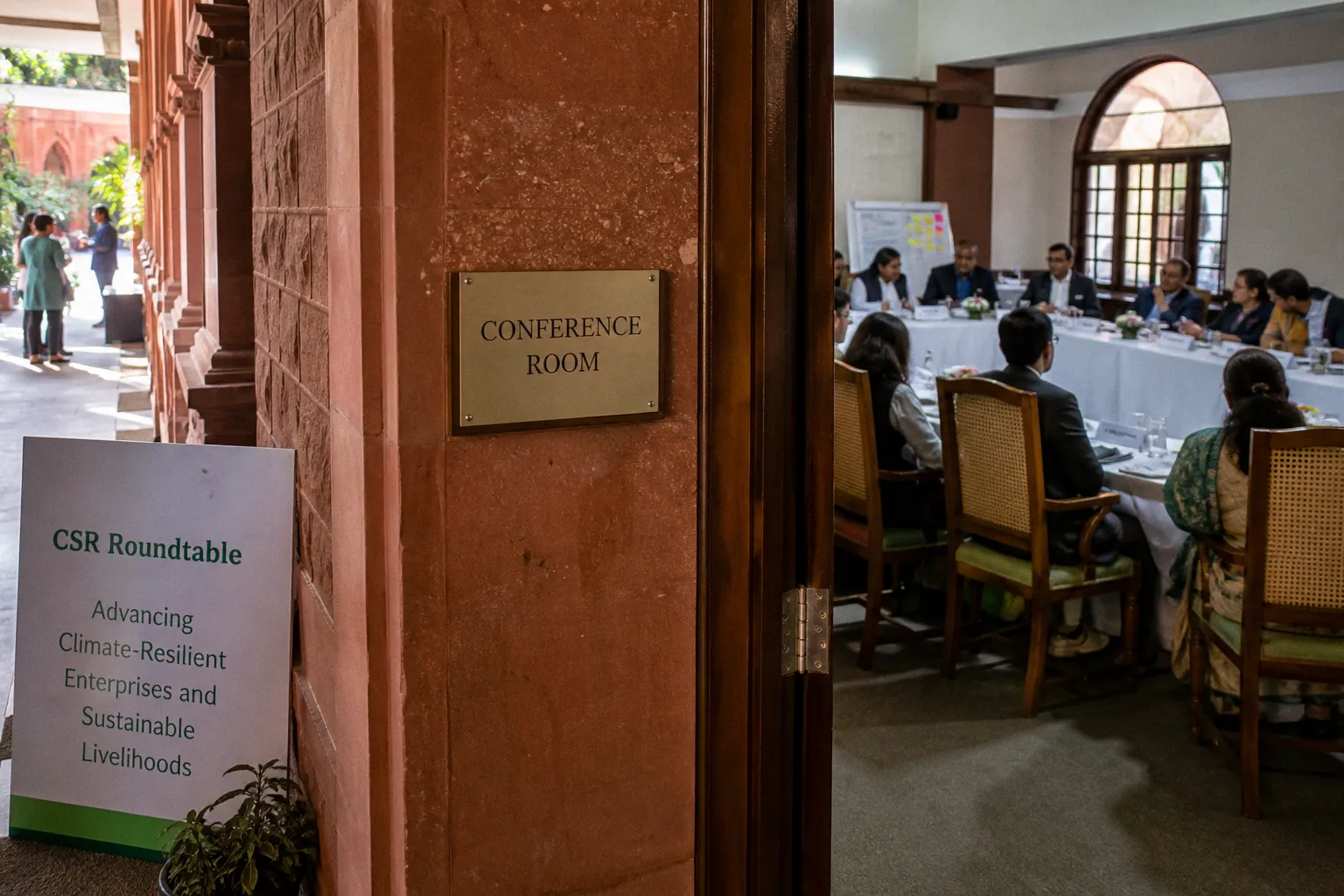
EDII has organized a CSR Roundtable in New Delhi aimed at climate-resilient enterprises and sustainable livelihoods. The geography is incidental. The structure is the signal. CSR funding is converting into enterprise pipelines. Founders should treat CSR consortia as institutional customers, not donors — with procurement cycles, deliverables, and reporting requirements. If your model serves resilience or livelihoods, the roundtable format is replicable in any market with active CSR regulation.
WEOG's framing reinforces the same logic. Climate education is not advocacy theater. It is the conversion mechanism between raw transition ambition and deployable operators. A workforce trained in emissions accounting, lifecycle analysis, or grid data modeling moves directly into accelerator throughput — shortening time-to-pilot and reducing founder hiring risk. The combined read: the next edge in ClimateTech is not new technology. It is the integration layer between education, capital, and operators.
Founder-side checklist
Track the next 90 days against four binary tests:
1. Pipeline fit — does your thesis map cleanly to one of Stanford's four funded verticals?
2. Unit cost — can you reach a defined milestone inside seed-tier norms?
3. Talent source — is climate-data literacy prioritized at the same level as core technical hires?
4. CSR channel — is at least one CSR consortium in your model treated as a paying institutional customer?
If any test fails, the bottleneck is internal. Fix it before raising. The transition is no longer awaiting capital. It is awaiting qualified throughput.