Climate MVP scope creep: 5 ways to avoid over-engineering
The most expensive assumption in ClimateTech is that an MVP should look like a small version of the final product. That sounds disciplined.
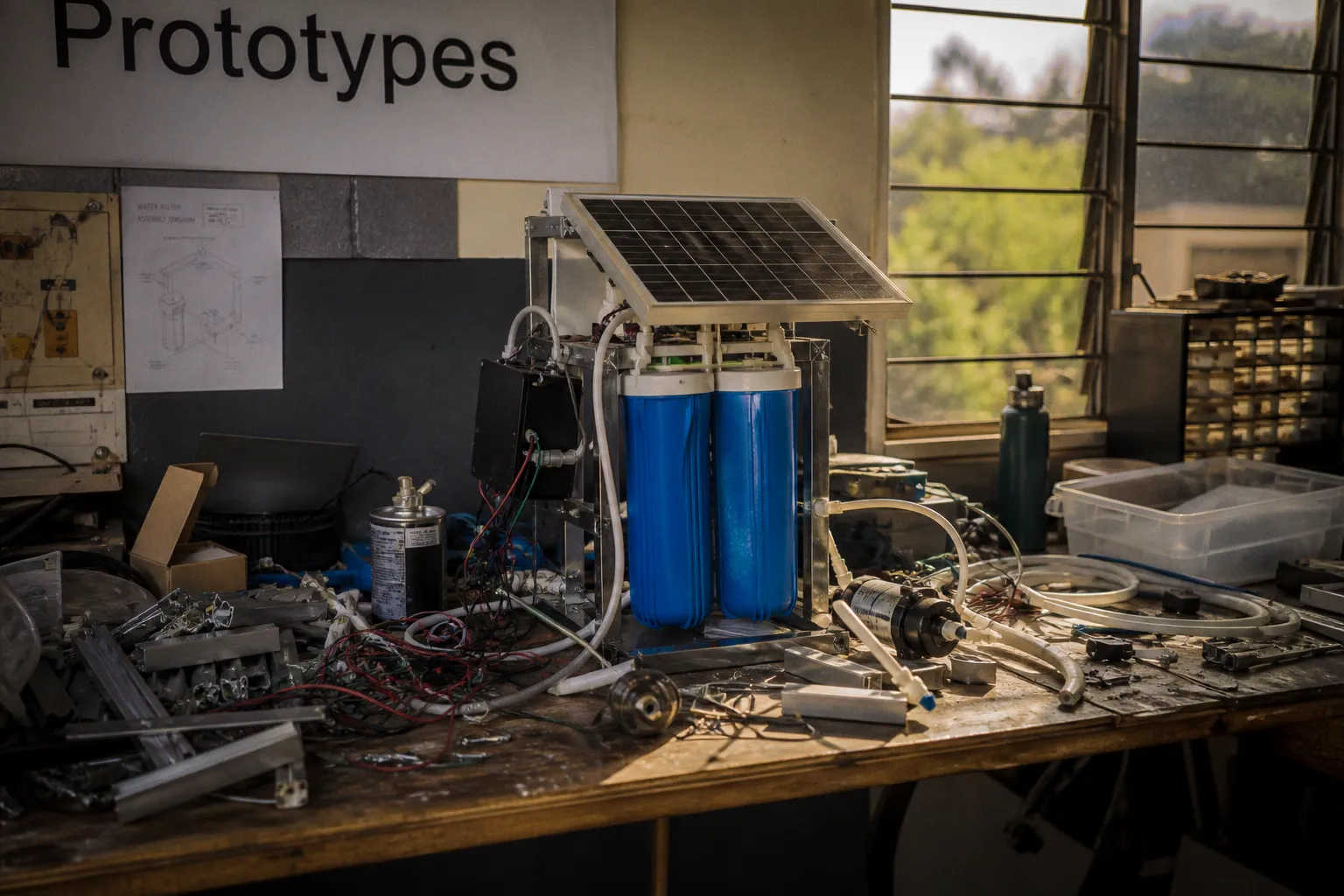
It is usually how founders end up funding a miniature commercial system before proving that anyone will buy it, operate it, or trust its measurements.
The risk is especially high in climate startups because the “product” is often physical. Around 61% of European ClimateTech startups are hardware-based, compared with 27% across the broader European startup market. A hardware MVP carries engineering constraints, supply-chain decisions, safety requirements, certification questions, installation friction, and environmental conditions that a typical software prototype can postpone. Climate founders cannot.
That does not mean you should build everything early. It means you need a more rigorous definition of “minimum.”
The best climate MVP is rarely the smallest product. It is the smallest credible test of the assumption most likely to kill the company.
1. Stop building a miniature final product
A common approach to ClimateTech MVP development looks sensible on a whiteboard:
1. Build a functional prototype.
2. Add the customer dashboard.
3. Connect the sensors.
4. Improve the enclosure.
5. Add automation.
6. Run a pilot.
7. Discover that the buyer was never prepared to pay for the result.
This is not a product development lifecycle. It is a sequence of increasingly expensive guesses.
A climate startup may need to prove several different things:
- that a physical process works outside controlled laboratory conditions;
- that the system can operate safely under real electrical, thermal, or environmental loads;
- that the customer experiences a meaningful operational benefit;
- that the result can be measured credibly;
- that the buyer has a budget and authority to purchase;
- that deployment does not require an unacceptable amount of labor;
- that the unit economics can survive manufacturing, maintenance, and compliance costs.
These assumptions are not equally risky. They should not receive equal development effort.
A non-technical climate founder often starts with the visible object because it feels like progress: a device, a polished interface, a sensor package, or a working demonstration. The market does not reward visible effort. It rewards a credible solution to a costly problem.
For a hardware startup, the first prototype may only need to demonstrate one physical mechanism. It may not need a finished casing, custom electronics, a mobile application, automated calibration, or a complete monitoring platform. If the core question is whether a filtration process can remove a target contaminant at the required flow rate, a manually operated test rig can be more valuable than a polished connected product.
That is not cutting corners. It is controlling the order in which uncertainty is removed.
The difference between an MVP and an MVT
A conventional minimum viable product tries to offer enough functionality for early users to interact with a product. A Minimum Viable Test, or MVT, starts from a different question:
What is the single riskiest assumption, and what is the cheapest credible test of it?
The assumption might concern:
- willingness to pay;
- technical performance;
- durability;
- installation time;
- emissions reduction;
- energy savings;
- regulatory acceptance;
- operator behavior;
- data reliability.
An MVT is not necessarily something customers use as a finished product. It is an instrument for learning. That distinction matters because many climate MVPs fail by combining several unproven systems into one expensive object.
Suppose you are developing software that helps industrial facilities reduce energy consumption. You may not need to build a full optimization engine first. A better initial test could combine existing data exports, a simple rules-based analysis, and a human-reviewed recommendation. The test is not whether the interface looks scalable. It is whether the recommendation produces measurable savings that the facility manager considers worth paying for.
Suppose you are developing a water-purification device. You may not need a production-ready enclosure or remote monitoring. You may need a controlled test that measures liters processed, contaminant reduction, energy use, maintenance intervals, and performance degradation.
The prototype can be ugly. The evidence cannot be.
2. Put scope changes behind a cost gate
Scope creep rarely arrives wearing a warning label. It appears as a reasonable request:
- “Can we add one more sensor?”
- “Should the dashboard show this as well?”
- “The pilot customer wants a different connector.”
- “We need a more professional enclosure before investors see it.”
- “Let’s support one additional operating mode.”
- “It would be useful to automate that step.”
Each request may be defensible in isolation. The problem is accumulation. Every scope change introduces hidden engineering, testing, procurement, documentation, and integration work. Estimates suggest that each individual change can add 10% to 20% in hidden costs. Five changes can potentially double the initial budget.
The arithmetic is not perfectly linear, but the operational lesson is. Small changes multiply across dependencies.
A new sensor can require:
- a revised power budget;
- firmware changes;
- new data structures;
- calibration procedures;
- mechanical redesign;
- additional failure modes;
- new testing;
- a different bill of materials;
- updated customer documentation.
The feature itself is rarely the full cost. The friction sits around it.
Use a scope ledger, not a feature wishlist
For every proposed addition, record five things:
- The assumption it tests: What do you learn by adding this?
- The decision it unlocks: What will you do differently if the result is positive or negative?
- The dependency it creates: What else must change?
- The cost of removal: Can you take it out later without redesigning the system?
- The evidence threshold: What result justifies keeping it?
If the team cannot answer the first two questions, the request is probably preference disguised as validation.
A useful scope gate can look like this:
| Proposed addition | Valid reason to include it now | Reason to defer it |
|---|---|---|
| Additional sensor | It measures the core performance metric or a safety-critical condition | It creates a more detailed dashboard but does not change the pilot decision |
| Custom enclosure | The existing setup creates a real safety, environmental, or installation risk | It is being added mainly to make the prototype look finished |
| Automated workflow | Manual operation would distort the test or make the result impossible to reproduce | A trained operator can perform the step consistently during the initial test |
| Customer dashboard | The buyer needs to inspect the result to approve the purchase | The team wants a dashboard because the product is expected to have one |
| Second use case | The first use case is technically validated and the same architecture supports it with limited change | The team is using a second use case to avoid confronting weak demand in the first |
This is one of the most practical climate MVP scope creep solutions because it turns taste into a decision. “It would be nice” is not a product requirement.
Treat scope as a budget allocation problem
A first-generation hardware MVP often allocates roughly:
- 30–40% to engineering and design;
- 15–25% to tooling and fixtures;
- 10–15% to certifications and testing;
- 20–30% to initial inventory;
- 10–20% to go-to-market assets.
These ranges are not a universal budget, and they will vary by subsector. A carbon-capture prototype and a climate software product do not share the same cost structure. But the distribution exposes a recurring mistake: founders allocate the visible build cost and forget the surrounding work.
Tooling, test fixtures, certification, inventory, customer deployment, and sales materials are not optional decorations. If they are absent from the plan, they will return later as surprises.
Build a contingency line for learning. Otherwise, the first unexpected result will be treated as a crisis—and the team will respond by cutting validation rather than cutting scope.
3. Separate the technical question from the commercial question
A prototype can prove that something works and still fail as a business. Climate founders know this intellectually. They still often ask one pilot to prove everything at once.
A technical pilot might demonstrate that a device reduces energy consumption under defined operating conditions. It does not automatically demonstrate that the customer will sign a contract, provide installation access, accept maintenance requirements, or pay enough to support deployment.
Likewise, a customer expressing enthusiasm is not evidence that the technology works. “This is interesting” is one of the least expensive statements a buyer can make.
Separate the assumptions into testable tracks.
Track one: technical feasibility
Measure the physical or software performance that determines whether the concept is viable:
- throughput;
- energy consumption;
- uptime;
- failure rate;
- thermal behavior;
- operating range;
- contamination or degradation;
- data accuracy;
- response time;
- maintenance burden.
Do not hide these metrics inside a general statement such as “the system performed well.” Define the baseline and the pass condition before the test starts.
Track two: operational feasibility
A climate product is deployed into someone else’s environment. That environment is not a laboratory and will not politely reorganize itself around your prototype.
Test:
- installation time;
- operator training;
- access requirements;
- interference with existing processes;
- inspection and maintenance;
- data connectivity;
- replacement parts;
- shutdown procedures;
- responsibility when something goes wrong.
Electrical, thermal, and safety constraints must be treated as first-order product requirements. If they are postponed as downstream checks, the prototype may pass in a lab and fail during a real pilot.
That failure is particularly damaging because it creates ambiguous evidence. Did the mechanism fail, or did the deployment design fail? Founders then spend weeks debating the wrong problem.
Track three: commercial feasibility
Ask for behavior, not compliments:
- Will the customer provide site access?
- Who owns the budget?
- What procurement process applies?
- What baseline data will they share?
- What happens if the test succeeds?
- What price or contract structure would follow?
- Which result would make the customer stop the project?
- Can the customer name the internal person responsible for rollout?
A pilot without a commercial path is often a demonstration with better branding.
The sequence does not need to be rigid. Technical and commercial learning can happen in parallel. But the hypotheses must remain distinct. Otherwise, a founder may interpret a technically promising result as proof of demand—or a slow procurement process as proof that the technology is unwanted.
“The customer likes it” is not traction. Traction is a measurable result, a committed next step, and a buyer with a reason to act.
4. Instrument the climate claim from day one
Climate startups often talk about impact as if it will be calculated after the product works. That is backwards. If environmental performance is part of the value proposition, it is part of the product.
Traction in ClimateTech is not only user growth or signed letters of intent. It may include kilograms of CO2 sequestered, megawatts saved, liters of water purified, reductions in fuel consumption, avoided material use, or changes in another operational metric. If these outputs are not instrumented from the beginning, the team may later discover that it cannot substantiate its central claim.
That creates more than a reporting inconvenience. It can undermine sales, investor diligence, regulatory positioning, and customer trust.
Define the baseline before you define the result
A credible climate metric needs at least four components:
1. The baseline: What would have happened without the product?
2. The measured intervention: What exactly did the system change?
3. The boundary: Which energy inputs, transport steps, materials, and operating conditions are included?
4. The comparison period: Over what duration is the result meaningful?
“Reduced emissions” is not a measurement. It is a conclusion that requires a method.
For an energy-management product, the baseline might be historical consumption adjusted for production volume and operating conditions. For a water-treatment system, it may include liters processed, contaminant concentration before and after treatment, energy consumed, and replacement-material use. For a carbon-removal system, the measurement boundary needs to account for the energy and materials required to deliver the removal.
The first prototype does not need perfect lifecycle accounting. It does need a transparent measurement plan that can survive basic questioning.
Design the data path with the product
Decide early:
- which sensors or data sources are necessary;
- how often readings are captured;
- how calibration is documented;
- what happens when data is missing;
- who can audit the result;
- how the baseline is stored;
- which metrics the customer actually sees;
- which metrics are internal engineering diagnostics.
This is where a no-code or low-code approach can be useful for a climate software MVP. A spreadsheet, structured database, automation tool, or simple internal dashboard may be enough to validate the data workflow before the team builds a custom platform. The point is not to imitate a production stack. It is to determine whether reliable data can move from the operating environment to a decision.
Do not confuse a lower-code prototype with lower technical standards. The measurement logic still needs to be explicit. A fragile spreadsheet that produces an attractive number is not an MVP. It is a liability with formatting.
Avoid the impact vanity metric
Some metrics look impressive because they are large, abstract, or difficult to challenge. They are not necessarily useful.
A stronger early metric is close to the customer’s operating decision:
- energy saved per unit of production;
- liters purified per hour at a specified quality level;
- maintenance hours per operating period;
- emissions reduced per deployed unit under defined conditions;
- percentage of waste diverted with a verified baseline;
- cost avoided per site, process, or tonne.
The closer the metric is to a customer’s budget and workflow, the easier it is to test whether the climate claim creates commercial value.
5. Write a learning contract before the pilot begins
Many ClimateTech pilots fail before installation because the parties have not agreed on what the pilot is supposed to teach. The startup wants validation. The customer wants experimentation. The investor wants a case study. The operator wants minimal disruption. These are not the same objective.
A written learning contract forces the ambiguity into the open.
It should define:
- the hypothesis being tested;
- the starting baseline;
- the performance metrics;
- the test conditions;
- the duration and operating schedule;
- the data collection method;
- acceptable deviations;
- who owns the equipment;
- who is responsible for installation and maintenance;
- what happens if the system fails;
- the criteria for declaring the pilot successful;
- the commercial step that follows a successful result.
The final point is the one founders tend to leave vague. A successful pilot should have a defined path forward: a paid deployment, a purchase order, a broader site rollout, a commercial negotiation, or a decision to stop. If the only outcome is “we will discuss next steps,” the pilot may generate a report but not a business.
Build the pilot around one decision
A pilot should answer a decision that matters.
Examples:
- Can the system achieve the required reduction in energy use without disrupting production?
- Can the customer operate the device without specialist support?
- Can the measurement method produce data that the buyer accepts?
- Can the system maintain performance over the required operating period?
- Does the result justify a price that supports deployment?
One pilot can produce secondary findings, but it should not have ten primary objectives. Too many objectives create interpretive friction. If one metric improves while another deteriorates, the team needs to know which trade-off was material.
A simple learning contract might use this structure:
| Element | Example of a useful definition |
|---|---|
| Core hypothesis | The system will reduce energy use per unit of output under the customer’s normal operating conditions |
| Baseline | Average energy use during a defined pre-pilot period, adjusted for production volume |
| Primary metric | Energy consumed per unit of output |
| Guardrail metric | No unacceptable increase in downtime, maintenance labor, or product defects |
| Test condition | Normal operating schedule with agreed access and data collection |
| Success threshold | A pre-agreed improvement that justifies the next commercial step |
| Commercial path | Paid expansion to additional equipment or sites if the threshold is met |
The exact thresholds will vary by product. The discipline does not.
Design for the field, not the demo room
A lab demonstration answers whether the concept can work under selected conditions. A pilot answers whether the system can work where the customer actually operates.
That means exposing the prototype to the constraints you are tempted to postpone:
- fluctuating power;
- temperature changes;
- dust, moisture, vibration, or contamination;
- inconsistent network connectivity;
- operator shortcuts;
- imperfect input materials;
- interruptions in the existing process;
- limited maintenance windows.
Passing a lab test does not guarantee readiness for a real-world pilot. Treating it as proof of readiness is one of the more expensive forms of optimism in ClimateTech.
The first field version should be robust enough to gather valid evidence and safe enough to operate responsibly. It does not need the polish of a final commercial product. A prototype enclosure can be functional rather than beautiful. A dashboard can be plain rather than branded. Manual procedures can be acceptable if they are documented and repeatable.
But the product must make the test trustworthy. If a loose cable, undocumented reset, or unlogged calibration change can alter the result, you are not learning about the product. You are learning about uncontrolled conditions.
What a disciplined first build actually contains
A focused climate MVP may still be technically demanding. The objective is not to reduce the build to a mockup. It is to eliminate work that does not reduce the most important uncertainty.
A first build might include:
- the minimum physical mechanism required to test performance;
- safety controls appropriate to the operating environment;
- basic data capture for the core environmental and operational metrics;
- a manual or semi-automated workflow;
- replaceable components rather than optimized production parts;
- a test fixture that allows repeatable comparisons;
- documentation for installation, operation, failure, and reset;
- a defined pilot protocol;
- a commercial hypothesis connected to the result.
It may not include:
- a complete product family;
- every integration requested by a prospective customer;
- a custom mobile application;
- automated support for every edge case;
- a production supply chain;
- final visual design;
- a broad feature set designed for future segments;
- an impact dashboard full of metrics no one uses.
Software teams have a useful warning here. Research from the Standish Group has found that approximately 45% of software features are never used and another 19% are rarely used. The exact percentages should not be treated as a universal forecast for every startup, but the pattern is hard to ignore: teams routinely build functionality that customers do not need.
Climate hardware adds another layer of cost to that mistake. An unused software feature may waste engineering time. An unused hardware feature can lock up inventory, tooling, certification effort, and field support.
The non-technical founder’s role in technical scope
Not having an engineering background does not require a founder to become an engineer overnight. It does require learning how to interrogate technical work.
A non-technical climate founder should be able to ask:
- Which assumption does this component test?
- What would we learn if we removed it?
- What failure mode does this design prevent?
- Which operating conditions are excluded from the test?
- How will we know whether the result is real?
- What is the cheapest credible alternative?
- Which requirements come from safety or regulation, and which come from preference?
- What must be true before we spend on tooling?
- What evidence would make us stop?
These questions do not replace technical expertise. They prevent technical work from becoming an unexamined refuge from market risk.
The right technical cofounder, contractor, or development partner should welcome this clarity. Someone who responds to every scope question with “we need to build it first” may be defending a process rather than solving the uncertainty.
Company structure and operations matter here as well. Incorporation, contracts, intellectual property ownership, pilot liability, data access, and supplier terms are not separate from product development. They shape what the team can test and who bears the consequences when the prototype behaves badly.
That does not mean creating a legal maze before a technical hypothesis exists. It means handling the operational decisions that can invalidate a pilot. A founder who owns neither the data nor the equipment may not control the evidence needed to raise the next round. A founder who has not clarified responsibility for installation may discover that the “customer pilot” is actually unpaid field service.
A practical sequence for controlling scope
If the project is already expanding, reset it around the next irreversible decision.
1. List every major assumption. Separate technical, operational, environmental, commercial, and regulatory questions.
2. Rank the assumptions by damage. Which failure would make the current product concept irrelevant?
3. Choose one primary hypothesis. Define the smallest credible Minimum Viable Test for it.
4. Remove features that do not affect the decision. Keep safety-critical and measurement-critical elements; challenge everything else.
5. Create a scope ledger. Record each addition, its purpose, dependencies, and evidence threshold.
6. Define the baseline and success conditions. Do this before collecting favorable results.
7. Write the learning contract with the pilot customer. Include the commercial step after success.
8. Reserve budget for surprises. Do not spend the full allocation on the first build.
9. Review evidence, not effort. A difficult build is not automatically a valuable build.
10. Decide what to kill. A disciplined MVP process must be able to stop an attractive but unsupported direction.
This process is less exciting than adding features. That is partly why it works.
The reality check
ClimateTech founders face a difficult balance. Build too little, and the prototype cannot produce credible evidence. Build too much, and the company spends scarce capital polishing assumptions that the market has not accepted.
The answer is not to avoid complexity. Climate products often have genuine physical and regulatory complexity. The answer is to stage it. Prove the mechanism before optimizing the assembly. Prove the measurement before scaling the dashboard. Prove the operating workflow before investing in automation. Prove the buyer’s commitment before treating a pilot as a commercial channel.
Scope creep is not just a project-management problem. It is a bias toward visible construction over uncomfortable learning. The cure is not another framework sitting in a shared document. It is a test with a cost, a baseline, a decision, and a consequence.
Before approving the next feature, ask what assumption it validates—and what evidence would justify leaving it out. Then put the prototype in the field. The market is under no obligation to admire the build. It will only tell you whether the result is useful.