Climate hardware MVP: a five-stage prototyping project
Every climate hardware founder eventually faces the same high-stakes decision: whether to fund another prototype or start committing money to production tooling.
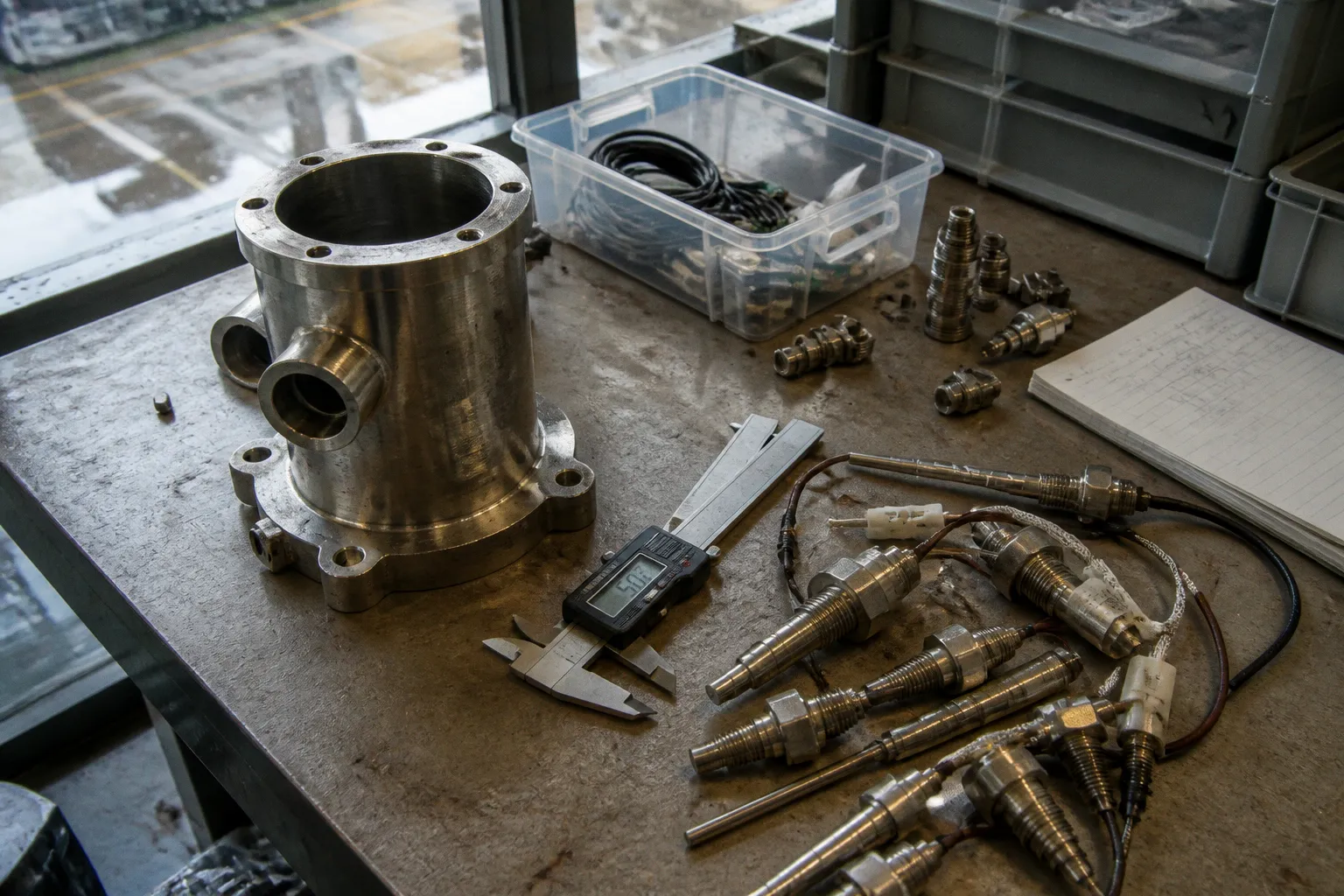
Moving too early can lock unverified thermal, electrical, and environmental assumptions into expensive parts. Waiting too long can drain the company before anyone learns whether the core product works.
There is no neat solution. The discipline is to make every successive build answer a narrower, more expensive question—and refuse to let polish stand in for proof.
A climate hardware MVP is not a smaller, cheaper version of the final industrial product. It is a staged body of evidence. The benchtop model proves that an idea can function. The engineering prototype proves that the architecture can survive real constraints. The beta build proves that a repeatable design can deliver the core result under representative conditions. Only then does production validation begin to test whether the company can manufacture that result consistently.
That sequence is especially important in climate technology. A heat pump, battery system, sensor network, carbon-capture component, or grid device cannot rely on rapid software deployment alone. Its physical design must tolerate power demands, heat, environmental exposure, and safety requirements before a customer puts it into service.
A polished prototype is still an expensive experiment if the killer assumption remains untested.
The lifecycle is a risk-reduction system
The five-stage climate hardware development lifecycle maps loosely to increasing Technology Readiness Levels, or TRLs. Those levels do not represent a company’s maturity, fundraising quality, or likelihood of success. They are a rough language for describing how much technical uncertainty has been retired.
| Stage | Typical TRL range | The decision it must support | Defensible output |
|---|---|---|---|
| Proof of Concept / Pre-EP | TRL 3–4 | Can the core technical idea work? | Benchtop or lab evidence around a killer assumption |
| Engineering Validation Testing / Alpha | TRL 5 | Can the integrated architecture perform under engineering constraints? | Functional alpha prototype and measured failure data |
| Design Validation Testing / Beta MVP | TRL 6–7 | Can a repeatable design deliver the intended result in representative use? | Controlled beta builds, test results, and a stable core design |
| Production Validation Testing / Pilot | TRL 8 | Can the product be assembled through the intended production process? | Pilot units produced with production methods and procedures |
| Volume Production / Deployment | TRL 9 | Can the product operate with adequate resilience in the field? | Controlled ramp, field feedback, support system, and change control |
The language varies across engineering organizations. One company may call a benchtop assembly a proof of concept, while another uses pre-engineering prototype. A team may reserve “MVP” for an early alpha build or a later beta system. The labels matter less than the evidence attached to them.
A credible stage gate should answer five questions:
1. Which product assumption was considered dangerous enough to test?
2. What physical, electrical, thermal, or environmental conditions were applied?
3. What was actually measured, and what remained merely observed?
4. Which failures or uncertainties are now closed?
5. What decision justifies spending capital on the next stage?
Without those answers, a stage transition is storytelling. A beautiful enclosure, impressive demonstration, or functioning dashboard can create momentum, but none of them proves manufacturability or field performance.
The lifecycle also resists the software habit of treating launch as the beginning of product development. Software can receive a minimum viable version, collect user feedback, and improve continuously. Physical hardware carries different consequences: heat cannot be patched remotely, environmental weaknesses do not disappear after an update, and a design change can require new parts, tooling, validation, and inventory.
The five stages therefore function as controlled commitments. Each one should earn the right to make the next build more production-shaped.
Stages 1 and 2: earn the right to build more
Pre-EP: make the killer assumption uncomfortable
A pre-engineering prototype, or proof of concept, belongs on a bench or in a lab. Its purpose is not to resemble the product a customer will eventually buy. Its purpose is to test the one failure that could destroy the company if left unresolved.
For a thermal product, that may mean proving that the system can achieve its central performance objective before heat becomes an uncontrolled constraint. For an electrical device, it may involve validating the core power architecture or sensor behavior. For environmental hardware, the first serious question may be whether the underlying process can tolerate the conditions it is meant to address.
A PoC becomes more useful when the team defines the test before building the demonstration. “See whether it works” is not a test plan. The founder should be able to state what is expected, what would count as failure, how the result will be measured, and which existing evidence is being challenged.
A practical pre-EP record can remain simple:
- the assumption being tested;
- the benchtop or laboratory setup;
- the observed and measured results;
- the dominant failure modes;
- the parts that were temporary;
- the decision to stop, continue, redesign, or pivot.
This record is valuable even when the result is disappointing. A failed proof of concept that reveals an invalid core assumption can save the company. A successful demo that quietly depends on an unrealistic setup can cost much more later.
The founder does not need a complete industrial design at this stage. Nor should the team spend heavily on production tooling, secondary interfaces, or aesthetic refinements. Those choices can make the PoC easier to admire and harder to challenge.
EVT: test the product as a system
Engineering Validation Testing, or EVT, begins when the isolated function must become an integrated alpha prototype. The build should be more representative of the final system, but it still is not expected to be production-ready.
This is where temporary lab solutions become expensive. If the PoC cooled a critical component with an improvised arrangement, EVT must examine how heat is actually managed in a more complete assembly. If the demonstration used a convenient power source, the alpha build must confront the intended power architecture. If the core sensor worked under stable conditions, the system must reveal how it behaves alongside other electronics and loads.
EVT is also the moment when safety, electrical, and thermal constraints stop being review comments and become first-order product requirements. The question is not only whether the device can reach its target performance. The team must understand what happens during abnormal operation, how faults are detected, and whether the architecture prevents an unsafe condition from becoming worse.
An alpha-stage build can tolerate exposed wiring, manual adjustments, and unfinished controls. It cannot tolerate vague ownership of safety risks. The company needs a clear operating envelope and a record of which failures are unacceptable, even if all of the final mitigations have not yet been engineered.
The move from Pre-EP to EVT is a natural point to strengthen the team. A non-technical founder may be able to coordinate a focused benchtop experiment, but integrating mechanics, electronics, thermal behavior, and software requires broader technical judgment. That does not mean the founder must find a perfect technical cofounder before doing anything. It means a technical owner or deeply experienced engineering partner should become involved before the company treats an isolated result as a credible system architecture.
Third-party work also creates an operational record. Before outside firms build critical components, the company should make intellectual-property ownership, confidentiality, and change responsibility explicit. The appropriate legal structure and contracts remain jurisdiction-specific, but ambiguous ownership is a poor foundation for a hardware product.
EVT is not a better-looking PoC. It is where separate laboratory promises have to survive contact with one another.
A useful EVT exit is not “the alpha unit turns on.” The build should establish whether the core architecture is coherent, where the thermal and electrical margins are being consumed, which safety responses are required, and whether the remaining problems are specific enough to guide the beta design.
Stage 3: DVT is the real MVP milestone
Design Validation Testing is the stage that most deserves the word MVP in a climate hardware project. The product is no longer a single laboratory assembly, nor is it merely a collection of possible components. DVT produces controlled beta builds that are close enough to the intended design to test whether the core product can perform repeatedly in representative conditions.
This does not mean the product needs complete industrial design or production-ready tooling. It means the company has stopped changing the central design simply to make the next experiment function. The team can now ask more disciplined questions:
- Does the core system meet its performance objective under the expected operating conditions?
- Can multiple beta units be built with the same components and procedures?
- Does the product respond safely when a sensor, power source, or controlled process deviates from normal behavior?
- Can the device be installed, inspected, serviced, and recovered with the tools and skills available to its intended users?
- Which environmental conditions can the product tolerate, and which remain outside its supported use?
DVT requires a test matrix rather than a collection of impressive demonstrations. A demonstration shows that a configured unit can work under chosen conditions. A validation program exposes the design to the conditions the product is expected to face and records what happens across more than one build.
The team should prioritize those conditions over secondary features. A useful climate hardware beta may include a minimal interface while the enclosure is still functional rather than refined. It may support one essential communication method while additional connectivity remains deferred. It may automate the core operating sequence while leaving non-critical automation out. It may not be beautiful, but it should produce evidence.
The same discipline applies to power and thermal design. If the MVP requires an unrealistic power source, that is a product limitation, not a detail for a later manufacturing conversation. If the system achieves target performance only while an improvised cooling arrangement removes heat, thermal viability remains unresolved. If protection circuitry is added after functional testing, safety has not been designed into the system.
DVT is also where change control begins to matter. Every change should identify the affected components, tests, documentation, and risks. That does not require a heavyweight quality system, but the company does need a reliable memory. Otherwise, a late enclosure change can quietly alter airflow, and a software update can change power demand without anyone revisiting the thermal validation.
The beta MVP should leave DVT with a stable core design, an explicit list of unresolved risks, and enough production-intent definition to plan a pilot. It should not imply that perfection has been reached. The honest output of DVT is a product that works well enough to be tested seriously, with a clear account of what could still prevent deployment.
Stages 4 and 5: make the transition to production deliberately
PVT: prove that the company can build what it validated
Production Validation Testing addresses a different question from DVT. DVT asks whether the design can deliver the required result. PVT asks whether the intended production process can build the design consistently.
That distinction matters. An engineer may hand-build several beta units that perform well. A pilot line may then reveal variation in components, assembly, inspection, supplier availability, or process steps. These are not secondary engineering concerns. They become part of the product.
PVT units are pilot prototypes produced with the methods, equipment, suppliers, and procedures expected to support the next phase. The exact maturity of those methods will vary, but this stage should not be used as a blank check to acquire full-volume capacity before the production process has earned confidence.
The team should examine the messy details that a laboratory build can hide:
1. Can each critical component be sourced with the necessary specification and traceability?
2. Can technicians assemble the product using controlled, repeatable instructions?
3. Are inspection and functional tests built into the process rather than added after assembly?
4. Does production performance match the results observed during DVT?
5. When a unit fails, can the team determine whether the cause is design, component, process, or test methodology?
6. Which changes can operators make in the field, and which must return through engineering control?
PVT is where the bill of materials becomes more than a rough estimate. A cheap component that varies between suppliers may create a much more expensive system-level problem. A difficult assembly step may consume labor and increase quality risk. A component that performs adequately in a beta unit may still be unsuitable for a repeatable pilot process.
This is also a procurement decision, not only an engineering one. The company is choosing which risks it will manage directly and which risks it will accept from suppliers. That trade-off should be visible before volume orders are placed.
Pilot units should be tested as products and as evidence of a process. Their performance must be compared with the DVT baseline, while failures are categorized and addressed. If every pilot unit needs a specialist repair before testing, the build is not yet a reliable production signal.
PVT is not a larger EVT batch. It is the first honest test of whether the company’s manufacturing system can carry the validated design.
Volume deployment: enter the field with controlled ambition
Volume production and deployment correspond roughly to TRL 9. Reaching this stage means the technology has survived a substantial validation progression, not that uncertainty has disappeared.
The field introduces variables that even careful testing cannot fully reproduce: customer operating practices, installation differences, maintenance capacity, ambient conditions, supply interruptions, and interactions with surrounding equipment. A controlled volume ramp allows the company to learn without pretending that one perfect launch can absorb every lesson at once.
Deployment planning should cover more than manufacturing capacity. The operating model must define how units are installed, monitored, maintained, updated where applicable, and removed from service. Critical spares and replacement paths matter. A support process that cannot respond to a field failure can turn a technical issue into a customer relationship problem.
Field feedback should flow back into engineering and operations. Performance data, failure reports, inspection records, and support tickets should influence the next design revision and the next production decision. Hardware resilience is built partly through this feedback loop.
Change control becomes more important after deployment. A revised component, supplier, manufacturing step, or software release may seem minor, but each can affect safety, thermal performance, interoperability, or regulatory status. The company needs a way to decide whether a change is trivial, requires focused retesting, or changes the product baseline.
Volume production also changes the founder’s relationship with capital. Tooling, inventory, supplier commitments, warranty exposure, and support operations create obligations that a prototype budget does not. Growth should not outrun the company’s ability to learn from the first production and field cohort.
The post-mortem from many failed transitions is brutally simple: the team optimized for proving that the product could work and neglected to prove that the business could make, install, and support it repeatedly. Avoiding that outcome requires discipline at PVT, not optimism at launch.
Put safety, thermal, and power ahead of polish
The central trade-off in a climate hardware MVP is speed versus evidence. Speed helps a team learn and conserve cash; evidence protects the company from scaling an unresolved physical risk. The right answer changes as the product matures, but the sequence should remain consistent.
At the earliest stage, spend on the benchtop materials and instrumentation needed to challenge the core assumption. At EVT, spend on the components and engineering work needed to test an integrated architecture. At DVT, spend on controlled beta builds and representative validation. At PVT, spend on the production process, supplier qualification, tooling, and pilot procedures. Only after those commitments does large-scale capacity become defensible.
A stage-gate budget is more useful than one undifferentiated prototype budget. Each release of capital should buy a particular result. If the team cannot name the question the money will answer, the purchase is probably solving a comfort problem rather than a de-risking problem.
The same principle applies to schedules. Hardware timelines should be governed by validation evidence, not treated as calendar promises made before the hardest technical risk is known. A delay that retires a safety or thermal concern is not schedule failure. A date-driven shortcut that weakens the test can be far more expensive later.
No-code tools have a legitimate place in this process. They can support internal dashboards, basic status interfaces, workflow tools, and early control logic. They are useful for arranging information and learning how a team will inspect a product. They do not replace physical validation of current draw, heat rejection, electrical protection, sensor behavior, environmental durability, or the ability of the complete assembly to operate safely.
That is also why non-critical features should stay out of the MVP until they no longer compete with essential validation. Secondary interfaces, multiple connectivity options, polished industrial design, and extra automation can all wait. A delayed feature is visible. A redesigned power architecture or unresolved thermal failure is much messier.
A practical operating review at every stage can use the same compact scorecard:
| Review item | The question the team must answer |
|---|---|
| Killer assumption | What could still make the product fail, and why is this assumption dangerous? |
| Test conditions | What load, environment, duration, and operating state were actually applied? |
| Evidence | Which results were measured, and which conclusions depend on observation? |
| Failure log | What broke, why did it break, and was the cause corrected or merely bypassed? |
| Scope trade-off | What was deliberately removed so the core result could be tested? |
| Capital decision | Why does the next build deserve funding, and what result will stop that investment? |
| Ownership | Who can approve a design, supplier, process, safety, or field change? |
This scorecard keeps the founder from being steamrolled by a convincing demonstration. It also makes the work easier to explain to investors, customers, engineering partners, and future employees: the company is not claiming certainty; it is showing how uncertainty is being reduced.
The final lesson is less glamorous than the launch photo. A climate hardware MVP is not the moment a polished product becomes real. It is the moment a founder accepts that physical resilience must be earned through a series of controlled, sometimes uncomfortable builds.
Move from PoC to EVT only when the core function has survived a meaningful test. Move into DVT only when the architecture works as a system. Commit to PVT only when the beta design can be built and tested repeatedly. Scale volume only when the pilot process, field support, and change controls can carry what the company has validated.
That is the trade-off at the heart of climate hardware development: spend enough to learn, but not so much that learning becomes too expensive to tolerate.