Climate tech IP strategy: patents vs open source
A climate startup can lose its competitive position in two opposite ways.
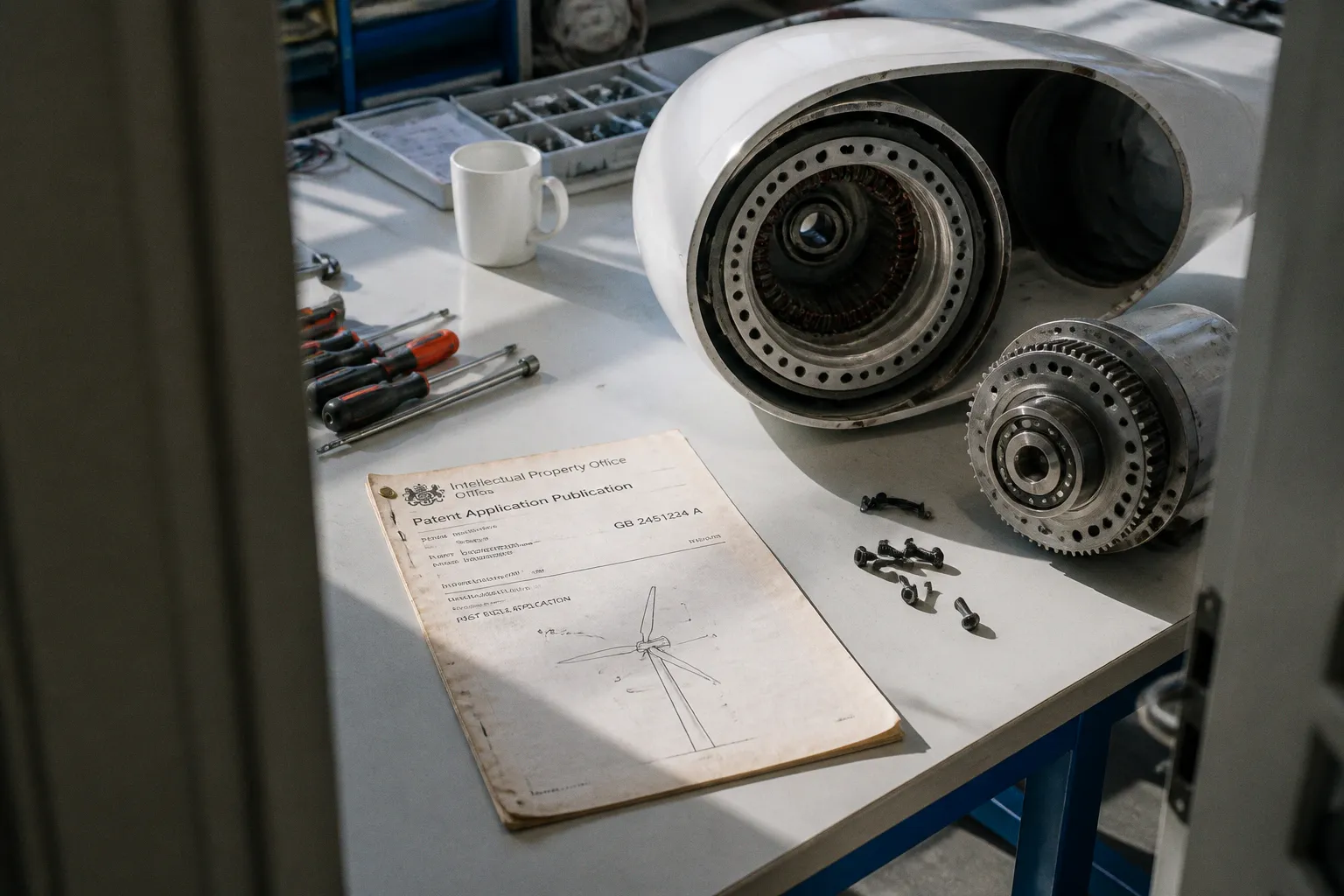
It can disclose the core mechanism too early, giving competitors a usable map before the company has secured protection. Or it can lock every component behind proprietary terms, slowing deployment, blocking integration, and increasing the cost of adoption. Both failures reduce throughput. Both damage unit economics.
The decision is not simply climate tech patent vs open source. The operating question is narrower:
Which parts of the system create defensible value, which parts must travel quickly across an ecosystem, and which parts can remain secret without blocking sales?
For a hardware company, the answer may involve patents around a manufacturing process, trade secrets around calibration, and open-source software for interoperability. For a climate software company, the balance may shift toward proprietary data, controlled APIs, and open implementation standards. The IP strategy must follow the bottleneck in the business model.
A patent is not a moat by itself. An open-source repository is not a distribution strategy by itself. Each is an operating mechanism with a cost, a timing constraint, and a measurable effect on scale.
The first split: protection, adoption, and control
Founders often treat intellectual property as one asset class. That is a category error. Different IP mechanisms solve different operational problems.
A patent can create exclusion rights around a claimed invention. It can also provide an asset for licensing, diligence, and investor review. But it requires disclosure, legal spend, and maintenance. It can narrow strategic flexibility if filed before the product architecture is stable.
Open source can reduce integration friction. It can create implementation volume, attract contributors, and support interoperability. It can also expose design decisions, create license obligations, and make it harder to control downstream use.
Trade secrets preserve information without public disclosure. They work only while the information remains secret and the company can prove that it took reasonable steps to protect it. They are useful for process parameters, supplier methods, training data pipelines, and operational know-how. They are weak when the product can be reverse-engineered.
Copyright protects software expression, documentation, and other authored material. It does not protect the underlying business method or technical principle in the same way a patent may. Contracts protect access, use, confidentiality, and commercial terms. They are operational controls, not substitutes for every form of IP protection.
A functional climate tech IP strategy therefore starts with an inventory.
| Asset or capability | Primary protection mechanism | Main operating benefit | Main bottleneck |
|---|---|---|---|
| Novel hardware mechanism | Patent | Exclusion, licensing, investor diligence | Filing cost, disclosure, examination time |
| Manufacturing process | Trade secret or patent | Process control and margin protection | Leakage through suppliers or staff turnover |
| Embedded software | Copyright, contract, selective patenting | Control of code and commercial use | Reverse engineering and license compliance |
| Data pipeline and datasets | Contract, access control, trade secret | Retention of data advantage | Data portability and customer ownership |
| Interoperability layer | Open source or open standard | Faster adoption and ecosystem integration | Loss of control over downstream implementations |
| Brand and product identity | Trademark | Market recognition and channel control | Enforcement across markets |
The table is not a filing schedule. It is a map of dependencies.
If the product cannot be copied without access to a hidden process, secrecy may be more efficient than a patent. If the product is visible, physical, and easy to reproduce, secrecy has a short half-life. If adoption depends on connection to existing infrastructure, an open interface may produce more value than an exclusive implementation.
The correct question is not “What can we patent?” It is “Where does exclusivity increase enterprise value without reducing adoption throughput?”
The VC case for proprietary hardware patents
Hardware-heavy climate companies face a financing problem before they face a legal problem.
The company may need to fund engineering, certification, tooling, pilot deployment, manufacturing, and field support before revenue becomes predictable. That creates a high burn rate. Investors then look for evidence that the company can defend price, retain margin, and prevent a better-funded competitor from copying the core design.
A patent portfolio can support that case. It does not remove execution risk. It can, however, convert technical work into an identifiable asset with a defined perimeter.
Orcan Energy AG illustrates the mechanism. The German clean energy company began as a TU Munich spin-off in 2008. Early patent ownership from the university helped the company attract venture capital. It later built a portfolio of more than 180 patent applications across 27 patent families.
The useful lesson is not the size of the portfolio. It is the sequence:
1. Identify the technical principle that creates the commercial advantage.
2. Secure ownership and assignment rights before external financing depends on them.
3. Use the portfolio to support investment, licensing, and market entry.
4. Expand protection around the product architecture as the company learns where value is concentrated.
A startup should not copy the portfolio count. A large number of applications can become a maintenance burden. The relevant measure is coverage per dollar and coverage per strategic risk.
For a climate hardware company, patent candidates usually fall into several groups:
- The core physical mechanism that delivers the performance advantage.
- A system architecture that reduces installation, maintenance, or energy loss.
- A manufacturing method that improves yield or lowers cost.
- A control method that allows the hardware to operate in variable field conditions.
- A configuration that makes the technology compatible with existing infrastructure.
- A design change that creates a material improvement in durability, efficiency, or safety.
The clean tech patenting criteria should be commercial, not ceremonial. Ask:
- Can a competitor reproduce the advantage by inspecting the product?
- Is the advantage material to customer purchasing decisions?
- Will the feature remain in the product for several years?
- Does the feature support a premium, lower operating cost, or faster deployment?
- Can the company afford prosecution and maintenance in the markets that matter?
- Does filing now create disclosure risk before the product architecture is stable?
- Does the claim cover the product that will actually ship, or only an early prototype?
If the answer to the first four questions is yes, patenting deserves priority. If the last two answers are no, the filing may be premature.
The patent portfolio as a bottleneck-management tool
Founders often describe patents as protection against competitors. That is incomplete. In venture-backed hardware, patents also reduce transaction friction.
An investor, strategic partner, or acquirer must understand who owns the invention. If the university, contractor, former employer, or technical cofounder retains rights, the cap table is not the only thing that requires cleanup. The IP chain of title becomes a financing bottleneck.
This is especially relevant for non-technical founders working with external engineering teams. A contractor agreement that pays for development does not automatically produce clean ownership in every jurisdiction or under every contract. Assignment language, background IP, pre-existing tools, and improvements need separate treatment.
The company also needs to distinguish between:
- IP created specifically for the startup.
- Tools or libraries the contractor already owned.
- Third-party components used in the build.
- Improvements that may be claimed by another party.
- Data and test results generated during the project.
If this inventory is missing, a patent filing can create the appearance of control without fixing the underlying ownership problem.
Green fast-track channels do not fix weak strategy
Several jurisdictions offer accelerated examination routes for environmentally beneficial inventions.
The UK Intellectual Property Office introduced its Green Channel in May 2009. The USPTO later created the Climate Change Mitigation Pilot Program for inventions designed to reduce greenhouse gas emissions. These programs can reduce examination friction for eligible applications.
They do not turn an unready application into a strong one. They do not guarantee a grant. They do not create a higher valuation. They do not replace claim strategy.
Available evidence indicates that only about 1% to 20% of eligible applicants use green fast-track channels. That range matters because it shows that access is not the same as adoption. Startups may delay examination for strategic reasons. They may want to manage renewal costs, preserve optionality, or avoid early public disclosure of the R&D roadmap.
The standard USPTO examination process has been described as involving an average wait of about 18 months. An accelerated route can appear attractive when the company is entering a competitive market. But speed has a cost if the application is filed before the invention and commercial position are clear.
Use a green channel if the following conditions are true:
1. The invention is already defined at the level needed for a defensible application.
2. The company expects to commercialize in the relevant jurisdiction.
3. Competitor activity creates a real timing risk.
4. The claims are tied to a product, process, or licensing plan.
5. The company can support prosecution and later maintenance.
6. Early disclosure will not expose the company’s next product iteration.
If those conditions are not true, acceleration may simply move an uncertain application through the system faster.
The timing decision also depends on the product development lifecycle. A hardware startup may have a technical prototype, a field prototype, and a production design. The patent claims that fit the first version may not cover the production version. Filing too early can create a narrow record that does not match the actual commercial system.
The practical approach is to maintain an invention register during development. Each entry should include:
- The date the technical concept was created.
- The people and organizations involved.
- The problem being solved.
- The mechanism that produces the result.
- Alternatives considered.
- Test evidence available.
- Existing third-party components.
- The expected product and market use.
- The decision: file, hold as secret, publish defensively, or release under an open license.
This is basic operations. It prevents the legal team from receiving a vague request to patent a product after the key disclosure has already occurred.
Open source as an adoption system
Open source is most useful when the company gains more from ecosystem growth than from controlling every implementation.
That condition appears in climate software, data tooling, hardware interfaces, monitoring systems, and infrastructure integration. A customer may reject a closed component if it creates lock-in, blocks procurement, or cannot connect to existing systems. An open implementation can lower the customer’s switching risk and increase the number of developers who can work with the product.
The company then monetizes another layer:
- Hosted services.
- Managed deployment.
- Support and maintenance.
- Compliance features.
- Enterprise administration.
- Hardware compatibility.
- High-quality data.
- Integration work.
- Certified performance.
- Access to a proprietary network or marketplace.
This is not a universal model. Open source does not automatically produce revenue. It increases the potential number of users and contributors. The company still needs a conversion mechanism.
For a climate software founder deciding between patent or open source, the key issue is often not whether software can be patented. The operational question is which layer should remain controlled. A company may release a protocol, SDK, or basic monitoring agent while keeping the optimization logic, customer-specific models, or premium deployment layer proprietary.
That structure creates a boundary between adoption and monetization.
License selection is a product decision
A permissive license and a copyleft license produce different downstream conditions. The choice affects commercial integration, redistribution, modifications, and obligations for users.
The selection must match the company’s intended ecosystem.
If the main bottleneck is adoption, a permissive license may reduce friction for commercial users. If the company needs improvements to remain available to the community, a stronger reciprocity requirement may be relevant. If the product includes third-party dependencies, the company must track their license terms before publishing a combined distribution.
The minimum operating controls are straightforward:
- Maintain a software bill of materials.
- Record the license for every dependency.
- Separate proprietary code from open components.
- Define contribution and copyright policies.
- Review inbound contributions before they enter a commercial codebase.
- Document what customers can modify, redistribute, and deploy.
- Assign ownership of internally developed code.
- Monitor forks and derivative products where enforcement matters.
This is not administrative overhead added after the product. It is part of the product architecture.
Open source removes one adoption barrier. It does not remove the need for a business model, ownership records, or release control.
The hybrid model: patent the core, open the interfaces
A hybrid IP framework is often the best fit for climate technology because climate deployment depends on both defensibility and coordination.
The company can patent the technical mechanism that creates the advantage. It can keep sensitive manufacturing parameters as trade secrets. It can open the interface required for integration. It can publish selected tools that increase adoption while retaining control over the revenue-generating layer.
A practical allocation may look like this:
| Product layer | Recommended default | Reason |
|---|---|---|
| Core physical invention | Patent candidate | Visible to competitors and linked to differentiation |
| Manufacturing yield or calibration method | Trade secret candidate | Harder to inspect and directly linked to margin |
| API or data schema | Open or documented interface | Reduces integration bottleneck |
| Basic developer tooling | Open source candidate | Expands implementation throughput |
| Proprietary forecasting or optimization model | Controlled software or service | Supports recurring revenue and performance advantage |
| Customer deployment data | Contractual and technical controls | Protects commercial value and privacy obligations |
| Safety-critical operating logic | Selective protection and controlled release | Limits misuse and preserves liability control |
The exact boundary depends on the product. The framework is useful because it prevents one mechanism from being applied to every layer.
Parameter 1: defensibility
A patent has value when it covers something a competitor needs to reproduce the commercial result. A patent around a peripheral feature may generate paperwork but not protection.
Measure defensibility against the product roadmap. If the company expects to change the architecture within a year, the filing may need to cover a broader inventive concept or wait for more certainty. If a competitor can avoid the claim by changing a minor component, the claim may not protect the real bottleneck.
Parameter 2: adoption throughput
Climate products often depend on utilities, manufacturers, installers, industrial customers, regulators, and software platforms. Every integration requirement can slow deployment.
If a closed interface forces each customer into a custom implementation, the company creates a services bottleneck. Open documentation, standard formats, and accessible APIs may increase throughput even if some control is surrendered.
The decision should be measured against time to integrate, support load, and conversion from pilot to repeat deployment.
Parameter 3: unit economics
Patents consume legal and maintenance budget. Open source consumes release management, security review, documentation, and community support. Neither is free.
The comparison belongs in the operating model:
| Cost or output | Patent-led approach | Open-source-led approach |
|---|---|---|
| Upfront legal cost | Higher for drafting and prosecution | Lower for licensing, but not zero |
| Disclosure | Required through publication | Depends on what is released |
| Adoption friction | Can be higher if integration is closed | Often lower for accessible components |
| Revenue control | Stronger around covered claims | Must sit in services, data, hardware, or premium layers |
| Maintenance load | Renewals, portfolio review, enforcement | Security patches, governance, documentation |
| Investor narrative | Defensibility and asset ownership | Distribution, ecosystem, and implementation volume |
| Main failure mode | Expensive protection around the wrong feature | Usage without conversion to revenue |
The right decision is the one that improves gross margin and deployment speed together. If IP protection increases legal spend while leaving the pricing power unchanged, it is not performing as a strategic asset.
Parameter 4: transfer risk
Climate technology often needs to move across borders and into markets with different capital structures. A licensing model can allow controlled transfer. An open-source model can remove negotiation delays. A patent pledge can support access to defined technologies without requiring each user to negotiate a separate license.
The Low Carbon Patent Pledge, launched in 2021 by Hewlett Packard Enterprise, Microsoft, and Meta, provides royalty-free patent licenses for technologies used in low-carbon energy generation, storage, and distribution. This demonstrates a third mechanism between full exclusivity and unrestricted release: the patent remains part of a controlled legal system, but access is expanded for a defined use.
The pledge does not prove that every climate patent should be free. It shows that a company can preserve patent ownership while reducing friction around selected applications.
Patent pools, pledges, and interoperability
A single startup rarely controls enough of a climate value chain to determine the full deployment environment. Batteries, grids, buildings, industrial systems, sensors, data platforms, and financing layers must connect.
This creates a coordination problem. If every participant blocks access to a necessary interface or patent, the system develops a licensing bottleneck. Deployment slows. The cost appears downstream as integration work, legal review, and delayed procurement.
Patent pools and pledges can reduce that bottleneck when the participants define the scope precisely. The scope must address:
- Which patents are included.
- Which use cases qualify.
- Whether sublicensing is allowed.
- Whether defensive termination applies.
- What happens to improvements.
- Whether the arrangement covers software, hardware, or both.
- Which jurisdictions are included.
- What compliance records are required.
The same discipline applies to open standards. A standard can be public while implementation remains fragmented. An API can be documented while access is rate-limited. A dataset can be open while the cleaning and validation process remains proprietary.
The company should therefore distinguish between:
1. Open access, where anyone can use the asset under defined terms.
2. Open specification, where the interface is public but implementation is controlled.
3. Open implementation, where source code is available.
4. Royalty-free licensing, where a protected asset can be used without royalties under conditions.
5. Collaborative ownership, where multiple parties contribute to a shared pool.
These are different operating models. Combining them under the label open source creates avoidable confusion.
Using WIPO GREEN for technology transfer
Climate founders also need a route to find partners, license technology, and place unused IP into markets where the company lacks direct distribution.
WIPO GREEN is an international online platform designed to facilitate voluntary technology sharing and licensing between green technology innovators and technology seekers. It can be relevant when the startup has a patent, process, or deployment capability but lacks a partner in a target market.
The platform should not be treated as a substitute for commercial diligence. Listing a technology does not establish demand, solvency, regulatory clearance, manufacturing capacity, or deployment support. Those remain separate bottlenecks.
A useful preparation sequence is:
1. Define the technology in terms of the problem it solves.
2. Separate the protected claim from the implementation package.
3. State the maturity level without inflating readiness.
4. Identify required inputs, infrastructure, and certification.
5. Specify the preferred transaction: license, joint development, manufacturing agreement, or deployment partnership.
6. Set the minimum support the startup can provide.
7. Clarify territorial rights and field-of-use limits.
8. Model the unit economics for both parties.
9. Record which technical information is shared before a confidentiality agreement.
10. Set a decision date for pursuing or rejecting a lead.
This is where many founders lose throughput. They expose technical information before defining the transaction. They accept broad exclusivity without minimum performance commitments. They negotiate access without estimating the support burden.
The IP strategy must serve the operating model. If the company cannot support five regional deployments, it should not grant rights that imply five regional support obligations.
A decision framework for the climate startup
The patent-versus-open-source decision can be reduced to a sequence of conditional tests.
If the advantage is visible and easy to reproduce
File a patent candidate before public disclosure, provided the invention is defined and the company can support the relevant jurisdictions. Use trade secrets for the parts that cannot be inspected.
If the advantage depends on a hidden process
Evaluate trade secret protection before filing. A patent may create public disclosure without improving enforcement. The decision changes if supplier access, employee turnover, or reverse engineering makes secrecy unreliable.
If adoption depends on integration
Open the interface, schema, or basic tooling. Keep control over the service, performance layer, data advantage, or certified implementation.
If the company needs external developers
Define contribution rules before accepting code. Select the license based on the desired downstream behavior, not on a generic preference for openness.
If investors require a defensibility story
Show ownership, invention records, filing logic, and the connection between each protected asset and the product roadmap. A list of applications without commercial relevance is weak evidence.
If climate impact depends on broad deployment
Assess whether a pledge, pool, open standard, or non-exclusive license can remove a bottleneck without giving away the revenue layer. The goal is not maximum openness. The goal is maximum deployment per unit of capital.
If the company is still changing the product
Do not force a final IP architecture onto an unstable design. Maintain records, control disclosure, and revisit the allocation at each major technical milestone.
The decision should appear in the board operating plan, not only in the legal file. Track:
- Time from invention to disclosure decision.
- Percentage of core product modules with assigned ownership.
- Filing cost per protected commercial feature.
- Time required for customer integration.
- Revenue attached to open-source users.
- Support cost per external implementation.
- Gross margin by proprietary and open components.
- Number of unresolved third-party dependencies.
- Licensing revenue or partner conversion.
- Product changes that invalidate existing claims.
These metrics expose whether the strategy is producing throughput or merely producing activity.
The final position: protect the bottleneck, open the path
There is no universal answer to climate tech patent vs open source. Hardware-heavy companies often need patents because physical differentiation is visible, expensive to build, and central to investor confidence. Software and infrastructure companies may gain more from open interfaces, accessible tooling, and ecosystem adoption. Most serious climate platforms require both.
The hybrid model is not a compromise. It is a systems design.
Patent the mechanism that competitors must copy. Keep hidden the process that protects margin. Open the interface that customers need to adopt. License selectively where climate deployment would otherwise hit a coordination bottleneck. Use WIPO GREEN, patent pledges, or pools when controlled transfer creates more value than isolated ownership.
End with a binary review:
- Patent if the advantage is visible, material, defensible, and linked to the product roadmap.
- Keep secret if the advantage is hidden, difficult to reverse-engineer, and operationally controllable.
- Open if access increases adoption throughput and the company can monetize another layer.
- License selectively if transfer expands the market without surrendering strategic control.
- Do not file if the invention is unstable, ownership is unclear, or the claim does not protect a commercial bottleneck.
- Do not open-source if the release exposes the only revenue mechanism and no conversion path exists.
IP is not an identity choice. It is a resource allocation decision. Balance burn rate, unit economics, adoption throughput, and control. Then protect the part of the system that actually determines whether the company scales.