Lab space for climate hardware: choosing your facility
A climate hardware startup can lose its runway before it loses its technical argument. The usual cause is not a failed experiment.
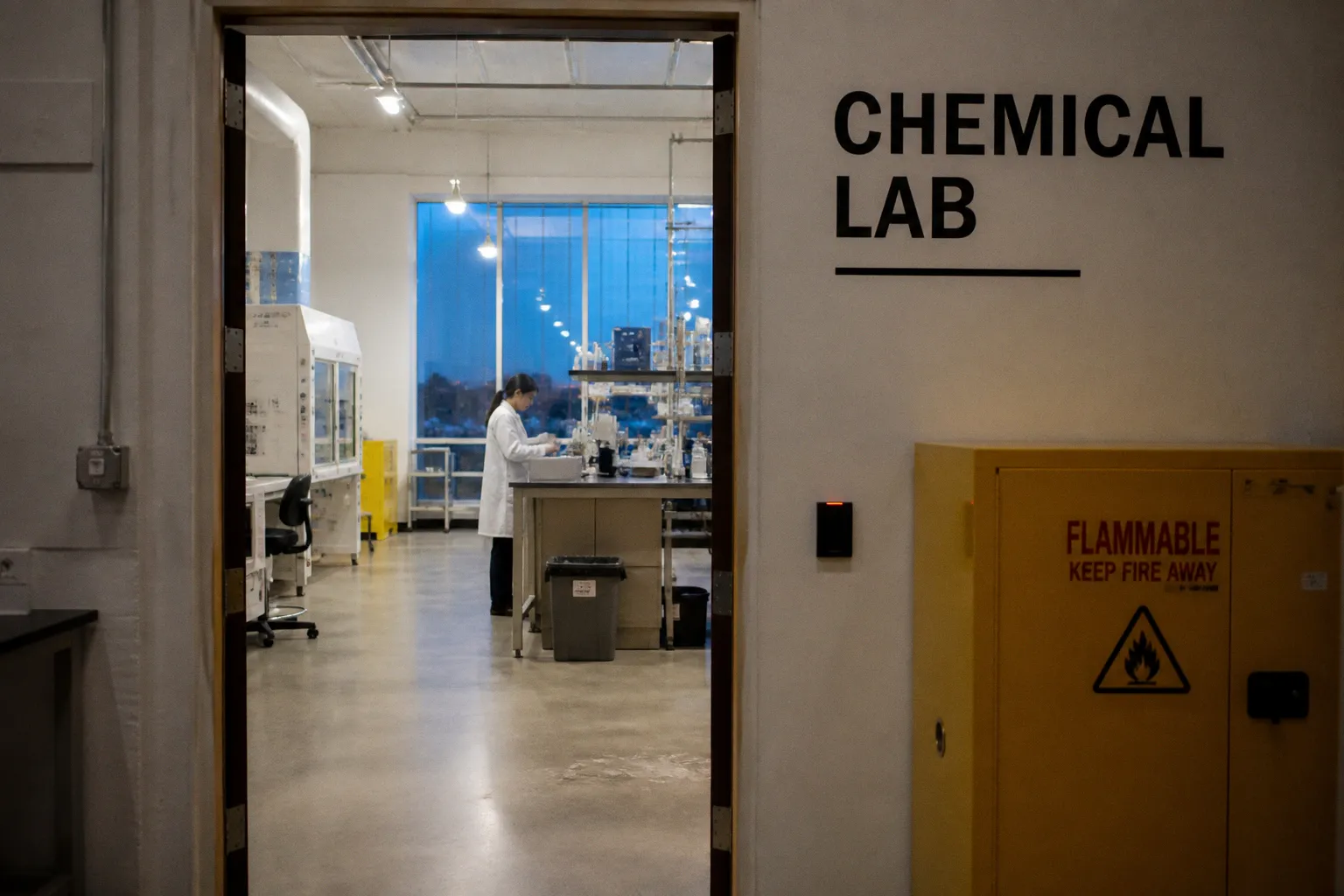
It is a facility chosen for rent, appearance, or proximity to the team instead of throughput.
The wrong lab creates fixed cost without increasing validation speed. It adds delays for deliveries, waste handling, utilities, machine access, and safety approvals. A shared bench at roughly $1,000 per month can be rational if it removes equipment purchases and keeps the team moving. A private lab can be rational later. At the wrong stage, it becomes a burn-rate problem.
The decision is not about finding the best room. It is about matching facility capability to the next technical bottleneck.
Start with the work, not the floor plan
A climate tech hardware prototyping facility is an operating system for physical development. It controls what the team can build, how often it can test, and how quickly it can identify failure.
The first question is not how many square feet the company needs. It is what the next 90 to 180 days of work require.
Map the development cycle in operational terms:
1. Build. What materials, components, chemicals, electronics, or biological inputs enter the facility?
2. Modify. Which processes are required: machining, welding, soldering, coating, mixing, sterilization, assembly, or enclosure work?
3. Test. What equipment, utilities, environmental conditions, and measurement systems are needed?
4. Store. Which inputs require cold storage, chemical cabinets, dry storage, gas handling, or controlled access?
5. Dispose. What waste streams are created, and where are they staged before collection?
6. Repeat. How many build-test cycles can the team complete each week?
The last parameter is the one founders often omit. A facility can support a prototype and still be unsuitable for product development. If the team can build only one unit per week because machine access is limited, that constraint will appear as a product problem, a hiring problem, or a funding problem. It is a throughput problem.
If the next milestone is a proof of concept, shared infrastructure may be enough. If the milestone is a repeatable pilot unit, the facility must support repeatable processes. If the milestone is field deployment, the facility must support packaging, logistics, maintenance, and test documentation. These are different requirements.
The facility is not an address. It is a constraint on iteration speed.
A useful requirements document should contain four layers:
- Non-negotiable capabilities. Equipment or utilities without which the next experiment cannot run.
- Useful shared capabilities. Functions that improve speed but do not justify dedicated ownership.
- Future requirements. Space, power, storage, or safety capacity needed after the next financing event.
- Excluded capabilities. Equipment that looks useful but does not affect the current validation path.
This prevents the standard failure mode: paying for a broad set of capabilities before the company has identified its actual bottleneck.
Four facility models
There are four common routes for early climate hardware teams:
- specialized hard-tech incubator;
- shared makerspace;
- university or research lab;
- fitted private commercial lab.
None is universally correct. Each solves a different cost and control problem.
| Parameter | Hard-tech incubator | Shared makerspace | University or research lab | Fitted private lab |
|---|---|---|---|---|
| Upfront capital | Low to moderate | Low | Low to moderate | High |
| Equipment access | Strong in selected domains | Strong for basic fabrication | Strong for research-specific work | Depends on fit-out and budget |
| Lab safety infrastructure | Often established | Variable | Usually established | Must be verified or installed |
| Access control | Shared, with operating rules | Shared, often less specialized | Restricted by institution and project | Controlled by company |
| Iteration speed | High if equipment is available | High for simple work | Variable | High after setup |
| Flexibility | Good within facility scope | Good for early prototypes | Limited by institutional process | High once operational |
| IP and data control | Requires contract review | Requires contract review | Requires detailed agreement | Highest control |
| Expansion path | Often available through facility network | Usually limited | Tied to research relationship | Direct, but expensive |
| Main bottleneck | Scheduling and facility rules | Capability ceiling | Approval and access process | Burn rate and maintenance |
Specialized hard-tech incubators
Hard-tech incubators are usually the default option when the company needs equipment but cannot justify ownership. Facilities such as Greentown Labs, mHUB, and Daybreak Labs are examples of the model. Their value is not the desk. It is the shared infrastructure.
A relevant incubator may provide access to machine shops, wet labs, electronics prototyping areas, cold storage, utilities, and technical community support. The company pays for access rather than building every capability from zero.
This model works if three conditions hold:
1. The facility already supports the company’s actual process.
2. The team can reserve critical equipment when needed.
3. The operating rules do not block the iteration schedule.
The third condition matters. A facility can advertise machine-shop access while limiting use to specific hours, requiring staff approval, or restricting certain materials. Those controls may be reasonable. They still affect throughput.
Ask for the access model in operational language:
- How many hours per week can the team book critical equipment?
- What happens when two companies need the same machine?
- Is staff supervision required?
- Are after-hours experiments permitted?
- Can the team bring external contractors or manufacturing partners?
- What equipment is included in the membership and what incurs additional fees?
- Who maintains and calibrates the instruments?
- What is the downtime process when a critical machine fails?
Entry-level pricing can start around $1,000 per month for a dedicated bench or coworking desk with shared access to instruments, cold storage, and utilities. That number is useful only as a starting point. Total cost depends on consumables, staff fees, storage, safety training, waste handling, and equipment-specific charges.
The incubator model is strongest when the startup needs a wide technical surface area but has a narrow current workload. It is weaker when the company needs uninterrupted access to one specific process.
Shared makerspaces
A makerspace can be an efficient route for mechanical prototypes, enclosures, fixtures, wiring, and early assembly. It often offers tools that would otherwise consume capital: 3D printers, laser cutters, CNC equipment, soldering stations, hand tools, and basic fabrication areas.
The limitation is usually not the tool list. It is the operating envelope.
A makerspace may not support:
- chemical storage;
- hazardous reagents;
- controlled biological work;
- high-voltage testing;
- pressure systems;
- continuous process equipment;
- specialized ventilation;
- cold-chain storage;
- regulated waste streams.
This makes the makerspace suitable for some stages of a climate hardware MVP and unsuitable for others. A team developing a sensor enclosure may gain speed. A team handling electrolytes, solvents, gases, or biological materials may create a safety and compliance gap.
The right question is not whether a makerspace has a machine. It is whether the entire process can run there without moving the risky or critical step to another location.
If the answer is no, the makerspace may still be useful as a satellite facility. Use it for mechanical work. Keep wet chemistry, hazardous testing, or controlled storage in a specialized lab. But model the transfer time and documentation burden. Every split site adds handling, transport, scheduling, and version-control risk.
University and research labs
University labs can provide high-grade instruments and domain expertise. They are often strong for materials research, electrochemistry, environmental testing, biological processes, and analytical work.
They can also create a different type of bottleneck: institutional process.
Access may depend on:
- a principal investigator relationship;
- sponsored research terms;
- training approval;
- campus access rules;
- equipment booking windows;
- procurement procedures;
- intellectual property agreements;
- restrictions on commercial use.
A university relationship can be valuable when the company needs a specific instrument or a research method that is not commercially available nearby. It is less suitable when the company needs daily operational control.
The key distinction is between research access and company throughput. A university lab may enable a critical measurement. It may not support rapid, repeatable build-test cycles under the startup’s schedule.
Before relying on university infrastructure, define the handoff:
- What work remains on campus?
- What work must happen in the company’s own facility?
- Who owns the resulting data?
- Can the company use the results in investor, customer, and regulatory discussions?
- What happens if the academic lab becomes unavailable?
- Is there a backup testing route?
Treat the university as a specialized node in the development network, not automatically as the company’s operating base.
Fitted private commercial labs
A private lab provides control. The company controls access, layout, storage, scheduling, data handling, and process design. That control is useful once utilization is high enough to justify the fixed cost.
The problem is timing.
Custom fit-outs consume capital before they produce validated product output. They also introduce permitting, contractor coordination, utility installation, waste-system design, insurance, maintenance, and downtime during setup.
A fitted private lab makes sense if:
- a critical process is used frequently;
- shared access is the current throughput bottleneck;
- the process requires restricted access or proprietary layout;
- the company has predictable funding;
- the team can manage facility operations;
- the facility will remain useful through the next product stage.
It does not make sense merely because the company wants to look established.
For early scientific and hardware startups, a pre-fitted standard biosafety or chemical-safety lab with shared core equipment is often a better capital decision than a custom build. The company buys time and access. It does not buy unused capacity.
Climate hardware already carries a heavier capital burden than software. Hardware startups typically require 20% to 50% more equity funding than software startups, and physical infrastructure can push the requirement higher. The exact number varies by technology. The operating principle does not: fixed infrastructure must be tied to utilization.
Audit infrastructure beyond the bench
A bench is not a lab. It is one work surface inside a system.
Many facility evaluations stop at the visible equipment. That is where the expensive omissions begin. Physical testing requires infrastructure for the material before, during, and after the experiment.
Utilities
Check the actual capacity, not the label on the brochure.
Review:
- electrical service and outlet type;
- available amperage;
- three-phase power if required;
- compressed air;
- vacuum;
- water quality;
- drainage;
- ventilation;
- temperature and humidity control;
- internet and data connections;
- backup power for sensitive equipment.
If a prototype draws more power than the facility can provide, the problem is not solved by buying a better prototype. If the facility cannot support the required ventilation, the process may be prohibited. If the internet connection is unstable, remote monitoring and instrument data capture will suffer.
Utility mismatch creates delays that are difficult to see in a monthly budget. The cost appears as idle engineering time.
Storage and material flow
Physical products create inventory before they create revenue. Storage must be part of the facility decision.
Audit:
- chemical storage cabinets;
- secondary containment;
- dry storage;
- cold storage at -20°C or -80°C where required;
- gas cylinder storage;
- hazardous material segregation;
- waste staging areas;
- incoming delivery space;
- unpacking and inspection space;
- finished prototype storage;
- quarantine space for failed or suspect units.
Delivery and unpacking space is easy to ignore. It should not be. Large components often arrive in packaging that cannot enter the main work area. If deliveries block corridors or require improvised handling, the site is already imposing an operational tax.
A facility with strong equipment but weak material flow will produce congestion. Congestion reduces throughput and increases handling errors.
Safety and waste
Waste is part of the process definition. It cannot be added after the first experiment.
Ask:
- Which waste categories does the facility accept?
- Who supplies containers?
- Who labels and stages waste?
- How often is collection arranged?
- Are there restrictions on chemical, biological, electronic, or contaminated waste?
- Are spill kits and emergency procedures available?
- Does the facility provide safety training?
- Who is responsible for incident reporting?
Do not assume that a facility supporting a process also supports its waste stream. These are separate capabilities.
The same applies to storage. A cabinet may exist, but the permitted material class, quantity, and access rules may differ from the team’s requirements. Record the limits in the operating plan.
Space allocation
Space should be calculated from activity, not headcount alone.
Standard laboratory planning guidance commonly uses 50 to 100 square feet per bench scientist for direct work areas. Total laboratory space, including aisles and shared areas, can reach 100 to 150 square feet per person. A further 10% to 20% buffer is used for expansion.
These figures are planning parameters, not a lease formula. A hardware team may need more space per person because prototypes, packaging, test rigs, pallets, and failed units occupy floor area. A software-heavy climate startup using a lab for occasional validation may need less direct bench space.
Separate the requirements into:
- active work area;
- equipment footprint;
- storage;
- circulation;
- receiving;
- waste staging;
- office or documentation space;
- expansion buffer.
If these categories are combined into one number, the resulting plan will usually underestimate the operational area.
Compare facilities using unit economics
Rent is not the correct comparison metric. Cost per usable development cycle is closer to the truth.
A low-cost facility can have poor unit economics if it creates:
- long booking delays;
- repeated transport between sites;
- equipment downtime;
- high staff supervision fees;
- duplicate purchases of basic tools;
- unusable storage;
- slow waste collection;
- rework caused by poor process control.
A higher monthly fee can be rational if it increases throughput and removes capital purchases.
Build a simple facility model with these parameters:
1. Monthly membership or lease cost.
2. One-time setup cost.
3. Equipment access fees.
4. Consumables.
5. Safety and training fees.
6. Storage fees.
7. Waste handling.
8. Delivery and transport.
9. Staff time spent coordinating access.
10. Expected build-test cycles per month.
Then calculate the effective cost per cycle. Do not treat this as a perfect financial forecast. Use it to expose the bottleneck.
If Facility A costs less but supports four build-test cycles per month, while Facility B costs more and supports ten, Facility B may have better unit economics. That conclusion is valid only if the team has enough work to use the capacity. Empty access is still burn rate.
A facility should be paid for by the throughput it unlocks, not by the equipment it displays.
This is also where funding stage matters. A pre-seed team should optimize for optionality and low fixed cost. A company with a funded pilot and a repeatable process should optimize for control and schedule reliability. The same facility can be correct at one stage and wasteful at the next.
Run the selection as a decision tree
Use strict conditions. Avoid scoring facilities on vague impressions.
If the next milestone is a first physical proof of concept
Choose the lowest-cost facility that supports the complete process safely.
That may be a makerspace for mechanical and electronics work. It may be a hard-tech incubator for mixed fabrication. It may be a university lab for a specialized measurement. Do not combine these options into one facility unless the process requires it.
The output should be a working prototype and a documented test method. Space for scale-up is not yet the priority.
If the bottleneck is specialized equipment
Choose a facility with reliable access to that equipment.
Do not accept a broad tool list as evidence of access. Check booking data, maintenance practice, operator requirements, and competing demand. A machine that is technically present but unavailable when needed has zero practical value.
If the bottleneck is wet lab or chemical safety
Choose a pre-fitted chemical-safety or biosafety facility that supports the exact material class and waste stream.
A shared desk and makerspace membership are not substitutes for the required infrastructure. Nor is an informal arrangement to perform hazardous work in an unsuitable room.
If the bottleneck is repeated assembly
Choose a facility designed for process repetition.
You need storage near the work area, clear material flow, fixtures, test stations, documentation space, and reliable utilities. A research lab optimized for occasional experiments may be inefficient for repeated builds.
If the company has proprietary process knowledge
Prioritize access control, data handling, visitor rules, and contract terms.
Shared facilities can still work. The company must define what can be observed, photographed, removed, or discussed. Review IP ownership and confidentiality before moving equipment or sending process data into the facility’s systems.
If the company expects headcount growth
Reserve flexibility without paying for all future capacity.
The 10% to 20% expansion buffer is a planning input. It is not a reason to lease double the required space. Ask whether the facility can add benches, storage, equipment access, or adjacent rooms when the company reaches the next milestone.
Contract terms are part of the technical design
A facility contract affects product development. Treat it as an operating document.
Review the following points:
- minimum commitment;
- termination rights;
- price changes;
- included and excluded utilities;
- equipment access limits;
- maintenance responsibility;
- liability and insurance;
- safety compliance;
- hazardous-material permissions;
- waste obligations;
- storage rights;
- delivery access;
- visitor and contractor access;
- IP and confidentiality;
- data ownership;
- equipment damage rules;
- business continuity if the site becomes unavailable.
A short agreement with unclear equipment access can create more risk than a longer agreement with explicit rules. The goal is not maximum legal complexity. The goal is to remove ambiguity from the development schedule.
Pay particular attention to termination and expansion. Climate hardware development rarely follows a clean calendar. If a facility becomes unsuitable after a process change, the company needs an exit path. If validation succeeds, it needs a way to add capacity without restarting the search.
Also check whether the company is permitted to use the facility for commercial development. Research access does not always imply unrestricted commercial use.
The practical shortlist
Reduce the market to three facilities. More options create noise unless the requirements are still unclear.
For each candidate, request the same information:
- floor plan;
- equipment list;
- utility specifications;
- safety and waste rules;
- access schedule;
- pricing sheet;
- storage options;
- delivery procedure;
- maintenance records or downtime policy;
- sample agreement;
- expansion and termination terms.
Then run one technical walkthrough. Bring the person responsible for the process, not only the founder or operations lead.
During the walkthrough, trace one complete unit:
1. Where does it arrive?
2. Where is it inspected?
3. Where are materials stored?
4. Where is it assembled?
5. Where is it tested?
6. Where are failed units placed?
7. Where is waste staged?
8. How is the data recorded?
9. How does the unit leave the facility?
If the answer changes between staff members, the facility has an information bottleneck. Resolve it before signing.
The final decision should fit on one page. Record the current milestone, required capabilities, expected monthly throughput, total monthly cost, one-time cost, primary risk, and exit condition.
Do not approve a facility because it has more equipment. Approve it because it removes the constraint that blocks the next milestone.
Final position
For most early-stage climate hardware teams, the default choice is a specialized incubator or pre-fitted shared lab. It limits upfront capital, provides access to equipment, and preserves runway while the product requirements are still moving.
A makerspace is a good fit for mechanical, enclosure, and electronics work within its safety envelope. A university lab is a good fit for specialized research and measurement, provided access, IP, and commercial-use terms are clear. A private fitted lab is justified when utilization, confidentiality, or process control makes shared infrastructure the bottleneck.
The decision is binary at the operational level:
- Yes: the facility supports the complete next process, including utilities, storage, safety, waste, access, and data.
- No: it supports only the visible prototype step.
Choose the facility that increases throughput, protects unit economics, and keeps burn rate proportional to validated demand. Everything else is floor area.